ISRAEL: What Went Wrong?, by Omer Bartov
Omer Bartov was born in Israel, was raised in a Zionist household and served for four years in the Israel Defense Forces. Now he teaches at Brown, where he is a professor of Holocaust and genocide studies. When he writes about Israel, a state founded in the aftermath of World War II, his understanding of his subject is both historical and intimate.
In November 2023, a month after Hamas’s brutal attacks on Oct. 7, he published an opinion essay in The New York Times about Israel’s military response. “I believe that there is no proof that genocide is currently taking place in Gaza,” he wrote, “although it is very likely that war crimes, and even crimes against humanity, are happening.”
Bartov insisted on maintaining the distinction between crimes against humanity (which are carried out against civilian populations) and genocide (which is carried out with the intent to destroy a national, ethnic, racial or religious group). He also rejected the “impulse to describe any instance of mass murder and massacre as genocide,” because that would stray from the legal definition of the term.
Yet he couldn’t have been surprised when his essay generated a furious response from some of his fellow Holocaust scholars. A group of them published their own opinion essay in Haaretz accusing him of downplaying Hamas’s atrocities and ignoring Israel’s “creation of humanitarian corridors.” For Bartov to suggest that Israel might be committing war crimes, let alone at risk of committing genocide, they wrote, was “inflammatory and dangerous.”
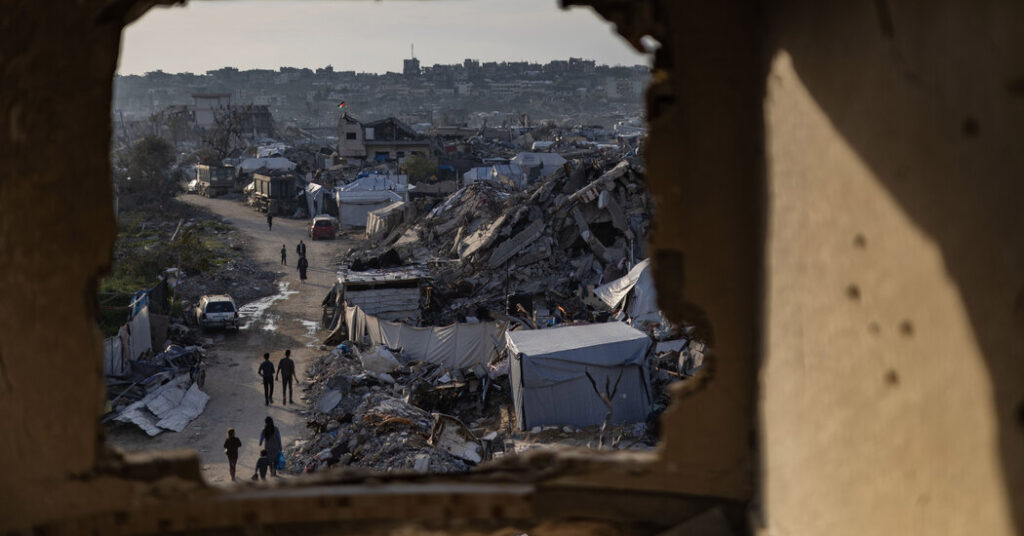
In his new book, “Israel: What Went Wrong?,” Bartov reflects on what has happened in the two and a half years since that episode. He implies that the actual danger turned out to be his critics’ reflexive denial. He publicized his fears because a lifetime of studying the grimmest events in history had taught him that it was urgent “to warn of the potential for genocide before it occurs,” instead of condemning it after it is too late. “Unfortunately,” he writes, noting the more than 68,000 Palestinian deaths to date, amounting to almost 3.5 percent of Gaza’s inhabitants, “what I had warned about at the time, and what these Holocaust scholars so vehemently denied, has meanwhile come to pass.”
Bartov doesn’t go in for rhetorical extravagance; his writing style is clear, sober and deliberate. “Israel” is his attempt to chart what has happened to the country where he was born, and where many of his friends and family — including his eldest son and two young grandchildren — still live. He is critical of how Zionism now functions in Israel, but he also believes that anti-Zionists can often miss a crucial point.
What makes the current catastrophe so tragic, he says, is that it was far from inevitable. Bartov discusses the Nakba, the violent displacement of Palestinians in 1948. From the beginning, he emphasizes, Zionism had two faces: one that was liberatory and pluralist, the other ethnonationalist. Over the decades, the emancipatory element receded while the ethnonationalist element was elevated to a “state ideology.”
The result has been a terrible irony for a country that was founded as a refuge from intolerance: “How is it that the appeal to humanitarianism, tolerance, the rule of law and protection of minorities that characterized the beginning of Jewish self-emancipation gradually acquired all the traits of the relentless, remorseless and increasingly racist ethnonationalisms from which Zionism sought to liberate European Jewry?”
To answer this painful question, Bartov uses all the tools at his disposal, weaving together history, personal anecdotes, even some literary criticism, including a close reading of a poem — by Hayim Nahman Bialik and known to “every Israeli schoolchild” — about the perils of vengeance that has been misinterpreted and warped for political ends. Bartov writes unsparingly about Hamas’s murderous attacks, in which about 1,200 Israelis were killed and about 250 others taken hostage, which he calls an unequivocal “war crime and a crime against humanity.” It was a “slaughter of innocents” that “evoked collective memories of massacres and the Holocaust.”
Indeed, in a May 2024 poll of Israelis that he cites, more than half of the respondents said Oct. 7 could be compared to the Holocaust, and the Israeli media repeatedly depicted the massacre as a pogrom. Bartov understands why — for traumatized people, new traumas will revive old ones — but he maintains that the label is a category mistake. Israel is a state; it has an army, laws and government. A pogrom “is a mob attack, condoned or supported by the state authorities, against a minority lacking any attributes of a state.” (“To be sure,” he adds, “pogroms have occurred within the territories controlled by Israel, but when they take place, they were and are being carried out, with increasing frequency and ferocity, by settlers in the West Bank.”)
Israel doesn’t have a constitution. After its founding, its government was supposed to codify the protection of religious freedom and minority rights, but efforts to adopt a constitution were waylaid and arguably thwarted by political figures like David Ben-Gurion, the country’s first prime minister. Bartov believes that a constitution could have made Zionism “superfluous” after it succeeded in establishing a state that could be a refuge for Jews. Citizens could have turned toward the task of building a “just society” that aimed at “peace, truth and reconciliation with the Palestinians.”
This sounds nice, if fanciful; constitutions don’t magically prevent authoritarianism. Not to mention that attacks by surrounding Arab states did nothing to alleviate Israelis’ sense that they were constantly embattled.
But one of Bartov’s points in this mournful book is that too many possibilities have been kept off the table. As a scholar of the Holocaust, he laments that its memory has been used in the service of precisely the wrong lessons, and he deplores the command to equate criticism of Israel with antisemitism. The genocide of the Jews “was no longer perceived as a past event, but also as a future,” while the perils of intolerance and dehumanization were minimized or ignored.
On the possibility that profound change will come from within Israel, Bartov is pessimistic. He says that the leadership, whether Jewish or Palestinian, just isn’t there. Any initiative will have to come from the outside, and he credits President Trump for pressuring Prime Minister Benjamin Netanyahu to accept a 20-point plan last fall that at least gestures “toward a new political horizon.” (Presumably Bartov wrote this before February, when Netanyahu persuaded Trump to help him start a war with Iran.) Bartov even envisions a possible role for Germany, which could help “Israel and Palestine set out on the road to peace” as its “greatest atonement” for the Holocaust.
Bartov is more convincing when writing about his own attempts at an intervention. A more peaceful future will require more understanding and more imagination — the very things that books can provide, if we let them. “I can only hope that this book will contribute to an opening of minds,” he writes, “by allowing us all to understand how we got here in the first place, and perhaps even how we might clamber out of the abyss.”
ISRAEL: What Went Wrong? | By Omer Bartov | Farrar, Straus & Giroux | 243 pp. | $28
Jennifer Szalai is the nonfiction book critic for The Times.
The post An Israeli-Born Scholar of the Holocaust Mourns for His Country appeared first on New York Times.