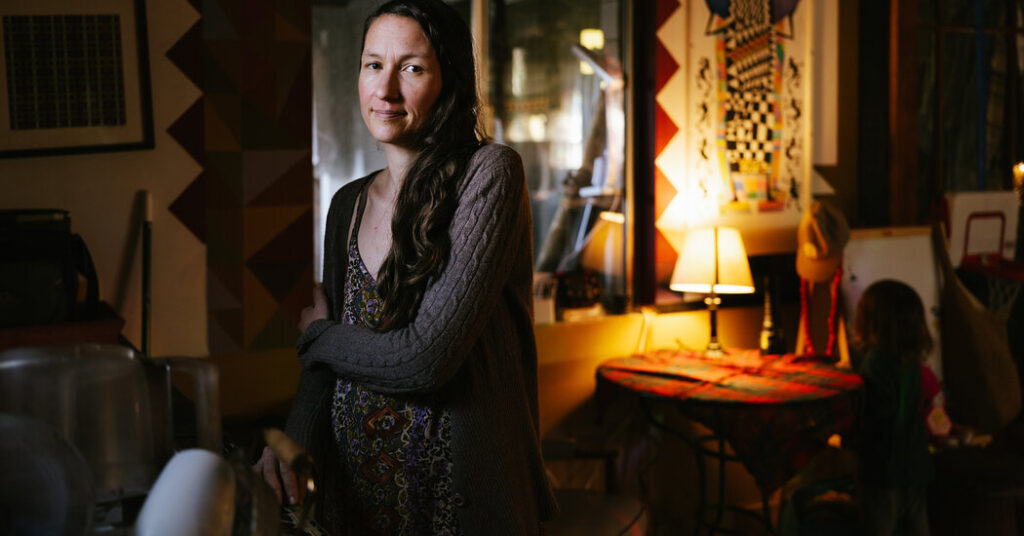
Emily Laszlo-Rath felt her first contraction when she was at home in her trailer outside Joshua Tree National Park. A first-time mother, she was living off the grid, far from medical help.
At first, the labor pains were mild, like cramps. Over the next three days, as they intensified, she weathered them in bed and on the sofa, trusting her body to know what to do. Now, though, she felt chilled, feverish.
Ms. Laszlo-Rath, who was 35 at the time, was intent on a “free birth” — having her baby with no doctor or midwife in attendance. In what is known as a wild pregnancy, she had also skipped all prenatal checkups.
On social media, free births are often depicted as idyllic: string lights, birthing pools, just the family present, childbirth returned to the hands of women. For her part, Ms. Laszlo-Rath said, she was enthralled. “I just kind of started romanticizing the whole thing of being at home,” she said.
Free birth is the home birth movement’s extreme edition. Its proponents advocate removing the guardrails of medicine, believing that the medicalization of childbirth results in too many unnecessary interventions. Although no one has exact figures, free births are believed to represent a tiny proportion of home births, a majority of which are planned and attended by midwives.
Online, interest in free births has trended upward, especially in the last year, according to ViralMoment, which analyzes social media: The approach has achieved a high enough profile that a woman who had planned to have a free birth was featured in the final episode of the hit series “The Pitt.” Recently, however, the movement has increasingly come under fire, with critics contending that it peddles misinformation about the birth process and that it has endangered, and in some cases cost, lives.
A spate of deaths linked to free births has brought more public attention, and women from the free birth community have been speaking out about the risks. In a post on Reddit, Brittany Cole, a stay-at-home mother from Alberta, Canada, described how moments after delivering a healthy girl in a free birth, she began to lose a lot of blood and drift out of consciousness. She was rushed to a clinic. “I probably would have died,” she said.
On social media, influencers have extolled free birth’s virtues, but the most prominent promoter of the method is the Free Birth Society. Since its founding in 2017 by a former doula, Emilee Saldaya, the society has sold access to a private online forum, classes for women and birth workers, and baseball caps saying, “Make Birth Great Again.”
The society now has 132,000 followers on Instagram, and its YouTube channel has received more than 27 million views. A podcast, according to the society’s website, has had more than more than five million downloads.
Critics of free birthing note that even when a woman’s labor is progressing smoothly, it can quickly turn dangerous, posing life-threatening risks to mother and child. This can happen in any birth setting, but early recognition and appropriately timed medical intervention can improve the outcomes.
Forgoing prenatal care further increases the peril, and can leave undetected serious conditions that develop during gestation or labor, the critics say. Midwives who attend home births are trained to provide medical care throughout pregnancy and birth, detect complications, administer some medications and know when emergency hospital treatment is needed.
The free birth messaging, the movement’s critics also contend, minimizes potential complications and stokes an outsized fear of the medical system, sometimes with tragic results.
“They’re let down by an ideology that has led them to believe that birth is normal, and that if you don’t intervene and just let nature take its course, you’re going to have a positive outcome,” said Melissa Cheyney, a clinical medical anthropologist at Oregon State University and a midwife. “That is generally true, except for all the times that it’s not.”
Why are some women choosing this?
When Ms. Laszlo-Rath discovered during the pandemic that she was expecting, she was fearful of hospitals and yearned for a natural childbirth. She knew that a lot of women ended up having cesarean sections — in 2024, almost a third of pregnant women in the United States had the procedure, according to the National Center for Health Statistics. Labor was induced in about an equal percentage.
Through an online search, Ms. Laszlo-Rath discovered free birthing. An American woman, Patricia Cloyd Carter, is considered the “grandmother” of the idea, according to a 2020 book, “Birthing Outside the System,” that examines the forces driving alternative birth methods. The term free birth is believed to have been coined much later by Jeannine Parvati Baker, an advocate of home birth.
Some women say they sought out free birth because they could not pay for or access a midwife, experts say. Others say they had bad experiences with the medical system. A 2019 survey of women who received maternity care in the United States from 2010 to 2016, published in the journal Reproductive Health, found that one in six women reported having experienced mistreatment.
Emily Hancock, a former labor and delivery nurse, said she could not forget the trauma of giving birth to her first child in a hospital. “I just remember feeling very overwhelmed and feeling like I was going to die,” Ms. Hancock, 35, said.
With her next pregnancy, Ms. Hancock said, she labored all night by herself and then gave birth in the bathroom. For her next two deliveries, she decided on free birth because it seemed more natural.
“Safety is relative,” said Mickey Sperlich, an associate professor of social work at the University at Buffalo and a certified professional midwife. For some expectant parents, safety might be modern medicine. But for those who feel they have been violated, she said, “then safety perhaps becomes something different.”
Ms. Laszlo-Rath knew that the Free Birth Society’s guidance carried risks. But it seemed safer for her baby. She purchased its $399 course, “The Complete Guide to Freebirth,” and dived in.
An advertisement for the course says, “You are powerful — birth like it.” But the classes were also filled with warnings: “From beginning to end, obstetrics is the story of rape, abuse, harm, violation,” students were told in one segment. Another class likened vaginal exams during labor to being fondled.
Ms. Saldaya and her teaching partner for the course, Yolande Norris-Clark, did not respond to multiple requests through email and social media to comment for this article. The society’s course includes a disclaimer stating that the instructors are not medical providers and that the classes are “educational and informational” and not meant to “offer medical advice of any kind.”
A worrying pattern of deaths
In an Instagram video, a very pregnant Ms. Saldaya rubs her bare belly. Superimposed on her bump is a recounting of the prenatal care she skipped: ultrasounds, vaginal exams, doctors, midwives and more.
Not long after posting the video, Ms. Saldaya shared heartbreaking news. “I recently gave birth to a beautiful boy, stillborn at 41 weeks of gestation,” she wrote in a newsletter last August. She has continued to promote free birth and to sell self-guided courses.
Stillbirths occur in both home and hospital births, and it is very possible that nothing could have prevented such an outcome.
But in Ontario, Canada, coroners investigating a stillbirth discovered a worrying pattern: 11 stillbirths or neonatal deaths and one maternal death had been linked to free births from 2020 to 2024, according to the Office of the Chief Coroner for Ontario, a marked rise from the one stillbirth connected to a free birth in the previous five years.
The act of giving birth is unpredictable. “In a matter of minutes, a baby can die,” said Dr. Justin Brandt, the director of maternal-fetal medicine at NYU Langone Health.
In September, an Australian natural food influencer, Stacey Warnecke, died after a free birth of a suspected postpartum hemorrhage, according to evidence gathered by the coroner investigating the death. The condition is one of the leading causes of maternal death.
Medical experts say monitoring women during pregnancy and delivery can identify a host of fetal issues, from birth defects to growth problems that predispose a fetus to stillbirth. Pre-eclampsia, a hypertensive disorder of pregnancy, and inadequately controlled diabetes are associated with an increased risk of preterm delivery and stillbirth, Dr. Brandt said.
When Grace, a Florida resident, was expecting her first child, she hired an unlicensed free birth attendant to shepherd her through a pregnancy and free birth. As Grace’s legs swelled and her blood pressure increased, the attendant reassured her that it was normal.
“Women’s bodies were designed for this,” the attendant told Grace, who is using her middle name and requesting anonymity because she has close friends in the free birth movement.
Near the baby’s due date, Grace felt unusually intense contractions. “He was moving a ton, it felt like he was trying to escape,” she said.
But by the next morning, the baby’s movement had stopped. During an ultrasound at the hospital, the doctor informed her that her son had died.
The loss, she was later told, was probably a result of undiagnosed pre-eclampsia. Had she visited an obstetrician at 36 or 37 weeks with those symptoms, she later learned, she would have immediately been induced into labor or given a C-section.
She and her husband buried their son in a small white coffin.
Making an informed choice
“Nobody’s meant to birth alone,” said Rachel Curnel Struempf, a licensed midwife and the owner of Gentle Beginnings Midwifery in Hawaii. “They were meant to have someone there. If you’re bleeding out, and your baby’s not breathing, what do you do?”
Ms. Struempf said she had arrived at the homes of families moments after free births had ended in loss.
“I’ve just seen too many babies die,” she said
Influencers market free birthing even to high-risk women — those who are carrying twins or a baby in breech position, for example. It’s a demographic for whom giving birth at home is generally not recommended, even with midwives present, because of the associated high risk, according to the American College of Obstetricians & Gynecologists. The group’s guidance says that hospitals or accredited birth centers are the safest places to give birth. In planned home births, outcomes are most favorable when the pregnancy is low risk, the birth is attended by a qualified midwife and there is timely access to medical consultation and safe transfer to a hospital, if needed, the group advises.
In the past year, a kind of reckoning has occurred within the free birth community as more women who have used the method have publicly shared their experiences of deliveries gone terribly wrong, many of them in a Reddit group.
On the Free Birth Society’s podcast, Ms. Saldaya and Ms. Norris-Clark, in a conversation about the backlash, called the stories “nasty lies” and “slander and vilification.” And in the Reddit group, some women have posted that they still firmly support free birth.
Dr. Bob Silver, the chairman of obstetrics and gynecology at University of Utah’s Spencer Fox Eccles School of Medicine, said prospective parents should be guided by their values, “but you want them to make those decisions with good information.”
The risks should be accurately explained before women give consent to medical treatment, experts advise.
“Medical interventions have been a godsend for high-risk cases,” said Eugene Declercq, a professor of community health sciences at the Boston University School of Public Health. “The challenge is identifying which cases are high risk, and limiting the interventions.”
‘I just didn’t listen to my own mom’
As Ms. Laszlo-Rath’s contractions progressed, she crouched on the floor of the trailer and screamed. She stopped drinking water or eating.
Her partner repeatedly suggested getting help, but she did not respond. Finally, though, she agreed, and they began the 20-mile drive to the nearest medical center.
There, nurses informed her she was dehydrated and fighting a serious uterine infection, Ms. Laszlo-Rath said. She had early signs of sepsis, a potentially deadly infection that is a top cause of maternal mortality.
Intravenous antibiotics and fluids were started. By morning, she was fully dilated and pushing. But the obstetrician was concerned: This delivery needed to be expedited.
With the help of a vacuum, a healthy, nearly eight-pound baby emerged, with a nose that reminded Ms. Laszlo-Rath of her grandmother’s.
Now, four years later, Ms. Laszlo-Rath remembers how the hospital’s medical team cared for her. Without them, she could have died — and her son could have, too.
Her mother had wanted her to hire a midwife. “I just didn’t listen to my own mom,” she said, still in disbelief. “I decided to listen to all these other people that I didn’t even know.”
The post She Wanted a ‘Free Birth.’ It Put Her and Her Baby in Grave Danger. appeared first on New York Times.