A strange-looking frog with bulging red eyes and green spikes poking from its back was nestled between leafy plants in a sprawling tropical garden, near the gallery and the rice paddies. A boy picked up the frog and played with it, then placed it under a tall jackfruit tree.
But it was not a real frog; it was a clay sculpture by the Indonesian artist Andy Sri Wahyudi, who also goes by Andy SW, part the exhibition “Fables.”
The show, featuring animals out of a surrealistic dream, ran from Dec. 13, 2025 through Jan. 13 at the gallery on-site at Yabbiekayu, a small eco-friendly community on the Indonesian island of Java. For the exhibition, artworks were displayed indoors and out, even amid the foliage, because, Wahyudi said, he was curious to see how visitors would respond to his art if it was placed in nature.
“Fables are closely related to the natural world around me, from childhood to the present day,” Wayhudi said in an email interview. He had grown up reading lines from Aesop’s fables carved into reliefs in the Mendut Temple nearby, he said. These reliefs carved into the ninth-century temple contained messages, he added, “about caring for nature, and natural and human-made disasters.”
Among the many natural disasters that plague central Java are volcanic eruptions, tidal floods and earthquakes. Nonetheless, the Yogyakarta region, one part of central Java, has become a major hub for education and tourism. It is also known as the island’s cultural capital. In this area, art and nature tend to go hand in hand.
This part of Java is known as the Special Region of Yogyakarta, run by the Yogyakarta Sultanate, an independent monarchy — not by the government of the Republic of Indonesia. Sultan Hamengkubuwono X, who rules from the 18th-century Kraton (palace) in Yogyakarta, has in recent years pushed for a cultural awakening in the region through the traditional Javanese arts, to help foster both local development and stronger international relations.
Yabbiekayu, a complex that includes a bed-and-breakfast, restaurant, gallery, arts center and garden, sits on seven acres in the Bantul Regency. It is about five miles south of downtown Yogyakarta, a city of some 400,000 that is part of a sprawling metropolitan area that includes about 3.75 million people. It is one of a number of homegrown businesses in the area that aims to be part of that awakening.
Its founders, the couple Bakti Widiarti and Dave Hodgkin, think of Yabbiekayu as a sustainable social enterprise, devoted to merging cultural activities with environmentally conscious development that can weather natural disasters.
The art foundation that they started last year, Ruang Karya Harmoni (Space for Harmonious Work), has partnered with many grass-roots organizations and collectives to support handicrafts, batik making, ceramics and shadow puppetry, along with other performing arts.
Wayhudi’s monthlong residency and exhibition, “Fables,” was the first arts residency the foundation hosted.
Tiaswening Maharsi, the director of the arts foundation, said that Ruang Karya Harmoni grew out of a desire to create a sustainable future for the village and the region, by promoting arts that are connected, somehow, to the environment.
On April 4, the village hosted an arts festival, Bersemi Tembi Eco-Creative Festival, which included some 40 local Javanese contemporary artists and makers, along with musical performances, pantomime and shadow puppet theater.
Yabbiekayu is built in Tembi Village (officially known as Desa Wisata Tembi) which dates to the 16th century. According to the accepted oral history, during the period of the Mataram Sultanate — the last major independent Javanese kingdom on the island before it was colonized by the Dutch — the royal family sent their children to Tembi to be educated by two gurus of martial arts, philosophy, history, traditional music and other art forms.
In 2011, Widiarti, who is Indonesian, and Hodgkin, who is originally from Australia, became the co-owners of the property and opened Yabbiekayu as a bed-and-breakfast. By 2015, it became a registered hospitality business, Yabbiekayu Eco Bungalows, which has since grown into a more of a social enterprise, with a foundation, shop and arts center.
Each wood bungalow on the property is a salvaged teak Javanese house that has restored and reconstructed in the old style of precolonial Java, and set in a lush tropical garden. Hodgkin, who works as a consultant on sustainable housing options for disaster-prone regions, said that he made sure that each building on the site was earthquake and floodproofed.
The bungalows and restaurant are run on solar power, with cooling coming from solar-powered fans as opposed to energy-consuming air-conditioning. Locally grown food is served at the organic restaurant in the garden, and an on-site shop sells fair-trade goods, like batiks made by local artisans.
“We think of it as a social enterprise,” Hodgkin said, “an eco-hospitality business and a consulting business as well. We have a whole bunch of things that come together, and now the arts and culture foundation.”
Hodgkin added that he and Widiarti have always been guided by core principles, which are about promoting biodiversity, using renewable and sustainable energy, avoiding plastics and encouraging a dynamic culture.
Before the Covid pandemic began, the visitors to Yabbiekayu were 85 to 90 percent foreigners, Hodgkin said.
“But during Covid, that changed,” he said. “We had a lot of Indonesians who were looking for nature hotels, because they became much more aware of environmental issues, and the idea of eating outdoors was really popular.”
Given the shift in visitor patterns, the couple began to increasingly focus on their own community’s needs, and they found ways to do that, most often, through the arts — an effort that has continued ever since. The pair have held film nights, poetry readings, performances and ceramics-making workshops on the property.
“We realized there was a market in Indonesia that we had never really tapped into,” Hodgkin said.
At the same time, Widiarti said she realized that the arts could be a terrific vehicle for spreading their message about sustainability.
“Nature makes you more creative,” she noted. “There is a reason why, in the past, Indonesian artists made a lot of paintings, because most artists wanted to give gratitude to nature. I want to make people feel connected through art events and to be more creative in the natural settings.”
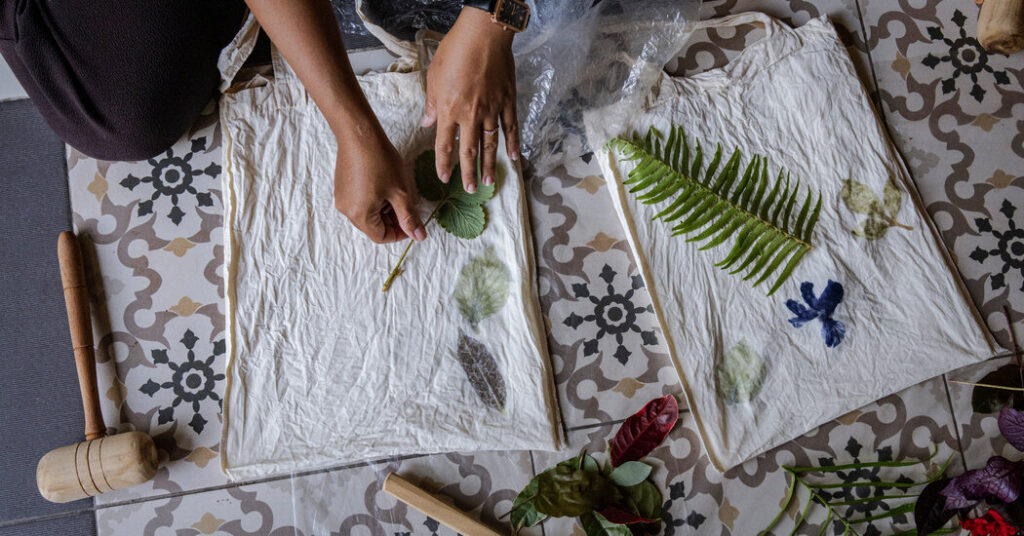
In 2023, the couple began hosting a monthly sustainable market, where local artisans could sell their wares. They partnered with two local women’s art collectives, according to Widiarti, one that made eco-prints out of local plants, and another that made bags and housewares out of recycled materials.
April’s art festival included 78 stalls of products made by villagers, and three stages for live performances, Widiarti said. The event was opened with a speech by the prince of Yogyakarta Kingdom, Kanjeng Pangeran Haryo Wironegoro, and thousands of people attended, from in and around the region and from the city of Yogyakarta, Hodgkin said.
At the end of his monthlong residency in January, Wahyudi sat down with other local cultural figures in the outdoor community space to talk about his art. He and his compatriots discussed how the boy had played with the frog sculpture, Maharsi said, and they asked the artist how he felt about someone playing with his sculptures and moving them around.
Wayhudi admitted that he did not know how to react, because no one had ever played with his sculptures in his gallery exhibitions before. But, according to Maharsi, Wayhudi said that he welcomed the boy’s response, as “an honest reaction to art.”
After Wayhudi’s talk, Maharsi said, many artist friends “came to us and they wanted to connect with us, and they wanted to see how creating with nature in mind was maybe different from what they normally do. They wanted to learn how to connect with the real surroundings.”
Widiarti said she hoped the arts program would only continue to grow.
“We basically would like to promote sustainable practices in daily life through art,” she said. “Art is close to everybody’s heart, right? Nobody likes to be lectured and people love to learn when they feel happy. Art is pretty powerful — and the most effective — tool we can use to make people do something good and be happy when they’re doing it.”
The post In Central Java, an Eco-Resort Aims to Build Sustainability Through Creativity appeared first on New York Times.