President Donald Trump’s 2027 budget proposes $111.1 billion for the Department of Health and Human Services (HHS), which oversees key health agencies including the Food and Drug Administration and the Centers for Disease Control and Prevention. That would be a 12.5% reduction from this year’s budget, and includes continued slashing of research grants as well as programs dedicated to women’s and children’s health services.
At an April 21 hearing before the Senate Appropriations Subcommittee on Labor, Health and Human Services, subcommittee vice chair Tammy Baldwin of Wisconsin opened with a prediction: “I expect Congress to reject this budget request, just like we did last year,” she said. “It makes the Administration’s priorities clear: more money for war, less money for programs helping Americans here at home.”
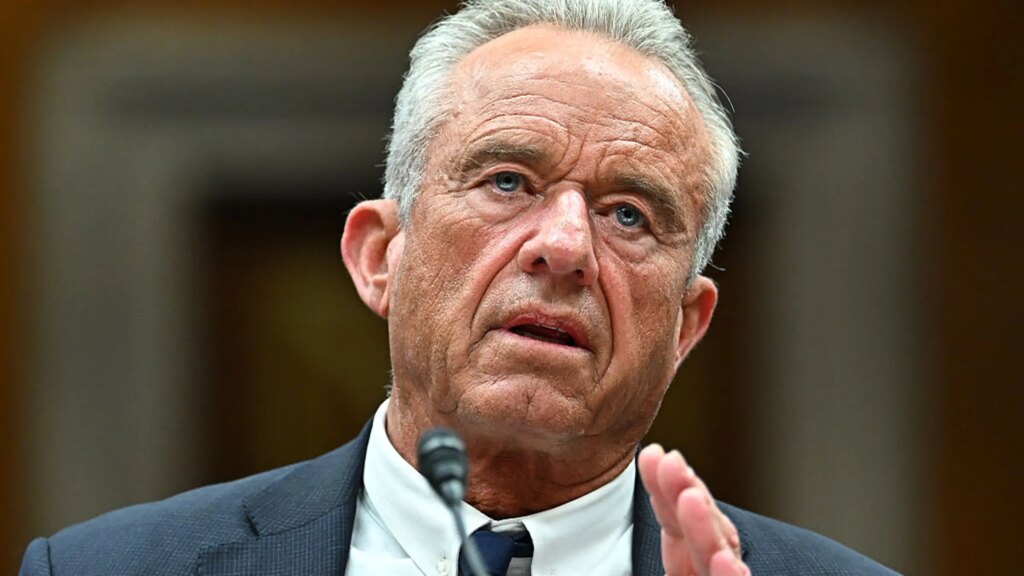
Testifying before the subcommittee, HHS Secretary Robert F. Kennedy, Jr. faced questions about a range of topics, including the decreased spending on health programs. “Nobody in the agency wants to cut these programs,” he said. “It’s Congress’ choice about whether to do it or not. It’s not my choice.” When Senator Patty Murray of Washington asked if he pushed back against Trump about the proposed reductions in HHS’s budget, Kennedy responded by providing justifications for the cuts at the National Institutes of Health, where he said “a lot of the money was wasted; I can read you the kind of studies, the insane studies that NIH was doing before I got there.” He went on to list a few involving “gender-affirming hormone therapy” and “transgender and gender-diverse adults.”
Kennedy admitted that the cancellation of critical grants for the Substance Abuse and Mental Health Services Administration (SAMHSA) earlier this year were “a mistake…an overcorrection” that he reversed within 24 hours after learning about them.
Read More: New Dietary Guidelines Urge People to Eat More Protein and Fewer Processed Foods
When asked about cancellations in grants to cancer and other vaccine research, Kennedy said he authorized funding in cancer vaccines and a universal flu vaccine—“so I’m not anti-vaccine. The $500 million that we cancelled were for vaccines that don’t work…mRNA, we now know, does not work for respiratory illnesses” (a claim that not supported by scientific evidence). Baldwin later challenged Kennedy’s statement about the effectiveness of mRNA vaccines, submitting a New England Journal of Medicine paper into the record countering his claim.
Senator Jeanne Shaheen of New Hampshire asked Kennedy about funds that HHS is holding that are owed to GAVI, the global public-private organization that provides vaccines for children around the world. Congress approved $300 million for the group, but “it is your department, and you personally, who is holding up funding for GAVI,” Shaheen told Kennedy. He acknowledged he had concerns about providing the funding, including that GAVI provides funds to the World Health Organization, to which the U.S. no longer belongs after Trump withdrew, and that GAVI uses an older version of the diphtheria, tetanus, and pertussis vaccine. But he agreed to appoint someone from HHS to work with Shaheen’s office to resolve the GAVI payment. “When 1.5 million children are at stake, it seems to me like those are issues that we ought to be able to resolve,” she said.
The post Robert F. Kennedy Jr. Defends Spending Cuts to Health Agencies appeared first on TIME.