Americans are just crazy about forming civic associations. It has always been thus: According to Alexis de Tocqueville, who wrote his “Democracy in America” almost 200 years ago, “There is scarcely an undertaking so small that Americans do not unite for it.”
American playwrights have learned that such picayune committees are ripe for hilarious treatment. In recent Broadway seasons, Tracy Letts turned a city council meeting into a bloody farce in “The Minutes”; Jonathan Spector depicted a school board in uproar during “Eureka Day.” Do-gooders, one hears, can be so petty and officious, after all, and so excited by the instruments of order. Case in point: In David Lindsay-Abaire’s barbed neighborhood association comedy “The Balusters” — which opened on Tuesday at the Manhattan Theater Club’s Samuel J. Friedman Theater — the best-timed gag involves a gavel. A gavel! It’s basically a little wooden comedy hammer.
“The Balusters,” directed by Kenny Leon, imagines a diverse group of upper-middle-class neighbors, devoted to serving their community — or at least their officially landmarked corner of it — where the lawns are lush and the architecture Victorian. Even amid such comfort, they discover constant causes for friction. Lindsay-Abaire based his comedy in part on the foibles of his own Brooklyn community; he told T.D.F. that he has reassured his neighbors that they are absolutely, 100 percent, not in the play. Perhaps there’s still some sense of fellow feeling, though: Lindsay-Abaire sets his characters up like bowling pins, but he only knocks them down with care.
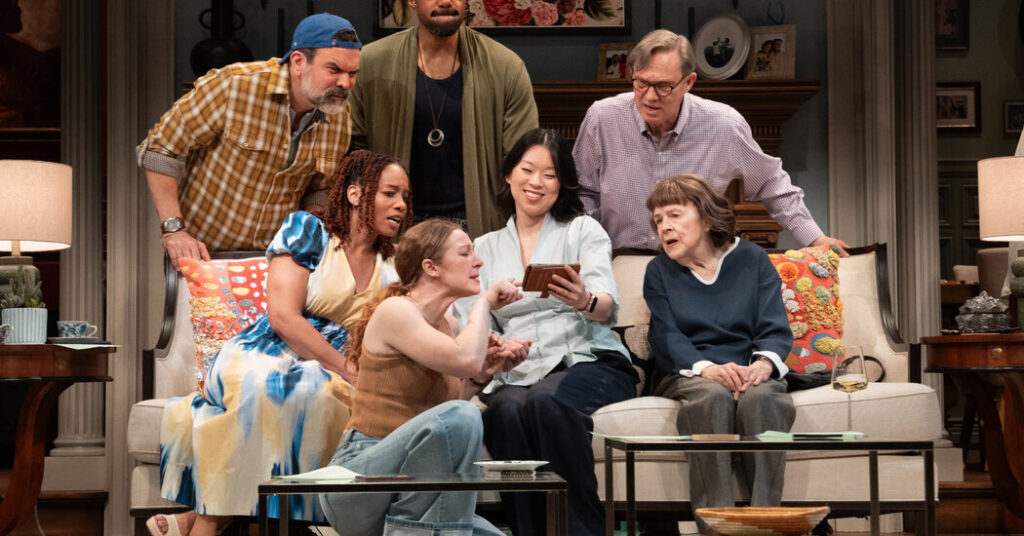
In a gorgeously appointed parlor, designed by Derek McLane with a deeply coffered oak ceiling and columned archways, a newcomer Kyra (Anika Noni Rose) bustles around, preparing to host her first Vernon Point Neighborhood Association meeting.
The art on her walls — a Kehinde Wiley-esque portrait of a woman among roses hangs above the mantel — announces the owner’s appetite for Black excellence and a beautifully curated life. Kyra herself is almost another artwork, dressed to glow richly against her white couch: At a moment of particular triumph, she wears a floating flame-colored dress, so that she’s a poppy against a field of snow. (Emilio Sosa designed the costumes.)
Members of the board enter, including the tart-voiced Melissa (Jeena Yi), who mistakes Kyra’s housekeeper, Luz (Maria-Christina Oliveras), for Kyra’s mother-in-law; Elliot (Richard Thomas), the organization president, who smiles and smiles like a villain; and the elderly Penny (Marylouise Burke), who tends to confuse this Melissa with another in the neighborhood. All the Vernon Pointers accept constant surveillance as their due — a security van patrols, and porch cameras hum — but they clearly never pay real attention themselves. Elliot doesn’t notice that his old photographs of the neighborhood show only white faces, and Kyra has no idea Luz has a son. Only Luz, watching in the way comic servants do, knows it all.
The nine association members, seated in that horseshoe shape that only occurs on stages and never in living rooms, gather in a series of meetings, hashing out the usual local issues, while nursing interpersonal ones. There are blowhards — like the brash Ruth (Margaret Colin) and Isaac (Ricardo Chavira), who’s happy to assign all the neighborhood’s ills to kids from “the projects” — and murmurers, like the diffident Alan (Michael Esper), who can’t say “boo” without the group’s youngest member, Willow (Kayli Carter), flagging it as problematic. The wry travel writer Brooks (Carl Clemons-Hopkins) takes a middle way, a little weary at the racism and homophobia he deals with regularly, but still ready with a needle-sharp aside.
Lindsay-Abaire’s precise and symphonic writing for so large a group depends on a specific instrument: Burke, his longtime muse. Now in her mid-80s, Burke is undimmed in terms of her comic timing, in which she uses her shuddering, reedy voice to prolong the instant of a joke. When her Penny repeats another character’s line, she makes it hilarious; when Penny swears, we all fall the heck to pieces. The show’s finest scene involves a series of revelations, which crash down on Penny, punctuated by peals of literal thunder. Burke is tiny and folded almost entirely into a couch cushion, and yet with each BOOM, our eyes jump to her. She’s all we see.
The alphas, though, do hold our attention: Elliot, who wields presidential power with folksy implacability, and Kyra, who challenges his throne. As she takes up his weapons, she assumes other qualities as well. While the others bicker about little stuff (dog poo comes into it, as does infidelity), larger thoughts hide among the wisecracks. Like, how do we distinguish between preserving a place and hoarding its riches? And where does solidarity end?
Leon and the sound designer, Dan Moses Schreier, introduce their own strand of racial analysis via the inter-scene playlist: We hear songs by artists including Kanye West (“In this white man’s world, we the ones chosen”) and Kendrick Lamar (“I come from a generation of pain”). In her nearly balletic portrayal, though, Rose makes Kyra seem ambivalent about being an embodiment of a reparative politics, even if she does go toe-to-toe with an avatar of complacent whiteness. She’s full of unresolved conflicts: Rose’s melodious voice, rings out with conviction when Kyra’s right — but also when she’s making excuses for her own self-regard.
This psychological delicacy comes as no surprise: Lindsay-Abaire wrote one of our most persuasive dramas on social collision, “Good People,” which explores the two ends of the class struggle in New England. I may have quibbles with the way his plot here unfolds, particularly the way it incorporates Luz, whose circumstances must be manipulated in unrealistic ways. But all boulevard comedies lean on coincidence, and I guess that applies even when the boulevard is a residential esplanade. (I laughed while I watched “The Balusters”; I only grumbled while thinking about it hours later.)
The title refers to one of Elliot’s pet issues — a resident who may be putting unapproved spindles on a refurbished porch. Balusters are the parts of a railing that “hold everything up,” Thomas says, smiling as always. The double meaning of that phrase is Lindsay-Abaire’s theme: These nine do hold everything up, both in the sense of delay (ego and impatience impede true communication) and support (through their dedication to service, progress does seem possible).
And so there’s a second play happening here, the one in the seats. Which kinds of “holding up” are we capable of? An audience is itself a volunteer organization, one with its own voting blocs. I found myself on the same tenterhooks as the Vernon Point association members, listening to my neighbors so that I might evaluate their responses. (In a comedy, you can clock laughter … and have opinions about it.)
Lindsay-Abaire is making fun of our eagerness to leap to judgment while also, by writing this play, multiplying our opportunities to do so. I tutted under my breath, for instance, at how easily people laughed at the censorious millennial Willow — a wan joke about nonbinary voting received roars of approbation — while totally failing to notice anything weird about those moments that tickled my own fancy. Lindsay-Abaire had just offered me a slippery, sensitive, clever play about how we reveal ourselves by what we choose to bristle over and what we find funny. But I wasn’t worried; he didn’t mean me. I’m pretty sure I was doing all my laughing correctly.
The Balusters Through May 24 at the Friedman Theater, Manhattan; manhattantheatreclub.com. Running time: 1 hour 50 minutes.
Helen Shaw is the chief theater critic for The Times.
The post Review: In ‘The Balusters,’ Neighborly Dysfunction Is on the Agenda appeared first on New York Times.