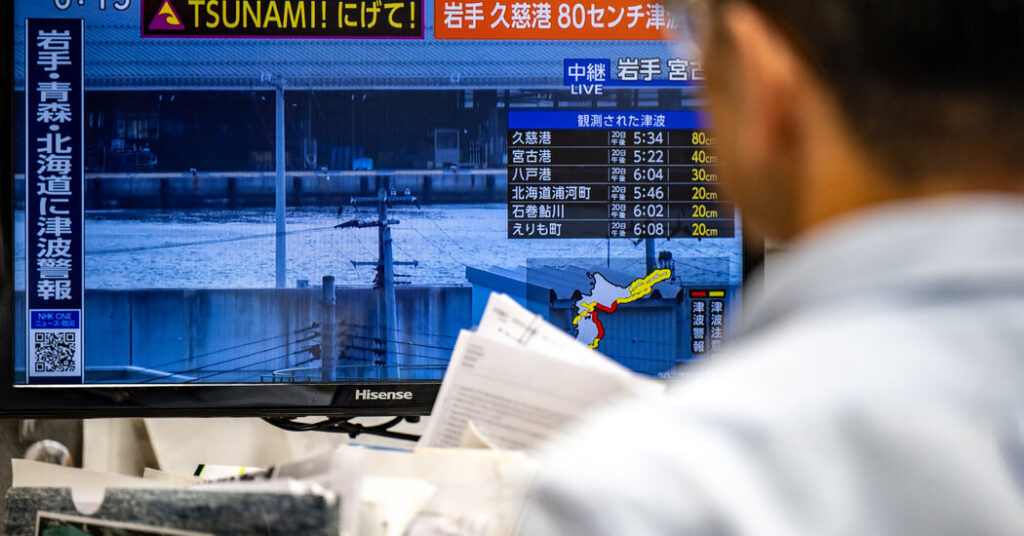
A 7.4-magnitude earthquake jolted Japan this week and set off a tsunami warning, but shoppers at one grocery store simply steadied their carts and kept browsing as the building shook. Within hours, Tokyo’s subways were once again packed and bullet trains had resumed journeys near the epicenter.
“It’s happened so many times, I think it’s not a big deal,” said Hiroyuki Utsunomiya, 77, who runs a trucking company in the northeastern city of Ishinomaki.
Japan is one of the most seismically active parts of the world, with an average of two to three quakes each day. For many people in the country, tremors are not extraordinary and life tends to swiftly return to normal after an earthquake.
But after the quake on Monday, the national meteorological agency urged people to be prepared for a more destructive earthquake. It warned that there was an elevated risk of a “megaquake” — magnitude 8 or higher — in northeastern Japan in the following week.
It is not possible to predict earthquakes and only probabilities can be calculated, according to the U.S. Geological Survey. The Japan Meteorological Agency is candid about the limitations of its advisories. “This information is extremely uncertain,” the agency said on Monday. A megaquake might not hit at all or there might be one after the advisory expires in a week, it added.
The megaquake advisories were designed after a 2011 earthquake devastated Japan as a way of encouraging preparations, officials said.
The advisory system for the Nankai Trough, a seismically active zone off southern Japan, began in 2019. A second system was created in 2022 for a zone off northeastern Japan where Monday’s quake struck. The advisories are rare, though. Together, the systems have generated only two other alerts.
Both systems note the increased probability of a megaquake based on historical data. On Monday, the agency assessed that the chance of such a quake in northeastern Japan had risen to 1 percent from the base-line 0.1 percent — a tenfold increase in probability.
For the authorities in Japan, where most structures are built with earthquakes in mind, even the slight rise in probability of a catastrophe merited the warning.
Since the latest advisory was issued on Monday, officials in the northeastern city of Kuji have sent alerts three times a day — via radio, messaging apps and email — reminding residents to keep emergency kits ready and prepare to seek shelter anytime.
“We are raising awareness and disseminating information in a way that does not cause too much panic,” said Teruki Maeno, a crisis management official in Kuji, a city in Iwate prefecture.
This balance — vigilance without panic — is the result of living with earthquakes for centuries. The consequences of Japan’s geology are everywhere: skyscrapers built on shock-absorbing rubber pads; early warning systems that can halt bullet trains seconds before tremors arrive; and generations who grew up doing regular earthquake drills in school.
The most devastating earthquakes have shaped how life, cities and architecture have developed in modern Japan. Experts say this focus on readiness helps explain why there were so few injuries on Monday, even though a similarly powerful earthquake could have leveled towns in another country.
“Ishinomaki has sturdy buildings that are rebuilt in the bedrock,” said Mr. Utsunomiya, whose office was swept away by the tsunami unleashed by the 2011 Fukushima quake. “It won’t budge.”
That earthquake and the resulting tsunami killed more than 19,000 people and led to a nuclear disaster. The Fukushima catastrophe is fresh in the memories of people in northeastern Japan.
“This region has lived with the threat of tsunamis since ancient times,” said Mr. Maeno, the Kuji city official. “The lessons learned from the past have been passed down through generations.”
But that confidence has its limits. The small tsunami wave — under three feet tall — that reached the coast of Iwate on Monday caused little concern. Had the authorities warned of something even bigger, Mr. Maeno said, the mood would have been completely different.
“Everyone would panic,” he said.
It is for this reason, officials said, that the Japanese authorities take care with their earthquake advisories. If the tone is too alarming, they could cause the kind of panic that paralyzes life and the economy. If it’s too vague, nobody would pay attention.
The 1 percent chance the agency warned of on Monday was carefully calibrated. It indicated that the risk of catastrophe was elevated but low enough to keep the economy running normally, said Hiroki Muramatsu, a cabinet official who oversees disaster prevention.
“Simply saying ‘it’s dangerous’ won’t get anyone to act,” said Hiroshi Ueno, an earthquake specialist at the Japan Meteorological Agency, referring to the probability-based warnings. “So we thought it would be more reliable to have some kind of numerical data.”
At the port in Kuji, Takuro Kokami, a fishery association official, said that fishermen reacted in different ways to the tsunami warning after the earthquake on Monday. Some took their boats out to sea instead of evacuating, hoping to protect their vessels from the waves, he said.
“This is entirely a matter of individual responsibility and judgment,” he said.
Mr. Kokami said he takes a different approach: Evacuate first, get back to work later.
John Yoon is a Times reporter based in Seoul who covers breaking and trending news.
The post Japan Is Used to Earthquakes, but What About a Big One? appeared first on New York Times.