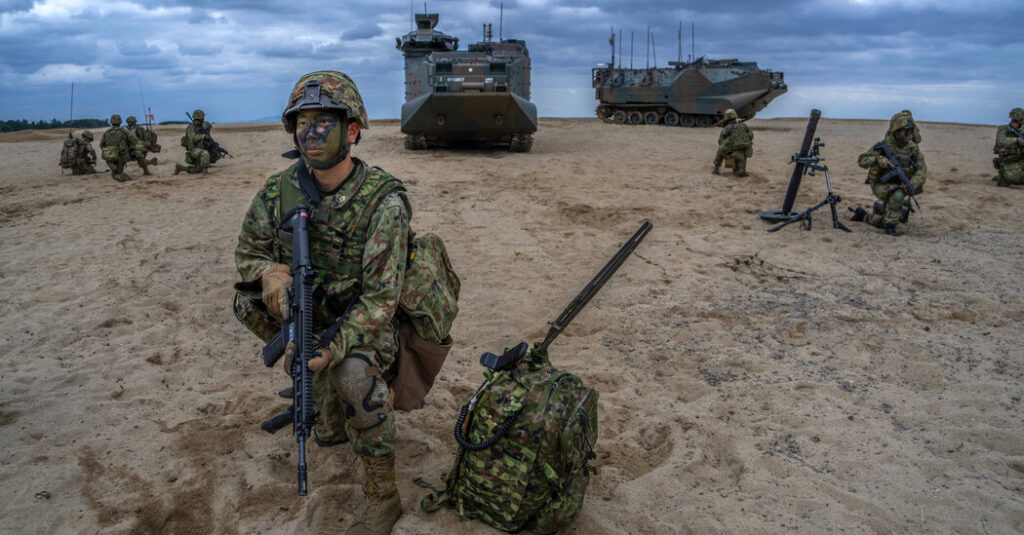
The Japanese government moved on Tuesday to allow the sale of more weapons abroad, in the latest shift away from pacifist policies imposed after World War II, as it grapples with rising security threats from China and a rapidly changing global order.
Prime Minister Sanae Takaichi, at a cabinet meeting in Tokyo, reversed longstanding limits on the sale of Japan-made weapons overseas. The move comes days after Japan welcomed more than 30 NATO envoys for a visit meant to show stronger ties, and after Tokyo sealed a $6.5 billion deal to supply warships to Australia.
Ms. Takaichi said in a post on X that the change was necessary in an “increasingly challenging security environment.”
“No single country can now protect its own peace and security alone,” she said.
Ms. Takaichi, an outspoken critic of Beijing who rose to power last year, is seeking to shore up Japan’s defense industry and to build a more diverse network of allies, with increasing uncertainty over the reliability of its main partner, the United States. Japan hopes that easing the export rules can help strengthen deterrence in the region by showing China, North Korea and Russia that democratic countries around the Pacific are building a global arms supply chain.
Japan, which adopted pacifism in the aftermath of World War II, has gradually eased limits on weapons exports over the past decade, allowing some exceptions, such as for rescue purposes, surveillance or under license agreements.
Ms. Takaichi addressed concerns about Japan abandoning its postwar pacifism, writing that “there is absolutely no change in our commitment to upholding the path and fundamental principles we have followed as a peaceful nation for over 80 years since the war.”
The changes approved on Tuesday will unfetter defense contractors, allowing them to sell lethal weapons systems directly to 17 countries. That will permit Japanese companies to provide advanced frigates to the Philippines, for example, or submarines to Indonesia. But Japan will still prohibit the transfer of lethal weapons to countries in active combat, unless top officials determine that national security is at stake.
Japan is stepping up at a time when the United States is distracted by the war in Iran. The decision by the Trump administration to move some military assets out of Asia in recent weeks to support the war has fueled concerns about U.S. commitment to the region.
“The idea that the U.S. would champion the global order has turned out to be sort of an illusion, and that’s a very inconvenient reality,” said Michito Tsuruoka, a professor at Keio University in Tokyo. “Now Japan is rushing to find viable alternatives for its own security and defense.”
The shift in policy is aggravating tensions with China, which has accused Ms. Takaichi of reviving World War II-era militarism. China has unleashed a wave of economic reprisals against Japan over the past five months to punish Ms. Takaichi for saying Japan could intervene military if Beijing were to attack Taiwan.
Tensions have risen since last Friday, when Japan sent a warship through the Taiwan Strait. In response, China said on Sunday it was sending naval vessels through a waterway near southern Japan, near Kagoshima Prefecture.
Japan should “act prudently in military and security areas, and stop going further down the wrong path,” Mao Ning, a spokeswoman for the Chinese foreign ministry, said when asked about possible changes to the export rules at a recent news conference.
Faced with the increasingly unpredictable foreign policy of President Trump, Japan has hedged its bets. Ms. Takaichi has welcomed a procession of European officials to Tokyo recently, including the leaders of Britain, France, Italy and Poland. In the coming weeks, she is expected to visit Vietnam and Australia.
Last week, NATO sent its largest delegation to Japan since they established a partnership more than a decade ago.
Anita Nergaard, the permanent representative to NATO for Norway, who helped lead the three-day visit, said Japan’s decision to export more weapons would be “really valuable to us, to Europe and the entire alliance.”
“We are exactly at the point where need to turn those commitments and funding into concrete capabilities,” she said in an interview.
Japan and NATO both face the challenge of dealing with Mr. Trump, who has criticized Japan and NATO countries for a lack of support in the war in Iran.
Dan Neculaescu, Romania’s permanent representative to NATO, who also helped lead the delegation, said concerns about the role of the United States did not dominate the conversation in Tokyo.
“We have had 70 years of the U.S. in NATO,” he said in an interview. “We can see the dynamics on the outside. But inside, the alliance is quite powerful.”
He added that the spread of conflict around the world made it clear that “we have to work with Japan and they have to work with us.”
Japan has gradually shifted its approach to weapons as it has sought a larger global security role. In 2014, Shinzo Abe, then Japan’s prime minister and Ms. Takaichi’s mentor, revised regulations to allow weapons to be exported for international security efforts, such as peacekeeping missions by the United Nations. That ended a strict ban that had been in place for nearly 50 years.
The rules changed again in 2023, when Japan allowed the sale of advanced air defense systems to the United States under a license agreement. The move helped bolster American military stockpiles at a time when Washington was helping Ukraine in its fight against Russia.
Hisako Ueno and Kiuko Notoya contributed reporting.
Javier C. Hernández is the Tokyo bureau chief for The Times, leading coverage of Japan and the region. He has reported from Asia for much of the past decade, previously serving as China correspondent in Beijing.
The post Japan to Sell More Weapons Abroad, Breaking With Postwar Pacifism appeared first on New York Times.