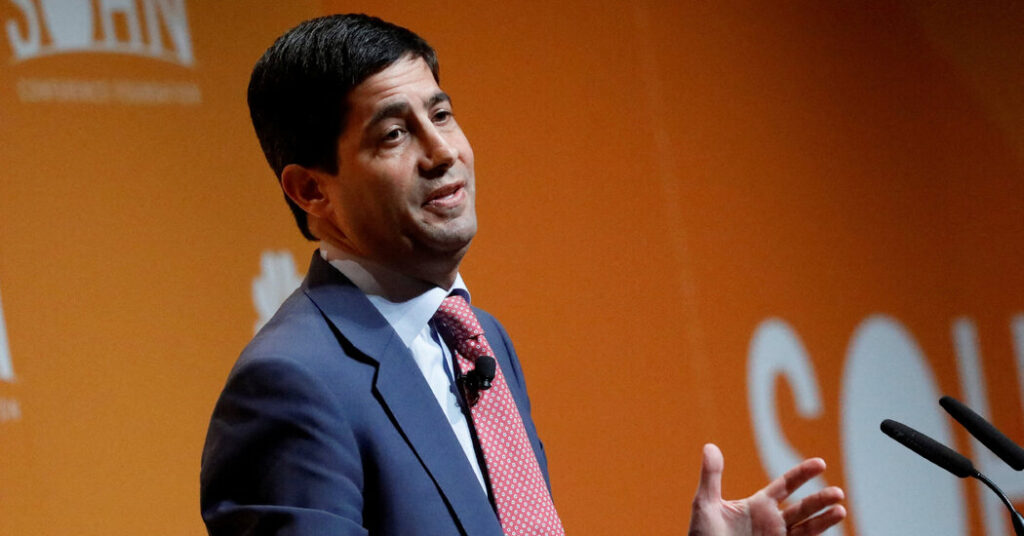
Kevin M. Warsh is set to tell lawmakers on Tuesday that the Federal Reserve’s independence in setting interest rates is “essential,” even as he concedes that the president should have more sway in other policy decisions made by the institution he hopes to soon lead.
In opening remarks to be delivered to the Senate Banking Committee, President Trump’s pick to become the next chair of the central bank will say that its policymakers must make decisions based on “analytic rigor, meaningful deliberation and unclouded decision-making.”
In his opening remarks, Mr. Warsh did not dissuade elected officials, including the president, from stating their views on interest rates, as Mr. Trump has repeatedly done. Instead, Mr. Warsh will say that central bankers must be “strong enough to listen to a diversity of views from all corners, humble enough to be open-minded to new ideas and new economic developments, wise enough to translate imperfect data into meaningful insight and dedicated enough to make judgments faithfully and wisely.”
Mr. Warsh’s testimony in front of the Senate Banking Committee will be a milestone in his bid to succeed Jerome H. Powell, whose term as Fed chair ends on May 15. But his ability to get Senate confirmation by then is far from guaranteed amid concerns about the administration’s attempts to encroach on the Fed’s independence.
Mr. Trump wants significantly lower interest rates and has repeatedly attacked Mr. Powell and other officials at the Fed for not delivering them. As part of his pressure campaign, the president has sought to fire Lisa D. Cook, a member of the board of governors. Her lawsuit seeking to block her ouster is being considered by the Supreme Court.
The Justice Department has also opened a criminal investigation into Mr. Powell and his handling of costly renovations at the central bank’s headquarters in Washington, D.C. Senator Thom Tillis of North Carolina, a Republican on the Senate Banking Committee, has vowed to block any Fed nominee from advancing to a full vote by the upper chamber until those legal threats end.
Mr. Warsh is not planning to mention the investigation or recent attacks from the president in his opening remarks. Instead, he will make clear that he will not be sanguine about inflation, suggesting that he will not comply with Mr. Trump’s demands for lower rates if the economic circumstances do not call for it.
“Inflation is a choice, and the Fed must take responsibility for it,” he will say.
Mr. Warsh will argue that the Fed’s independence is “earned — and better policy decisions crafted — by steering clear of distractions.”
“Fed independence is placed at greatest risk when it strays into fiscal and social policies where it has neither authority nor expertise,” he will say. “The Fed should not act as some general-purpose agency of the U.S. government or as an appellate court for matters that are rightly debated and decided elsewhere.”
His comments will echo years of criticism he has directed at the central bank since his five-year tenure as a governor ended in 2011. While auditioning for the job, Mr. Warsh, who has deep ties on Wall Street, called for “regime change” at the central bank and said “the credibility deficit lies with the incumbents that are at the Fed, in my view.”
He has previously faulted the Fed for engaging in “mission creep” and focusing on issues outside of its remit of low, stable inflation and a healthy labor market. He has also taken aim at the central bank’s balance sheet, which has swelled as the Fed has bought up government bonds over the years during financial crises. The central bank has in recent years shrunk the balance sheet by about $3 trillion from its peak of nearly $9 trillion after the pandemic, but it still remains far larger than Mr. Warsh would like.
“In the period after the crisis, I also witnessed an institution that was tempted to play a larger role in the economy and society, to extend its reach and stretch its hard-earned credibility, often with the best intentions, to the very edge of, if not beyond, the Fed’s statutory responsibilities,” he will tell lawmakers.
Mr. Warsh does not believe that all of the Fed’s responsibilities are subject to the same degree of independence, however, a point he is preparing to make on Tuesday.
Fed officials, he will say, are “not entitled to the same special deference in their stewardship of public monies, or in bank regulatory and supervisory policy, or in areas affecting international finance, among other matters.”
The Fed has already embraced much of the administration’s views about loosening the reins on Wall Street, including reducing capital requirements on large and regional banks in hopes that trimming red tape will encourage more lending. Further changes are very likely once Mr. Warsh is confirmed.
Colby Smith covers the Federal Reserve and the U.S. economy for The Times.
The post Trump’s Fed Pick to Defend Central Bank’s Independence on Rate Setting appeared first on New York Times.