PALM BAY, Fla. — Seniors at Pineapple Cove Classical Academy draw upon the Bible and books from the Western canon to answer a quintessential question in their capstone project: What is the good life?
Children at the K-12 school learn Latin, engage in the Socratic method and write in cursive. The use of technology is rare. Students walk past paintings of historical scenes that include Betsy Ross sewing an American flag and down hallways lined with portraits of the Founding Fathers.
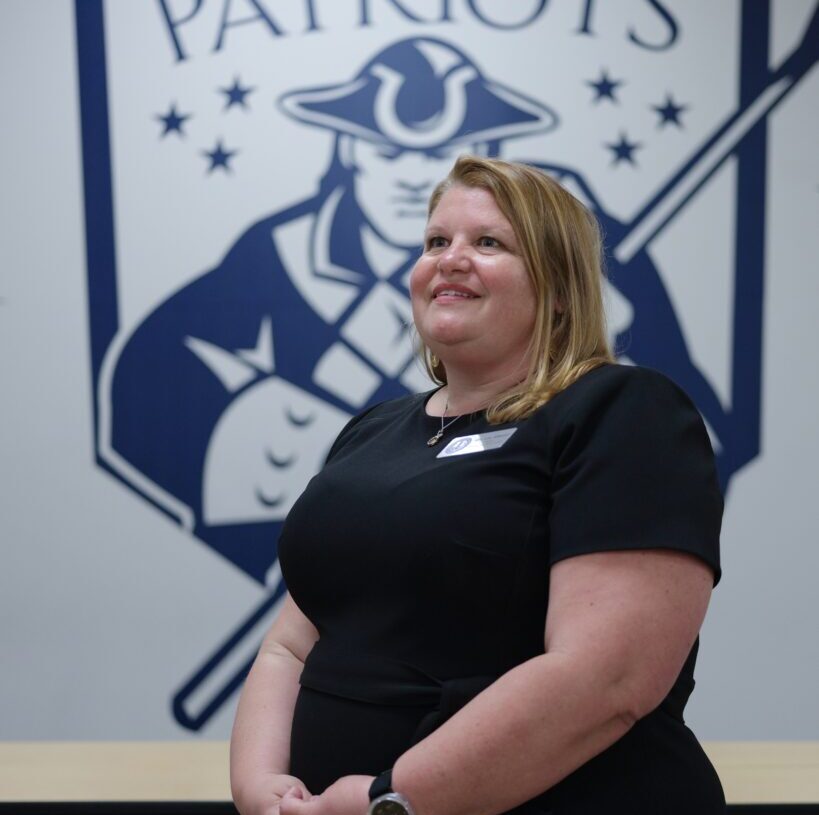
“We are going to honor the creation of our flag. We are going to honor George Washington,” Lisa Wheeler, principal of the Palm Bay campus, said of the school. She wants students to graduate with an “understanding of the Western civilization” and an appreciation for “the great people who founded our country.”
The model at the Florida school, known as classical education, emphasizes Western history and literature, and draws on teaching methods from ancient Greece and Rome. The approach has found new popularity among families who say the methods offer more rigor than schools that have relaxed their grading policies or use screens for much of their teaching. And, supporters argue, the Eurocentric content is more proven than evolving modern teachings.
While the model is apolitical, it is also being pushed by conservatives, who say it celebrates American ideals and Western thought. Classical education’s newfound popularity comes as the Trump administration seeks to promote patriotism and frames criticism of the darker chapters of U.S. history as un-American. The president is also attempting to eliminate diversity, equity and inclusion initiatives from schools, governments and workplaces.
Critics of the classical approach, including some education experts, say the schools can be a Trojan horse for conservative ideology and promote a myopic worldview — undermining efforts to expand curriculums to better reflect the experiences of all students in public K-12 schools, the majority of whom are not White.
Of the 895 classical schools in the United States, one-third opened or adopted the model between 2020 and 2024, according to a database published by the Heritage Foundation, a right-wing think tank. The vast majority of the schools are private and Christian, but a growing number are public charter schools, which are independently operated and taxpayer-funded.
Defending the model, Wheeler said students receive “a very wide view of the world and our country.” The classic European teaching methods that the school uses — seminars, memorization and recitation, character development — mold children into critical thinkers who can reason and communicate effectively, according to Wheeler. They study texts known as “Great Books” that have shaped Western civilization over centuries and impart lessons about the human experience, she said.
“If you think about a traditional public school today, standards are changing often, the expectations for what students will learn is changing often,” Wheeler said. “I think this degradation of society, when it comes to our ability to read and speak and write well, is the fact that we just keep trying to change things.”
“Classical education … it’s tried and true. It’s what’s worked,” she said.
More than 2,700 children attend Pineapple Cove’s three campuses in Brevard County in central Florida. Like many classical schools in the U.S., it has ties to Hillsdale College, a small, conservative Christian school in Michigan that has partnered with the Trump administration. It’s known for promoting “patriotic education,” and in 2021 published a K-12 history curriculum that teaches that “America is an exceptionally good country,” echoing rhetoric from President Donald Trump.
Wheeler, however, said Hillsdale’s work at Pineapple Cove has been nonpartisan. The college provides curriculum and other supports to classical K-12 schools.
Every classical school is different, but they are bound by a focus on cultivating virtues and teaching the liberal arts of grammar, logic and rhetoric — or effective communication. Children study American and Western European literature written between the 8th and mid-20th centuries, mostly by White men, including Homer, William Shakespeare and John Steinbeck. Pineapple Cove students also read the memoir of abolitionist Frederick Douglass, and school staff say they think there is sufficient exposure to different perspectives.
Kelly Gunter, director of school operations, pointed to Mark Twain, whose views on race were complicated and evolved over time. “I think one of the things that classical schools do really well is focusing on not only humans as virtuous people,” she said, “but their vice as well.”
New growth
The classical education movement goes beyond schools to include the Classic Learning Test, an alternative to the SAT and ACT that is increasingly being accepted by state university systems and U.S. service academies. The model has been buoyed by Republican state leaders, federal officials, including Education Secretary Linda McMahon, and parents who are seeking schools that align with their values.
McMahon has toured multiple classical schools, including Pineapple Cove, which she called a “student-centered charter school that is seeing real results.”
Parents at the Florida school say they were attracted to the academics — they wanted their children to be challenged by reading novels and learning Latin.
Families elsewhere are finding refuge in classical schools after fleeing their traditional public districts, said Jonathan Butcher, acting director of the Center for Education Policy at the Heritage Foundation. Some have been opposed to how schools are teaching about race and racism in the U.S., he said. Others were concerned about policies supporting transgender students.
“You would see the headlines of parents going to school board meetings and challenging the district’s position on boys’ access to girls’ bathrooms or sports teams, or material that was teaching critical race theory, what have you,” he said.
Studies support certain aspects of the classical model — such as phonics instruction — but generally, research on the schooling method is sparse. Findings are often limited by small sample sizes.
At Pineapple Cove, staff tout standardized test scores. A higher share of children at the Palm Bay campus are on grade level in math and reading than at other schools in the state, Florida testing data shows. The school also has a smaller proportion of low-income families than the surrounding county, which is often tied to higher scores.
Researchers who focus on inequity in education have criticized the classical approach for limiting or excluding non-White perspectives.
“Diversity in curriculum is very vital to the kinds of actual critical thinking that students should develop,” said William Rodick of the nonprofit organization EdTrust. He added that students benefit when the content they learn in school reflects them and their experiences.
“This is a narrowing of history,” Rodick said of the classical education curriculum.
Teachers at Pineapple Cove acknowledged that pushback, but also said the school covers history honestly.
“When we talk about George Washington and that he owned slaves, but he was still a virtuous man, we have those conversations about those things,” said Julie Austin, an eighth-grade history teacher. “It would be impossible to study U.S. history without being honest about the fact that this is a diverse country.”
Austin said the history department recently widened its curriculums to include modern world history.
But a faction of classical education supporters argues that the overall approach could be expanded even further.
Anika McKinney-Prather, an assistant professor of education at Catholic University, said classical education is often misunderstood by a swath of the far right who have latched on to it to defend beliefs that White culture is superior. Though, many of the Greek and Roman scholars who are studied in classical schools learned from scholars in Africa, the Middle East and Asia — a fact that is often overlooked, she said.
At the Living Water School, a Christian classical school that McKinney-Prather founded in 2015, students read classic texts, as well as diverse authors who were inspired by those texts. For example, Huey P. Newton, co-founder of the Black Panther Party, drew inspiration from Plato’s “Republic.”
Angel Adams Parham, an associate professor of sociology at the University of Virginia and a co-founder of a nonprofit organization that provides classical curriculums for students of diverse backgrounds, said the understanding of the Western tradition can be incredibly narrow in classical circles.
“It doesn’t need to be,” she said
‘A place where learning is happening’
Pineapple Cove began as a preschool in 2006, then grew into a classical school in 2015, said John Moran, its president and chief executive.
More than 60 percent of students who attend the campuses are White, about 20 percent are Hispanic and 9 percent are Black, according to state education data.
During a recent physical education class, a group of girls passed a volleyball in the school’s big gym where the floor is emblazoned with their mascot, a patriot.
“Everybody knows everybody. It feels like a big family. Most of us grew up together,” said Nataleigh Gardner, 15. She said she enjoys learning about history, but wishes her class had spent more time studying Africa. “We had to go fast,” she said about the lesson.
Other teens raved about dissecting pigs and researching the Aztecs.
Joline Fried-Midkiff, who sends both of her sons to Pineapple Cove, was impressed when her boys could name every U.S. president by the time they finished kindergarten.
The school’s affiliation with Hillsdale has given her pause — some of the college’s conservative views aren’t aligned with her own — but she said she keeps her sons enrolled because they’re thriving.
“The type of support and culture you get there is just outstanding,” said Fried-Midkiff, a stay-at-home mom. Pineapple Cove has a “bright, rich, rigorous curriculum. … They also enhance developing the whole person, with the virtues. And that was very important to us.”
Others — including faculty — came to the school after becoming disillusioned with traditional public education.
“It’s a place where learning is happening,” said Chelsea Leather, a ninth-grade English teacher who came to Pineapple Cove after teaching in the local public school district. At her old school, students read book excerpts on their laptops. At Pineapple Cove, they read entire novels.
In kindergarten, students begin memorizing poems and get “explicit phonics” instruction — a tenet of classical education — Wheeler said in a classroom as children arranged themselves on a colorful carpet. Their teacher, Laura Matthews, sat in a rocking chair and held up flash cards with different phonograms — tiny units that represent the sounds that make up words.
Matthews raised a notecard with the phonogram “ai.”
“ ‘A,’ ” the children said, pronouncing the long vowel sound in unison before reciting some lines they had memorized on how the phonogram is used. “Two-letter ‘a’ that we do not use at the end of English words. Why not? English words do not end in ‘i.’”
In second grade, students get lessons in cursive, the standard for most writing assignments. By sixth grade, children are ready for Latin — a core piece of the classical curriculum because it helps students understand English grammar, school officials said.
Jeff Spears, a Pineapple Cove father who studied Latin when he attended Catholic school as a child, was surprised his kids would be doing the same at a charter school.
“I wanted them to have teachers who are passionate about what they were teaching,” Spears said. “And who were focused on their growth and their academic excellence, and making them good humans.”
Lydia Sidhom contributed to this report.
The post This teaching method, backed by conservatives, is on the rise appeared first on Washington Post.