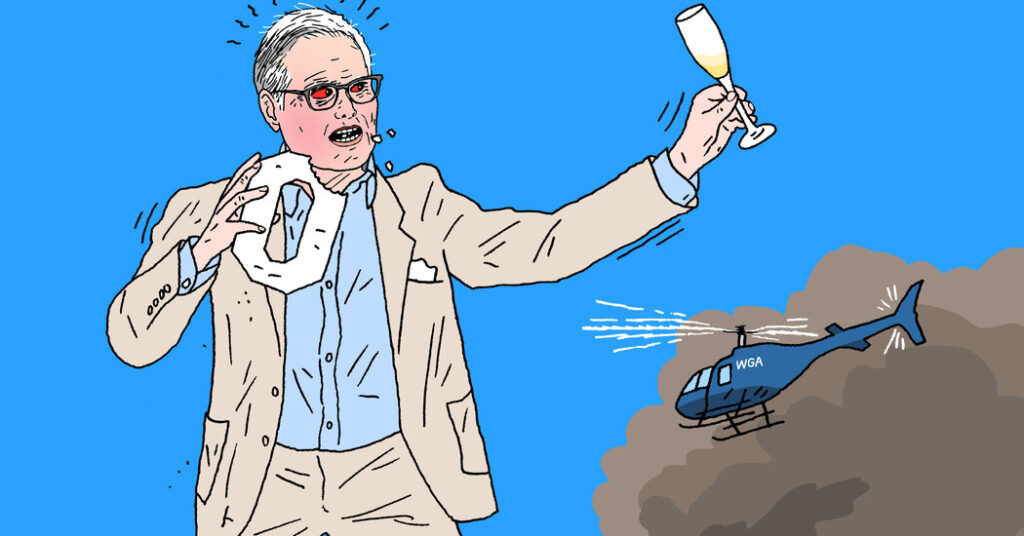
If Hollywood has a supervillain right now, it’s the early-rising, bean-counting, hoodie-wearing, about-to-be-absurdly-rich David Zaslav.
Already, many saw the Warner Bros. Discovery chief executive as an accidental mogul. The deal-making protégé of the octogenarian cable mastermind John Malone, Mr. Zaslav was in the right or wrong place at the right or wrong time, depending on how you look at it. Thanks to a series of fortunate (for him) events, Discovery, his very basic cable TV company, in 2022 ate the larger and more prestigious WarnerMedia while in the process loading the whole thing up with $50 billion in debt.As the sale of Warner Bros. Discovery to the much smaller Paramount Skydance hurtles toward board approval at an April 23 vote, nearly 4,000 writers, actors and directors (including Bryan Cranston, who plays an absurd character in “The Studio” that Seth Rogen based on Mr. Zaslav) have signed a letter opposing the deal as a job killer that will squeeze an already beleaguered industry. The assumption is that consolidation will mean more layoffs and less production. There will absolutely be more debt to pay off.
“My intention was never to sell the company,” Mr. Zaslav told me. “My intention was to build and run that company. We were in the middle of a generational disruption and had to make a lot of hard calls in the beginning.”
If it goes through, Mr. Zaslav, who was already known for being unusually well paid, stands to be rewarded with a contractual jackpot so big that the independent corporate governance expert Glass Lewis considers it worthy of “severe concern.” Institutional Shareholder Services similarly noted that it “represents one of the highest golden parachute estimates ever observed” and is “problematic.”
Mr. Zaslav’s payout from the sale of the studio he ran for just four years will range from $551 million to $887 million, including accelerated stock triggers. That means most of his equity awards would vest and be paid as soon as a change in control occurs. This “is not a best practice,” noted Institutional Shareholder Services.
This haul does not include the $114 million worth of Warner Bros. Discovery stock that Mr. Zaslav sold in March.
It was no secret in the world of television that Mr. Zaslav longed for Discovery, his cable company known for reality fare like “Deadliest Catch” and “Naked and Afraid,” to be considered on the same level as HBO.
In 2022, he made the deal with the chief executive of AT&T, John Stankey, to spin off WarnerMedia (as it was called then) and combine it with Discovery. The plan was to combine their premium streaming audiences, expand abroad and create a rival to Netflix and Disney+ called Max. I remember Zaslav laying out this vision to me in a meet-and-greet at the Beverly Hills Hotel in the spring of 2022. He was certain that within a few years his new company would be the second or third biggest streamer in entertainment.
Mr. Zaslav cut costs, including dumping movies (“Batgirl,” R.I.P.), memory-holing several HBO Max series to save on taxes (goodbye, “Westworld”) and laying off thousands of employees. Debt plus a declining cable business pushed down Warner Bros. Discovery’s stock price from $24 at the time of the merger to below $10 a share a year ago. Mr. Zaslav decided he needed to spin off his cable businesses and cut even more costs.
There were things that went well during Mr. Zaslav’s reign. HBO Max added international subscribers. Warner Bros. had a banner 2025 with hits like “Sinners,” “One Battle After Another” and “A Minecraft Movie.” But what really saved him was just the luck of being the target of someone else’s ambition: the tech scion turned actor turned movie producer David Ellison. In the year since announcing the company split, Mr. Zaslav at first spurned Mr. Ellison’s advances to marry Warner with his Paramount Skydance. Instead, he did a deal with Netflix. But Mr. Ellison would not be deterred. A bidding war ensued, and Paramount agreed to pay $31 a share in the end.
Will it be good for Hollywood? No, not at all. In addition to the fears of more job losses — entertainment industry production related employment has already dropped 30 percent since 2022 — and lack of creative opportunity expressed by the group of actors, directors and producers, a group of 11 state attorneys general have called for the Department of Justice to conduct a “thorough and exacting review” of the deal’s compliance with federal antitrust law.
But it’ll be good for Mr. Zaslav.
Hollywood is always a place of self-invention. But Mr. Zaslav’s studio mogul posturing rankled the Hollywood snobs. He bought Robert Evans’s old house in Beverly Hills, dragged Jack Warner’s desk out of storage and gave a party at the Hotel du Cap-Eden-Roc with Graydon Carter.
Much to the annoyance of those whose livelihoods might be upended by the consolidation he helped engineer, Mr. Zaslav moguls on. Earlier this month, he entertained a small group of around 30 Hollywood bros (yes, all men) — including the producer Jason Blum, the actor Sean Penn and the billionaire David Geffen — at his house in Beverly Hills to watch a game and have dinner.
Later the same week, he swung by the red carpet of HBO’s new season of “Euphoria” before buzzing off with the boys to a Bruce Springsteen concert.
Sharon Waxman is the founder, chief executive and editor in chief of The Wrap.
The Times is committed to publishing a diversity of letters to the editor. We’d like to hear what you think about this or any of our articles. Here are some tips. And here’s our email: [email protected].
Follow the New York Times Opinion section on Facebook, Instagram, TikTok, Bluesky, WhatsApp and Threads.
The post The Man Who Ate Hollywood appeared first on New York Times.