KERN COUNTY, Calif. — At the bottom of the San Joaquin Valley, a low-slung Midcentury building tucked into the green-gold hillside is the beating heart of California’s impressive water delivery system. For more than five decades, the Edmonston Pumping Plant has lifted water nearly 2,000 feet up the towering Tehachapi Mountains, connecting water from Northern California to 27 million people in the southern part of the state.
The plant houses 14 rumbling pumps in two football-field sized wings and is one of the most powerful water lifting systems in the world. But it can need upward of 800 megawatts of electricity to run, making it among the largest single power users in the state.
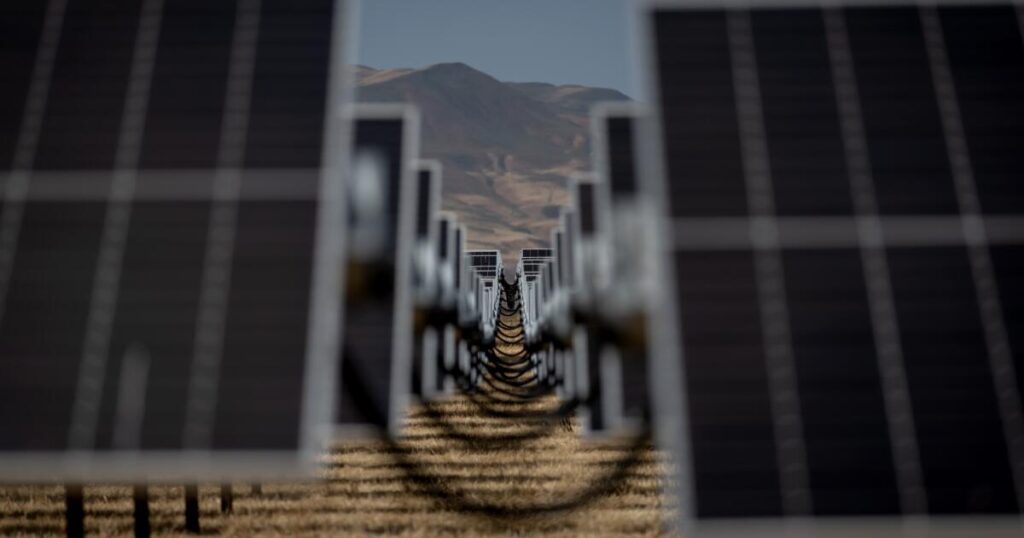
Now the equation is changing. On a recent weekday morning, dozens of state officials and energy industry representatives gathered at Tejon Ranch, just across the road from Edmonston, to celebrate a sparkling new solar plant that will help power the pumps. The 105-megawatt Pastoria Solar Project from Calpine, part of Constellation Energy Corp., represents the largest renewable energy project contracted by the California Department of Water Resources and is a major step in its plan to fully decarbonize operations by 2035, consistent with state law.
“Most Californians — the equivalent of 1 in 12 Americans — get water from the State Water Project,” said Karla Nemeth, director of the DWR. “To make that system carbon neutral by 2035, we need efforts like the Pastoria Solar Project. When we achieve our clean-energy goal while continuing to deliver water supplies without interruption, we’ll set a standard for other public agencies across America.”
The pumping plant draws its power from California’s main electric grid, and that will continue. But the water department has signed a contract to take the solar power produced by the plant, a common and recognized way for agencies and companies to clean up their electricity supply.
The new Pastoria project is roughly two miles from the pumps. Its 226,000 solar panels sit on a 500-acre parcel and feed into a substation on the property. While electricity doesn’t choose its path, officials said power generated nearby tends to serve nearby demand.
The solar plant also is sited next to a soon-to-be-finished 80-megawatt/320-megawatt-hour battery storage bank and Calpine’s existing 750-megawatt natural gas-fired combined-cycle generating plant, which company officials described as a “trifecta” of energy reliability. The four-hour batteries will help bridge the gap during hours when the sun doesn’t shine, while the gas-and-steam plant will make up for the rest.
“By co-locating solar, battery storage and a highly efficient natural gas combined cycle plant, we’re able to provide critical services at a key point on the transmission system while supporting California’s long-term energy goals,” said Andrew Novotny, Calpine’s president and chief executive.
The water department has signed a 20-year power purchase agreement for the solar plant at a rate of $1 per megawatt hour. Pacific Gas & Electric signed a 15-year agreement for the battery bank at a rate that has not been disclosed.
The project comes as California and the nation are grappling with rising energy demand fueled by the rise of artificial intelligence data centers, putting fresh pressure on grids already strained by extreme heat and aging infrastructure.
It also arrives as the Trump administration moves to roll back federal climate regulations and accelerate the production of fossil fuels. The president last year announced an end to federal tax credits for commercial solar projects, which he described as “expensive and unreliable.” Pastoria is sliding in just under the wire, as projects must start construction by July or begin running by the end of next year.
But officials said projects like Pastoria represent a path for California to add more power quickly while staying on track with clean energy goals: About half of the State Water Project’s energy needs can be met with its own hydropower, but the other half will have to come from Pastoria and similar efforts, said John Yarbrough, deputy director of the State Water Project. That includes another Kern County solar project slated to come online next year, the 100 megawatt Kyan solar project.
“We have a front-row seat in seeing the effects of our changing climate,” Yarbrough said. “It really gives us a vested interest in doing what we can to protect the state and mitigating the causes of climate change.”
Yarbrough said the primary benefit of the Pastoria solar project isn’t monetary savings but rather decarbonization, as climate change fueled by fossil fuel emissions is already creating more unpredictability for California’s hydropower. In fact, the project is likely to increase the cost of water for contractors that purchase from the State Water Project.
That’s created some unease among the agencies, according to Jonathan Young, energy manager with State Water Contractors, a nonprofit that represents 27 water agencies in California, including the massive Metropolitan Water District that serves Los Angeles.
“In general, we’re supportive of the direction that DWR is going, but there are concerns that there’s a cost impact,” Young said. The group estimates that DWR’s decarbonization efforts will cost its members $1.5 billion through 2045.
Those costs will trickle down to ratepayers, he said, although it is not yet clear how much the Pastoria project alone will add to people’s water bills.
But Young said water agencies also recognize the need to address climate change — and that building these projects now may be the last opportunity to take advantage of cost savings before the federal tax credits expire.
“At the end of the day, this is an additional cost on our members, and it is in the face of a lot of other affordability challenges,” he said. But they care most about reliable water delivery, so “if it means our members can still receive and deliver water to growers and cities, then it kind of is what it is.”
Others were optimistic about the project, including Molly Sterkel, director of electric supply, planning and costs at the California Public Utility Commission. She said projects such as Pastoria show that the state’s clean energy plans can be achieved and “are not just on paper.”
“These are really important — they’re demonstrating that these goals are reliable,” she said. “Every year, we’re bringing down our greenhouse gas emissions, we’re improving our air quality.”
California has brought 31,000 megawatts of new clean energy resources online since 2020, and has 22,000 megawatts of new contracted resources scheduled to come online by 2030, Sterkel told the crowd in front of the gleaming solar panels.
“This project is real,” she said, “and it’s part of a wave of historic clean energy development in California.”
The post California’s newest solar project isn’t powering homes. It’s powering your water appeared first on Los Angeles Times.