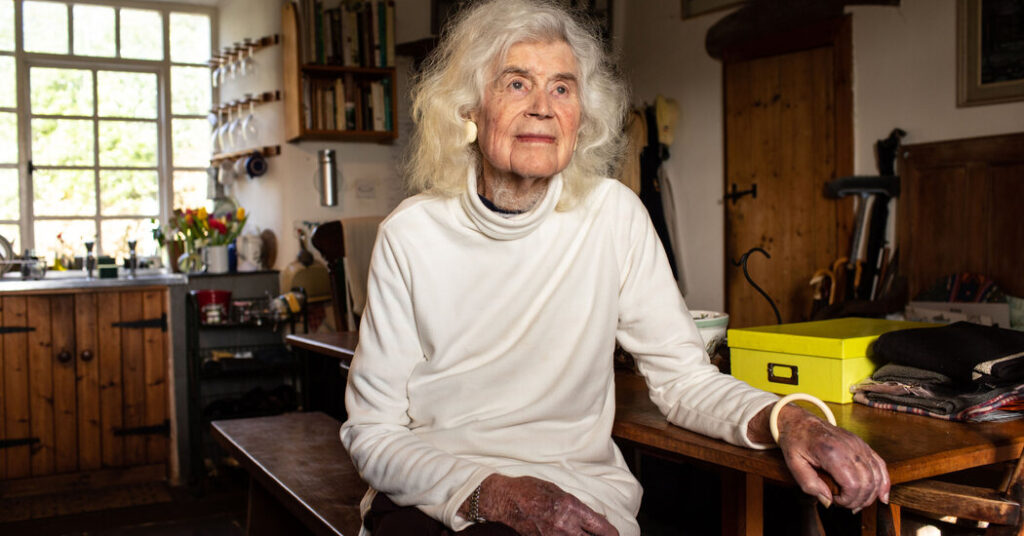
JAN MORRIS: A Life, by Sara Wheeler
Jan Morris’s memoir “Conundrum,” about her 10-year transition from man to woman, was a landmark book when it appeared in 1974. There’d been previous books about transitioning, but none so well written or so popular. Morris, a British journalist, historian and travel writer, almost single-handedly dragged the topic out of the closet — and out of the grubby “back of store” sections of book shops, as dear to some people as those outlaw sections were.
One of the most moving segments of Sara Wheeler’s new biography, “Jan Morris: A Life,” is when she pauses to review the contents of the landslide of grateful and inquisitive mail Morris received, from readers worldwide, in the book’s wake. The most upsetting part is when she notes that Morris, were she alive today, might be blocked from entering the United States because the information on her passport would not be in sync with the sex assigned on her birth certificate.
Not everyone loved “Conundrum” — not even some of the period’s essential literary feminists. “Jan Morris is perfectly awful at being a woman,” Nora Ephron wrote, reviewing the book in Rolling Stone. Ephron found Morris to be “so giddy and relentlessly cheerful that her book has almost no dignity at all.” To her, Morris sounded like “a girl, and worse, a 47-year-old girl.”
The book had its purple patches, for sure. It was breezy; it was lacking in specificity and gravity; it was self-absorbed, even for a memoir. Germaine Greer, whose second-wave feminist manifesto “The Female Eunuch” had been published four years earlier, noted some of these things. She wrote that she couldn’t help liking the author but that “Jan Morris is still to me a man who has eaten a great many pills.”
Morris’s reaction to these slights was to ignore them and move onto her next travel book. (She was always moving onto her next book: She wrote more than 50 of them.) To the dismay of some, she wasn’t a proselytizer. She didn’t want to wave a trans flag, lead support groups or make trans friends. Her transition was simply a fact of her life. “She didn’t even want to be a ‘trans woman,’” Wheeler writes. “She wanted to be a woman.”
Morris (1926-2020) was internationally famous before “Conundrum” redoubled that fame. As James Morris, he had accompanied Edmund Hillary and Tenzing Norgay on their 1953 expedition up Mount Everest, in the first confirmed ascent of the highest point on Earth. Untrained as a climber (and having never worn crampons nor handled an ice ax), he made it to 22,000 feet, a serious physical endurance test, especially then, when we knew less about the training required.
Morris was a 26-year-old correspondent for The Times of London. He got the scoop of a lifetime when, after making a hazardous descent to Base Camp in the dwindling light and writing in code to deceive competitors, he sent confirmation of the summiting to his editors. Two decades later, when news of his transition made the rounds, tabloids ran headlines like this one, which appeared in the Daily Mirror: “James of Everest is now a woman.”
Morris seemed to have been made for the spotlight. When young he was said by an acquaintance to be “rather better looking than any young man is entitled to be.” He had high cheekbones, a noble nose, straight teeth and a square jaw. He was likened to Lawrence of Arabia, and to dashing World War I-era poets such as Edmund Blunden and Siegfried Sassoon. He captured Britain’s imagination.
Morris was born in Clevedon, in southwest England, the youngest of three children. Her father, who had been gassed on the Western Front and never fully recovered, drove a cab and sometimes a hearse. His profession caused Morris lingering class agonies.
She served in the British Army during and after World War II, spending time in Italy and Palestine, before graduating from Oxford and becoming a star correspondent for The Times. She eventually left to begin writing books. Her breakout work was “Venice” (1960), an impressionistic and witty portrait of that city. She went on to write the well-regarded Pax Britannica trilogy, charting the rise and fall of the British Empire.
Wheeler’s biography is vivid, comprehensive, a bit fluky and very British. A room is “kippered with the smoke of the 1950s”; the former Prime Minister Harold Macmillan, on second reference, is “Supermac”; The Times is often referred to by its nickname, the Thunderer. The tone can be glib (“King Farouk, still an ass …”). Her garrulous interjections don’t always land. Yet being a bit fluky is better than being dull, which this biography is not.
Wheeler, who is a travel writer and biographer, captures Morris’s multiple and overlapping contradictions. “Is it possible to reconcile the larky persona with its flinty doppelgänger?” she asks. “How can a writer be superficial and profound at the same time? Why did she dress like a Walmart version of the Queen?”
Morris, in this accounting, was a terribly flawed human being. She was a narcissist and a snob who often found people too fat or too common. She could be cruel; she seemed to rarely take Elizabeth, her wife (they divorced during Morris’s transition but were together for more than 70 years), into account. She disliked being touched or hugged. She was pouty. She was a distant, at best, parent to the couple’s three children.
For those who loved her, she was rarely around. This biography is a study in literary intensity. Morris had, in Wheeler’s phrase, a “Stakhanovite work ethic.” At one point, early in her career, she published six books in four years. Her method was to pile assignment on assignment, to write stories up for The Times and other newspapers, then either rework or simply collect the material into book after book. Like Ishmael in “Moby-Dick,” she liked to get paid when she traveled.
Morris was often ill from the effects of the medications she took during her long transition. She estimated that, between 1954 and 1972, she swallowed 12,000 pills. “Few so ill have worked so hard,” Wheeler writes.
Some of her work could feel slapdash, but Morris had terrific instincts, and her books were filled with reverberant stretches of writing. Nearly all of them still feel alive. She wrote so intensely and often that it was like she was fleeing something. For shutting out personal torment, writing is a more powerful distraction than reading.
There is a good section here comparing Morris’s prose with that of writers including Joseph Mitchell, whom Morris knew — each sometimes didn’t let the facts get in the way of a good story — and New Journalists such as Tom Wolfe. Like Wolfe, Morris wrote a good deal for Rolling Stone, especially later in her career.
She grew flightier as she aged. She was given to comments such as (about a famous seaman), “I’m going to have an affair with him in the afterlife.”
Wheeler never quite gets to the bottom of Morris’s sex life, a topic Morris mostly avoided in print. “I have boxed the sexual compass,” she wrote, but it’s unclear what she meant by that. Her libidinous fantasies were vague, she once said, “concerned more with caress than copulation.” She apparently never cared much for penetrative sex and wrote, “I certainly did not feel myself to be homosexual.” Achieving orgasm was still possible after her surgery, she wrote, “because the erotic zones retained their sensitivity.”
I wish this biography suggested more of the hassles and anxieties that routinely accompany travel. Here, Morris just seems to appear in far-flung locales, arriving as if by magic carpet. I wanted more about the grain of getting there: missed flights, turbulence, insomnia, foolish risks, constipation, bribery, self-important authorities and terrible hotels with fuzzballs under the bed and strange hairs on the bathroom’s tile floor. Did Morris ever sink a quarter into a motel room’s Magic Fingers? How did she manage to lug her heavy typewriter everywhere?
At the close of this biography, Wheeler writes that “Do you like her?” is the question she is asked most often about Morris. “It’s not like that,” Wheeler says, cagily. “I am human. So was she.”
JAN MORRIS: A Life | By Sara Wheeler | Harper | 413 pp. | $37.50
Dwight Garner has been a book critic for The Times since 2008, and before that was an editor at the Book Review for a decade.
The post She Saw Herself as a Woman, Not a Trans Woman appeared first on New York Times.