While Pakistan has become the central mediator between the United States and Iran in negotiations to end the war, its leaders are scrambling to contain the fallout of the conflict at home.
On March 18, just days before Pakistan’s army chief, Field Marshal Asim Munir, emerged as the main interlocutor between the United States and Iran, he summoned Pakistan’s leading Shiite clerics for a meeting. News of the killing of Iran’s supreme leader, who is also a spiritual guide for many Shiites worldwide, had set off unrest in parts of Pakistan, and the meeting was widely seen as an attempt to prevent the violence from spreading further.
“Violence in Pakistan, on the basis of incidents occurring in another country, will not be tolerated,” the field marshal warned the clerics, according to the military’s media wing.
Some clerics who attended the meeting described it as tense, and said they felt their loyalty to Pakistan had been questioned. Others said his remarks — suggesting that those loyal to Iran should leave Pakistan — had been misinterpreted, and they gave the army chief credit for trying to restore order.
But while Pakistan’s diplomacy has won praise from President Trump and leaders across the region, the sense of grievance has only deepened among Pakistan’s estimated 35 million Shiites, a minority often targeted by militant violence.
The war in Iran has become a major domestic issue, second only to sky-high fuel prices and prolonged electricity outages, with officials worried that the conflict could reignite sectarian violence and tarnish Pakistan’s new image as a peacemaker.
Already, the war in Iran has raised tense questions of loyalty and identity for many Shiites, a minority group among Pakistan’s 250 million people. Some adhere to a doctrine, known as wilayat al-faqih, which grants Iran’s supreme leader transnational religious and political authority over Shiites.
“We are Pakistani,” said Syed Ali Owais, 30, a Shiite activist who attended a March 1 demonstration in which protesters stormed the U.S. Consulate in Karachi, Pakistan’s largest city, where 11 people were killed. “But when our religious leaders are attacked, silence is not an option,” he added. “And when we mourn, we receive bullets.” He said that a friend, Syed Adeel Zaidi, had been among the victims.
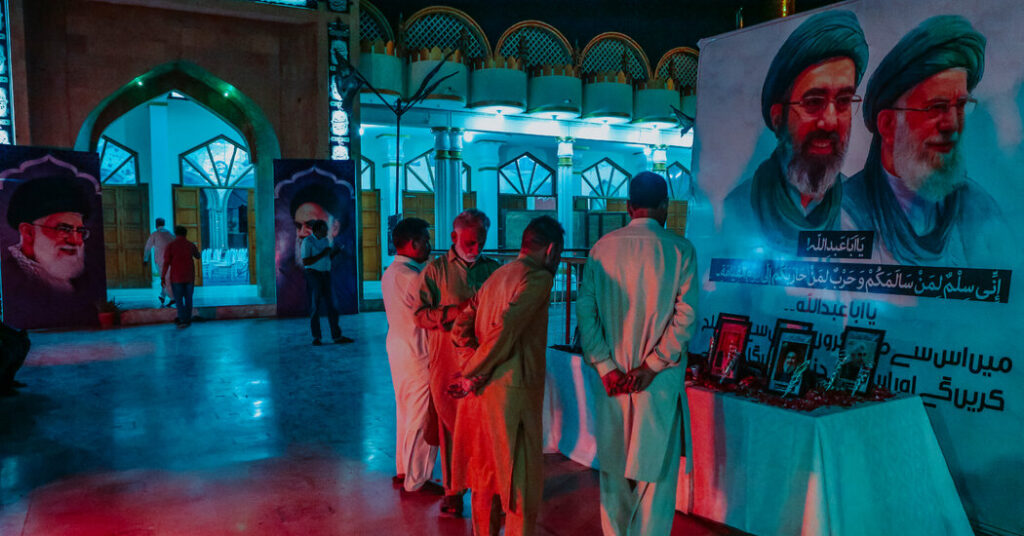
Across Shiite communities in Karachi and around the country, in rallies and private gatherings, clerics and activists have been mourning Ayatollah Ali Khamenei and pledging allegiance to Mojtaba Khamenei, his son and successor. Shiite clerics have increasingly framed the conflict in Iran as a religious war, drawing parallels to the seventh-century Battle of Karbala, a defining episode in Shiite history.
Syeda Fatima Batool grew up listening to Mr. Khamenei’s speeches, and his portrait was a constant presence — in her family’s home, along neighborhood streets and inside places of worship scattered across the city.
“He may have been the head of state in Iran,” said Ms. Batool, 25, a physician. “But I, like millions of other Shiite Muslims, chose him as my religious and moral guide.”
At a gathering in a mosque in a Shiite neighborhood of Karachi on April 1, clerics addressed a crowd waving Pakistani and Iranian flags, declaring their readiness to sacrifice their lives for Mr. Khamenei’s cause.
Speaking after Field Marshal Munir’s warning, the clerics appeared to choose their words carefully, condemning Israel and the United States but avoiding any mention of Pakistan’s role in the negotiations.
“Khamenei’s martyrdom has not weakened us; it has united us against global tyranny,” said Allama Baqar Zaidi, a cleric. The crowds greeted his remarks with chants of “Death to America” and “Death to Israel.”
The current Iran conflict is “reigniting faded anti-Americanism,” said Bilal Gilani, head of the research firm Gallup Pakistan. He noted that such sentiment had subsided after the U.S. withdrawal from Afghanistan in 2021. But after Ayatollah Khamenei’s killing, Shiite clerics in Gilgit-Baltistan, a popular tourist region in Pakistan, announced a ban on American visitors.
Many Pakistani Shiites have also been angered by the country’s recent diplomacy. Pakistan has joined Mr. Trump’s Board of Peace and deployed troops to Saudi Arabia under a joint defense agreement. On April 11, Pakistan’s capital hosted Vice President JD Vance and a delegation of Iranian negotiators trying to reach a cease-fire agreement. On Thursday, Mr. Trump floated the possibility of coming to Islamabad if a deal is reached, praising Pakistan’s leaders in a social media post as “fantastic people.”
“Trump’s praise is meaningless when most people at home reject the U.S. and its wars in Iran and elsewhere,” said Baqir Karbalai, 35, a Shiite and software engineer. He said that there was a clear disconnect between the government’s foreign policy and public sentiment.
And while the unrest that followed Ayatollah Khamenei’s killing has calmed, Pakistani officials said they feared that if the war is prolonged, Shiite groups in Pakistan might be reactivated, causing a resurgence of sectarian violence.
After the 1979 Iranian Revolution, Iranian outreach to Pakistan’s Shiites alarmed Gulf rivals, fueling an Iran-Saudi proxy conflict that drove sectarian militancy across Pakistan in the 1990s.
Alex Vatanka, a senior fellow at the Middle East Institute in Washington, said that unlike its approach in Lebanon or Iraq, Iran “prioritizes stable bilateral ties with Pakistan, carefully avoiding actions that appear as overt sectarian interference.”
In 2024, Pakistan banned the Zainebiyoun Brigade, a Shiite group believed to be backed by Iran. The group was accused of recruiting Pakistani Shiites to join the forces of Bashar al-Assad, Syria’s ousted ruler, to protect holy shrines in Syria and carry out attacks on rival Sunni clerics inside Pakistan.
Many Shiites view Iran as a protector against violence by Sunni militant groups. The Islamic State killed at least 33 Shiites in two attacks this year.
Although Pakistan has so far contained further violence by Shiite groups, a Karachi-based counterterrorism official who spoke on condition of anonymity because he was not authorized to speak to the media warned that prolonged turmoil, particularly strikes on top clerics and holy sites in Iran, could drive Shiite youth toward militancy. These individuals might target American interests in Pakistan or join conflicts abroad in defense of Iran, which they see as the sole Shiite holy state, the official said.
Across Shiite neighborhoods in Karachi, portraits of Mojtaba Khamenei now hang alongside those of his father and other leaders, signaling what many followers see as continuity rather than rupture.
For Ms. Batool and others who adhere to wilayat al-faqih, his ascent represents a spiritual succession, not merely a political one — he provides a form of guidance they believe will endure until the return of the Mahdi, the messianic figure in Shiite belief expected to establish global justice.
“You cannot measure this in borders or governments,” Ms. Batool said. “For us, it is a faith that continues, no matter what changes around it.”
The post Pakistan’s Leaders Try to Contain Rising Anger Over Iran War at Home appeared first on New York Times.