The tulips were in full bloom last week at Longwood Gardens in the Brandywine Valley of Pennsylvania as unusually warm temperatures had April feeling more like June or July.
Roger Davis, a landscape manager at the garden, a 1,000-acre lot just outside Philadelphia, said the heat made the flowers bloom earlier than they would have otherwise, and it also shortened their bloom period from about two weeks to one. The area near Longwood reached 87 degrees on Thursday, when 67 is more typical for this time of year.
This week, Longwood’s flowers are facing a much different landscape. Temperatures are expected to reach barely above 50 degrees on Monday and as low as 30 degrees overnight.
Despite the chill, Mr. Davis said, the spring plantings the garden has planned for Monday — snapdragons, pansies and African daisies — will go as usual. By Tuesday morning he expected the gardeners to be looking closely for signs of frost.
People like to call this pendulum swing from hot to cold “weather whiplash.” At cafes, baristas know it as a shift from hot coffee to iced coffee — or back again.
At Copper Mug Coffee’s packed outdoor patio in Williamsburg, Brooklyn, on Wednesday, people were drinking cold brew in the heat, said Amir Saltanat, the owner. That day, Central Park, the site of the official weather station for the city, hit 90 degrees, the hottest temperature for April 15 since records began in 1869.
“We had almost double sales of cold brew compared to two months ago,” Mr. Saltanat said.
On Monday, with a low in the 30s and the high only reaching the mid-50s, he said, he expects to sell a few more hot lattes, the cafe’s No. 1 drink in cold weather.
Temperatures are largely controlled by large blobs of air, stretching for hundreds to thousands of miles. Temperatures are mostly uniform within each blob, but when one moves into another one’s territory, the highs and lows on the ground can swing wildly.
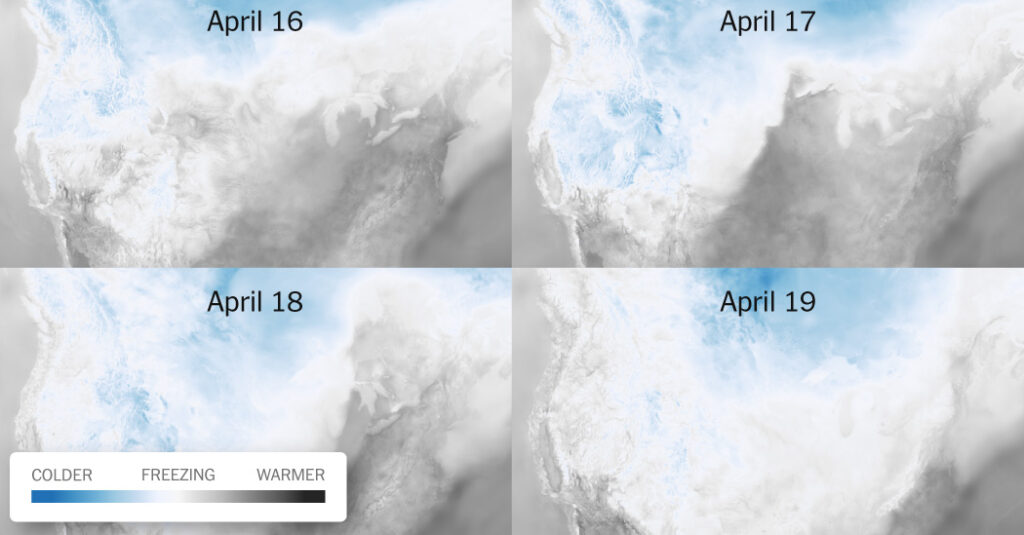
In this case, a warm air mass that caused last week’s heat has been replaced by a cold one moving down from Canada, said Scott Kleebauer, a meteorologist with the Weather Prediction Center.
The cool air pushed into the East Coast behind a cold front that had swept the Eastern Seaboard on Sunday, prompting freeze watches from Iowa through Pennsylvania. The chill was spreading east on Monday, pushing temperatures down to 25 to 35 degrees below where they had been in the middle of last week.
This isn’t even the first such moment this year. In mid-March, some places along the Mid-Atlantic went from highs in the 80s one day to actual snowfalls the next.
Temperature fluctuations are typical as winter transitions into spring, though James Tomasini, a meteorologist with the National Weather Service in Upton, N.Y., said this one had felt particularly extreme. Temperatures went from above normal, even record-breaking, to below normal in less than a week.
Mr. Tomasini said the New York City area wasn’t expected to reach any record-breaking lows, but it would come close.
On Monday, the coldest temperatures are forecast from western New York into New England, with afternoon highs in the 40s. Across the Mid-Atlantic, daytime highs are expected to be in the 50s.
The coldest weather this week is expected overnight Monday into Tuesday, and there is a chance for frost and freeze conditions across much of the Northeast and Mid-Atlantic.
A return to mild weather is expected to begin on Wednesday, with temperatures slowly rising to normal across much of the region through the week. By the end of the workweek, temperatures are expected to be in the 60s in New York City and the 70s in Washington.
At Longwood Garden, temperatures are likely to climb back into the 70s, and the spring annuals that are fresh in the ground will enjoy the more normal temperatures. Mr. Davis said these plants could tolerate the temperature ebbs and flows.
“To be honest, the garden is tough,” he said. “The plants are adaptable.”
Amy Graff is a Times reporter covering weather, wildfires and earthquakes.
The post Northeast Swings From 90 Degrees to Freezing Cold in Just a Few Days appeared first on New York Times.