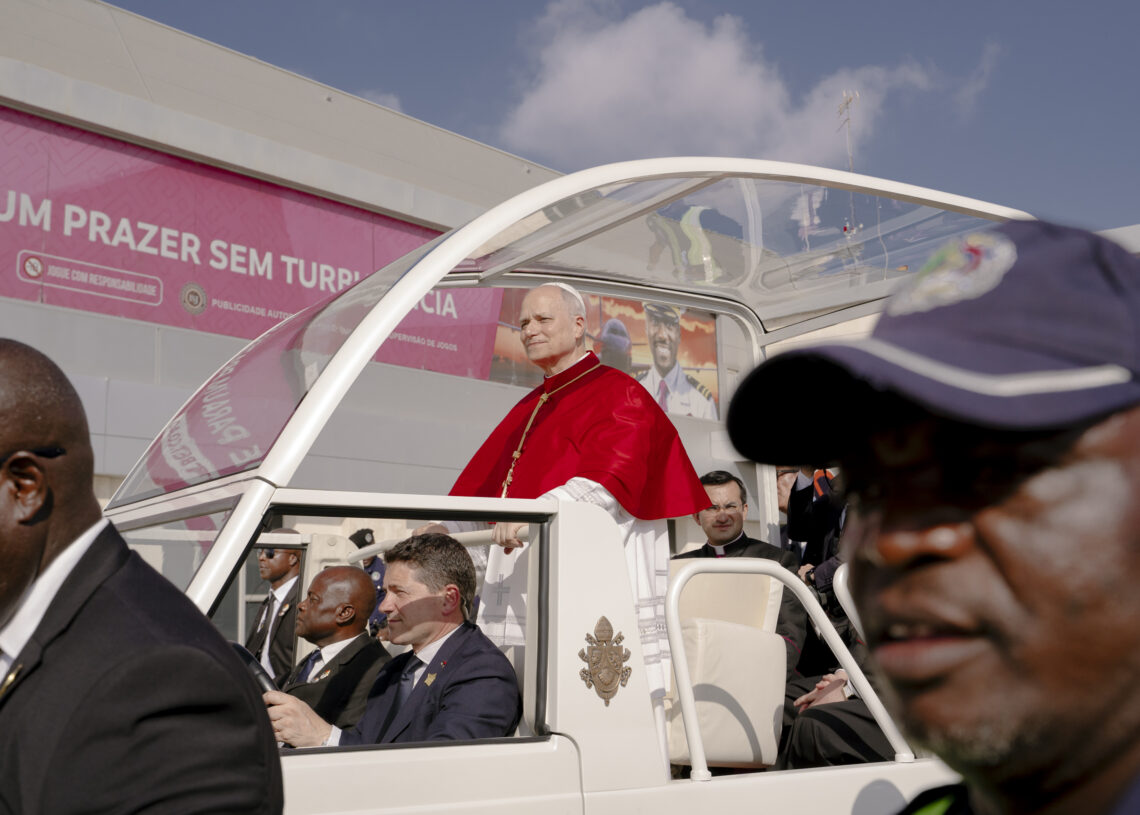
LUANDA, Angola — Josephine García and her friends had been standing under a sweltering sun for hours, dancing in the airport parking lot as they waited for a glimpse of Pope Leo XIV. The first American-born Pope, García said with a smile, was their “father in faith,” a man who stood for “peace and unity — in Angola and everywhere.”
Asked her impression of that other most influential American — President Donald Trump — her smile disappeared. She gave an impassioned shake of her head.
“We say that he is crazy,” she said. “That he is sick. We say that he should stop this war.”
Across the world, public opinion of the United States has plummeted since Trump and Israeli Prime Minister Benjamin Netanyahu decided to launch a war against Iran, according to experts, local reporting and available public surveys.
In seven countries surveyed by the research organization GeoPoll, including Nigeria, South Africa, Egypt and Kenya, 43 percent of respondents said they view the U.S. less favorably because of the Iran war. (Within the U.S., about 60 percent of Americans disapprove of Trump’s handling of the war, according to Pew Research Center.)
Meanwhile, love for Leo, whom Trump has criticized sharply in recent days, seems to be overflowing as he undertakes a 10-day trip to four countries in Africa, where the Catholic Church is experiencing its fastest growth.
In Angola, a nation of about 40 million in southern Africa where the oldest Catholic church on the continent is located, thousands of Catholics gathered outside the airport to greet Leo, who waved from the open-air back seat of his Electric G4 Mercedes popemobile.
“We are so proud of him — he is a pope that stood up and had the courage to say ‘no’ to Trump,” said Inácio Kahamba, a priest who was among those watching. “He is saying that peace will reign.”
Leo has spoken out in recent weeks against war in the Middle East and against those who invoke God in the name of war — as Trump administration officials have repeatedly done.
Trump dramatically escalated tensions last Sunday when he posted an online screed calling Leo “WEAK on crime” and “terrible for Foreign Policy.” Vice President JD Vance followed up with his own broadside, saying the pope should be “very careful” when he talks about theology.
Speaking on the plane to Algeria, where he followed in the footsteps of his icon, Saint Augustine of Hippo, during the first stop on his Africa tour, Leo responded that he had “no fear of the Trump administration, or speaking out loudly of the message of the Gospel.”
During a speech in Cameroon on Thursday, Leo did not directly name Trump but condemned what he described as a “handful of tyrants” who are ravaging the world and “masters of war” who do not understand the impact of their actions.
Speaking to journalists on the plane to Angola from Cameroon, Leo said that his comments had been misinterpreted as a rejoinder to Trump when, in fact, they had been written before the president’s critique of him, according to Agence France-Presse. The remarks, he said, were “perceived as if I were trying to start a new debate with the president, which doesn’t interest me at all.”
During a meeting Saturday afternoon with officials in Angola — an oil-rich southern African country that until 1975 was a Portuguese colony — Leo took aim at “despots” who exploit Africa’s natural resources, and he called on Angolans to work for a society free from the “slavery imposed by the elite who are laden with much wealth but false joys.”
“All too often people have looked — and continue to look — to your lands … in order to take,” the pope said during remarks to Angolan President João Lourenço and other top officials. “How much suffering, how many deaths, how many social and environmental disasters are brought about by this logic of extractivism?”
Kahamba, the priest, said that he did not see Leo as an American but more as a global “symbol of unity and reconciliation.”
But he added that it would not hurt if Leo “advised his American brothers to pursue a path of peace.”
Many in Angola — which emerged as an increasingly important U.S. ally in Africa during the Biden administration — had hoped when Trump was elected that he could deliver on his initial promises to be a president of peace, Bishop Maurício Camuto said in an interview.
However, Camuto, the bishop of the city of Caxito in Bengo province, said it did not take long to realize that Trump cared only about his own interests. Trump’s decision to go to war in Iran, Camuto said, served as a turning point for many in Angola.
“The Angolan people come from long years of suffering because of war,” he said, referring to the country’s civil war, which lasted from 1975 until 2002. “Seeing the suffering of people in Iran brings us back to our own suffering. Anyone who brings such suffering is not a person of goodwill.”
Oscar Constantino, who works for the country’s Catholic radio, said that he had wanted to believe Trump when he declared during his 2024 presidential campaign that he would end Russia’s war in Ukraine within 24 hours.
“But he hasn’t delivered on his promises,” Constantino said. “He has started more wars than he has solved.”
Standing outside one of the biggest Catholic churches in Luanda, Rovandro Dos Santos, 16, said that he already wasn’t the biggest fan of Trump when he saw the president’s social media posts about Leo. That was the final straw, Dos Santos said.
“I was shocked,” he said. “I thought, ‘Is Trump going insane?’”
The attacks on Leo, Dos Santos said, “don’t make any sense.” He added that he was proud of the pope for “not bending” and for continuing to spread a message of peace.
Dancing in the airport parking lot, García said she was such a big fan of the pope that she decided to spend her 47th birthday here, waiting to spot him. Trump, on the other hand, she said she had never cared for much.
But she said it was only since the start of the war that her opinion of him had plummeted. Around García, her friends nodded, listing off the foods that had become more expensive because of the conflict, including rice and vegetables. In Angola, where poverty is rampant despite the country’s vast wealth in oil and diamonds, life was hard before, they said. But war has made it even worse.
On top of that, García said, it reminded everyone of their own civil war.
“We are sick because of that situation,” she said. “Because we understand it.”
One of her friends interjected that there was still hope, that she was praying for Trump. García nodded her head.
“We hope that he can change,” García said. “He is really a terrorist … but we hope that God can make his heart lighter.”
Herculano Coroado contributed to this report.
The post In Angola, love for an American pope but not for an American president appeared first on Washington Post.