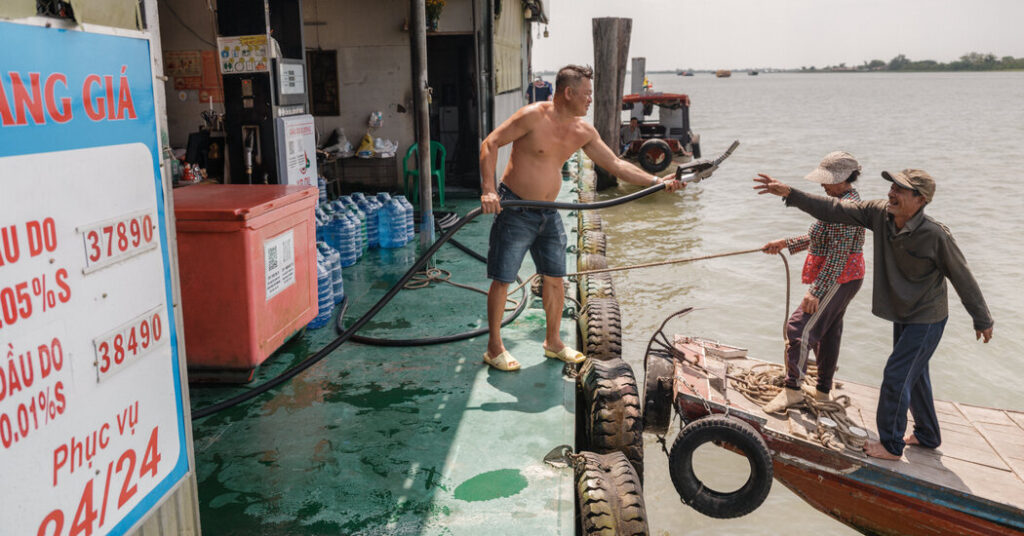
When the war in Iran started on Feb. 28, Asia expected to see serious, gradual impacts from losing access to a huge portion of the world’s oil and gas. But the conflict’s economic and social impacts have hit the region harder and faster than officials and experts expected.
Many countries across the Asia-Pacific are experiencing sudden jolts of disruption that they are struggling to manage, with some comparing the crisis’s breakdowns and scope to the Covid pandemic.
Even if there is a peace deal soon, the future of this industrious region that has driven global economic growth for decades will likely include months of canceled flights, surging food prices, factory pauses, delayed shipments and empty shelves for products long considered quick and easy to buy worldwide: plastic bags, instant noodles, vaccines, syringes, lipstick, microchips and sportswear.
Collectively, according to many officials and experts, if the war’s strangling of commercial traffic through the Middle East lasts for even a few more weeks, and uncertainty lingers, shortages could push several countries into convulsions of unrest, followed by recession.
Countless businesses are verging on insolvency. Governments are taking on enormous debt to slow inflation. By year’s end, in the most dire projections by the United Nations and others, millions across Asia could be pushed into poverty.
“The impacts are so rapid and deep,” said Phillip Cornell, a senior fellow at the Atlantic Council’s Global Energy Center who is based in Sri Lanka. “Just from a magnitude perspective, this is really very, very, very large.”
Resource scarcity tends to unleash dark forces in human psychology and capitalism. As the International Monetary Fund has noted, the world economy is slowing nearly everywhere because roughly a fifth of the world’s fossil fuels have been held back from the global market since the war started. Even if the Strait of Hormuz stabilizes tomorrow, it could take years for oil and gas output and shipping to reach fat prewar levels.
The Asia-Pacific has been the war’s first and worst zone of impact outside the Middle East because:
1) the Asia-Pacific relies more heavily on Middle Eastern energy imports than almost anywhere else in the world;
2) the massive regional economy is deeply integrated, with supply chains crisscrossing borders in ways that are heavily reliant on fossil fuels;
3) even before the war started in February, Asia’s energy capacity was falling short of demand. The backlog for energy generation turbines now affecting global data-center growth started with surging power demands from Southeast Asia’s industrial hubs.
Wealthier countries, including China, face less immediate risk, with bigger fuel reserves and budgets. But comfort is neither permanent nor widespread. The rest of Asia, excluding China, is responsible for as much of the global economy as the United States or Europe. And many countries in that group have been struggling more than is publicly known.
In interviews, farmers in Vietnam, laborers in India, innkeepers in Sri Lanka, drivers in the Philippines, and executives in Hong Kong and Singapore all sounded more worried than many of the region’s politicians, who are seeking to project a stoic calm that often understates the scramble occurring offscreen.
Transportation, manufacturing and upward mobility — three pillars of stability in Asia — are all confronting powerful shock waves.
A Sprawling Transportation Crisis
The United States and Israel started the war in Iran on Feb. 28. Within hours, trucks, ships and planes stopped operating in Asia, a region defined by near-constant motion across land, sky and sea.
Air travel, the strongest example of Asia’s transportation reversal, veered toward chaos.
In March, there were more than 92,000 flights canceled worldwide, doubling the prewar rate of cancellation, with the largest spike in eliminated flights linked to the Asia-Pacific.
Carriers flying through the Middle East, where 24 million migrant workers from South and Southeast Asia are employed, suspended trips to Dubai and other Gulf hubs right away. With jet fuel nearly doubling in price and with its availability threatened, airlines are slashing many more routes indefinitely.
Qantas, Air New Zealand, Lion Air of Indonesia, VietJet, AirAsia, Air India and Cathay Pacific are just a few of the companies cutting service. Batik Air of Malaysia has gone further than most, cutting flights by 35 percent this month to avoid insolvency.
Shukor Yusof from Endau Analytics, an airline advisory firm in Singapore, estimates that air traffic for Asia and the Pacific has already dropped by a third. Smaller airlines are losing millions of dollars weekly. Larger, better capitalized airlines in the region may survive, but discount players that buy more fuel on spot markets will likely shrivel, merge or die.
“Even if the cease-fire holds, because of the chokehold that’s been triggered by the closure of the Strait of Hormuz, the flow of fuel is going to just be a trickle,” Mr. Yusof said.
“It’s massive in the scale of things, unprecedented in the industry,” he added. “Even with Covid, we weren’t gripped to our seats like we are now.”
Airports and airlines are not the only victims. Remote areas, from outback towns in Australia to the craggy foothills of the Himalayas, are slipping further into isolation. Travel agencies, hotels and restaurants are also grappling with a sudden collapse in business.
“Airline prices have tripled,” said Samath Gammampila, 39, director of Unu Boutique Hotel in Sri Lanka’s southern beach town of Ahangama. “We’re seeing about an 80 to 90 percent drop in occupancy.”
Interviews and official forecasts suggest the rest of the year could be as bad or worse in many countries.
Halted Production
Many of Asia’s most successful export industries require enormous amounts of energy and other ingredients from the Middle East. Seven weeks in, stockpiles are running out.
Cutbacks in manufacturing are now multiplying, revealing vulnerabilities rarely considered.
Copper and nickel production, for example, rely on high heat from natural gas and also sulfur, a fossil fuel byproduct. Both are in short supply, forcing several Indonesian nickel processors to reduce output by at least 10 percent.
Polyester and nylon are also derived from petroleum. In the sewing hubs of Bangladesh, Gazipur and Ashulia, where clothes are made for Wal-Mart, Zara and Uniqlo, severe disruptions to production and shipment schedules are common and on track to worsen.
“The strain we are under now — managing it will become very tough if there is no continuity in gas or fuel supply,” said Abdullah Hil Nakib, deputy managing director of TEAM, a Bangladeshi garment factory group. “We are seeing that the prices of our raw materials are also rising. Today the price of thread has almost doubled.”
Move on to higher-end manufacturing, and to helium, a gas byproduct used for semiconductors, and stress levels increase. Qatar, which normally produces nearly one third of the world’s supply, had to halt production on March 2 after an attack on its gas plants by Iran.
Prices have soared, and some Asian chipmakers are slowing production and reconsidering sources of supply.
Taiwan Semiconductor Manufacturing Company, the world’s largest producer of high-end chips, had previously accepted helium from Qatar and the United States. On Thursday, the company said on an earnings call that it had enough on hand to avoid a near-term impact.
But a prolonged shortage could force the company and other chip makers to accept supply from other locations, like Russia, the world’s third-largest producer of helium. Or it could force production cuts that would roll through everything from electronics to cars.
One bottleneck begets another; that’s the pattern. Without enough petrochemicals to make plastic packaging, fewer Korean beauty products are heading to stores. A lack of fertilizer is threatening rice crops in Vietnam. Cattle farmers in steak-crazy Australia are even warning of a red meat shortage because of idled slaughterhouses and truckers.
Human Suffering
Before the war, the United Nations projected that most of the next decade’s growth in middle-class consumers would be found in Asia.
Last week, a new U.N. report estimated that 8.8 million people in Asia and the Pacific are at risk of falling into poverty because of the war, depending on how long hostilities last. Most of those, about five million, would be in Iran. But in a region where most employment is informal, without a robust safety net, the conflict’s effects are starting to compound.
In an interview, Kanni Wignaraja, a U.N. assistant secretary‑general and U.N.D.P. regional director for Asia and the Pacific, said “the scale and the speed of transmission to Asia and the Pacific has been much bigger than initially anticipated.”
Poverty’s spread, she noted, threatens to be fused with other problems: vital medicines and vaccines failing to reach vulnerable populations; schools and universities unable to gather students; and increased pollution from the return to coal burning for electricity.
In India, where entire industrial clusters have been shut down for weeks by fuel shortages, workers are reversing urbanization, melting back to rural villages to thresh wheat. The cost of acetaminophen and some antibiotics in India has already gone up.
In Manila, Wednesday is considered a special day of Catholic devotion that usually attracts a throng of devotees and shoppers in the Philippine capital’s Baclaran district. After attending church, many scout for bargains at the nearby flea market.
But the district, far quieter since the war started, seemed closer to paralysis this week. Jeepney or minibus drivers gathered in groups, away from the wheel, for a three-day work strike to protest runaway gas and diesel prices.
Yunos Lilingco, 42, a widow and mother of three, said she initially believed the U.S.-Iran war wouldn’t affect her. She sells clothes she gets from a factory. The war seemed a world away.
But when gas prices went up, her costs rose, too. Her customer base has nearly disappeared. She used to make nearly $40 a day, now she makes less than $10.
“People don’t move around too much nowadays, because of high gas prices,” she said. “So there are fewer people to sell my clothes to.”
The U.N.’s report predicted that the war would cost Asia and the Pacific between $97 billion and $299 billion, equivalent to between 0.3 and 0.8 percent of regional gross domestic product.
At street level, suffering often starts with higher food prices and reduced employment.
“You’re losing income, and at the same time you’re paying more,” said Ms. Wignaraja, the U.N. official.
In the northern region of the Philippines, which supplies most of the country’s highland vegetables, like cabbage and broccoli, scarcity is killing abundance. Crops ready to be harvested last week are rotting in fertile fields, with farmers unable to afford the costs of transporting them to market.
The war’s damage, so quick and deep across the Asia-Pacific, will not be easy to contain. Even if the United States and Iran reach a lasting peace, the forces of scarcity and inflation have gained momentum and are on the move.
“You’ve seen tsunamis — they go across the ocean very, very fast,” said Mr. Cornell from the Atlantic Council. “I find it breathtaking to see the degree to which American policymakers think that they are insulated.”
Reporting was contributed by Jason Gutierrez from Manila; Hari Kumar, Pragati K.B. and Alex Travelli from New Delhi; Saif Hasnat from Dhaka, Bangladesh; Pamodi Waravita from Ahangama, Sri Lanka; Meaghan Tobin from Taipei, Taiwan; and River Akira Davis from Tokyo.
Damien Cave leads The Times’s new bureau in Ho Chi Minh City, Vietnam, covering shifts in power across Asia and the wider world.
The post The Forces of Scarcity Hitting Asia May Soon Spread Across the World appeared first on New York Times.