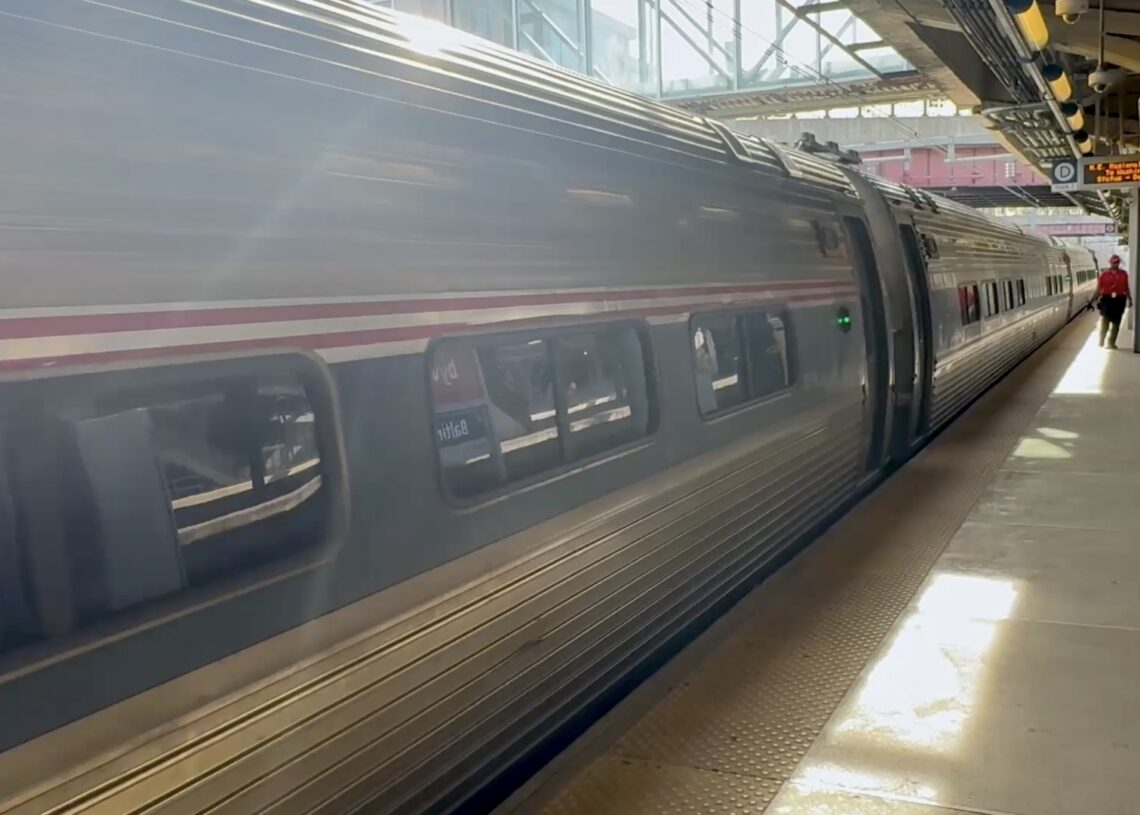
The first 10 hours flew by.
When I boarded Amtrak’s Cardinal train in D.C. on a sunny Wednesday morning, I said farewell to the fresh air and freedom of movement as if I were the fifth Artemis astronaut. That evening, I emerged from the coach compartment in Charleston, West Virginia, my final destination. Standing beneath a dome of pale stars, I watched the train vanish into the night, marveling at the magic of rail travel.
A day later, on the return trip, my budding romance with the train would be put to the test. Could it — and more importantly, could I — survive another 10 hours?
Cost and convenience often steer our travel plans. However, during tumultuous times, travelers may have to prioritize one over the other, paying more for a straightforward journey or less for a circuitous route.
When I started researching my trip to Charleston, TSA security lines were absurdly long because of the partial government shutdown and fuel prices were beginning to creep up because of the war in Iran. I considered my choices. Drive at least six hours one way, not including pit stops to fill the tank with $4-per-gallon gas. Fly 90 minutes each way for about $800 round trip. Or, the eventual winner, ride Amtrak roughly 10 hours in each direction for the comparatively low price of $162.
“Depending on the length of the trip and the circumstances, sometimes the train is a much better option,” said Jim Mathews, president and CEO of the Rail Passengers Association, a nonprofit representing rail travelers. (Amtrak defines long-distance train travel as journeys that exceed 750 miles.)
Mathews said he recently grappled with a similar dilemma for a trip from Syracuse, New York, to Toledo. A round-trip flight plus a shuttle or rental car transfer from Detroit would have cost $1,100. Instead, he took an eight-hour overnight train for less than $500. He woke up in Toledo.
“If I’m going to spend hours standing in an airport line,” he said, “maybe I will take the train.”
Though I didn’t want to squander my time in an airport, I wasn’t entirely sure an all-day train trip was the savviest move, either. As the Cardinal rolled west and then east, I weighed the pros and cons. After 20-odd hours, I’d have my answer.
Load up on liquids and bags
Amtrak is more charitable than the airlines, allowing travelers to provision their long-distance trips like preppers.
For all trains, regardless of distance, passengers can bring one personal item, two carry-ons weighing up to 50 pounds and two free checked bags. Unlike the carriers, Amtrak has not raised its fee — $20 per additional checked bag beyond the allotted two — to counter rising fuel expenses. It also doesn’t restrict liquids to thimble-size containers.
At Union Station, I jauntily strolled to the waiting area with my two carry-on bags, travel mug sloshing with coffee and full 40-ounce Hydro Flask. My standard-size tube of toothpaste was venturing outside my bathroom for the first time in years.
The boarding gate closed two minutes before departure, so as long as I didn’t run into any obstacles between the Metro station and the track, I could safely show up minutes — not hours — in advance.
Takeaway: Civility is still alive, with no limits on liquids, a generous bag policy and a swift boarding process.
WiFi works till it doesn’t
Amtrak WiFi is notoriously bad. Combine that with spotty cellphone service and you might as well set up an OOO message on your work email.
Surprisingly, on the westbound trip, I had a consistently strong connection for most of Virginia and a large swath of West Virginia. On the journey home, I was forced to digitally detox.
I tried to spin the circumstances as an opportunity to read. However, I was so distracted by the lack of service, I’d skim a few sentences then put my book down to check for phone bars or a WiFi icon. This seriously went on for hours.
Takeaway: If you need to do work, communicate with the outside world, track the train’s progress or look up, say, the name of the tree with the tiny clusters of pink flowers, there’s a strong chance you can’t.
Entertainment outside your window
So afraid of boredom, I brought a capsule library of books, magazines and downloaded podcasts. With the exception of the memoir I skimmed while on WiFi Watch, I didn’t crack open any of my materials.
Instead, I chatted with my seatmates — we were, after all, a trapped audience — or watched the Americana slideshow flicker by. The Blue Ridge Mountains and New River, click. Vineyards and weathered barns, click. Gamboling goats and frolicking children, click.
At least once a week, a National Park Service volunteer will hitch a ride on the Cardinal and narrate the nearly 60-mile stretch through the New River Gorge National Park and Preserve in West Virginia, part of the Trails & Rails partnership between the agency and Amtrak.
Trena Riffle, dressed in signature forest green, strolled down the aisle, handing out a pamphlet of key attractions and a brochure for the newest national park, which earned its designation in 2020. For nearly 60 miles, she regaled us with historical tidbits interlaced with wildlife-viewing tips (look for bald eagles), pop culture sightings (to your left is Alderson Federal Prison Camp, where Martha Stewart briefly resided) and personal stories (according to her father, foraging for ramps was a valid reason for skipping school). Speaking over the intercom, she told us she had a hard stop at 8 p.m. or nightfall, whichever came first. The hour did.
Takeaway: You can live-stream nature and small-town America programs outside your window, no WiFi required.
Small steps and fresh-air breaks
With the spacious seats and ability to roam free, I never lost feeling in my legs.
In my seat, I could roll my ankles, seesaw my feet and march in place without kicking the passenger’s seat back. Teresa, my ad hoc companion on the return trip, had enough space to set up a purple footstool and pillows for back support. For a full-body stretch, I could extend the footrest and recline the seat to a 40-degree angle.
Logging actual steps took a bit more effort. As a coach passenger, I could walk through both economy cars and the cafe car but could not proceed past the food and beverage counter. The area beyond was reserved for first-class roomette and bedroom passengers.
The crew also announced stops where we could hop out for a few minutes to smoke or breathe in the fresh air. Teresa and I tried to exit at White Sulphur Springs in West Virginia but were blocked by boarding passengers. In Staunton, Virginia, I covered the length of the station, from a restaurant where diners sipped white wine at outdoor tables to a patch of daffodils growing out of the brick sidewalk. I didn’t stray too far, the conductor’s warning buzzing in my ear, “The train will leave without you and the next one is the same time on Sunday.”
Takeaway: You can stay semi-active with low-impact exercises, but you won’t get your daily steps in.
Staff mood swings
For my leg of the journey, the staff lavished attention on us as if we were guests on the Orient Express. (The Cardinal runs from New York City to Chicago.)
At Union Station, a cabin attendant escorted me to a row with a person already installed in the window seat. In a conspiratorial whisper, she told me that as soon as seating opened up, I could switch.
Swiveling her head toward a couple across the aisle, she said, “They’re getting off in Charlottesville, so you can slide over here.”
She called us “my dear” and kept the quarters tidy, collecting our garbage and vacuuming. A few rows behind me, I heard her relay the cafe car menu to a passenger, down to the candy choices. When other staff members passed through, they’d smile or exchange pleasantries.
On the Friday return trip, I recognized many of the same employees from the outbound journey. Their demeanor, however, had changed. Instead of niceties, they snapped at us like parents eager for their kids to get out of their hair. I was no longer worthy of a term of endearment. I was a troublemaker who they chided for standing in the wrong spot.
“Not over there, over here,” an employee tersely instructed as we queued up to disembark for a short stop in Charlottesville. Another staff member shouted at us for walking in the parking lot, steps from the track. Unbeknownst to us, we were not supposed to wander past the locomotive.
Back on board, I asked for clarification about an upcoming cafe car closure. I received an exasperated reply as if I had been whining, “Are we almost there?”
Takeaway: The outbound staff seemed genuinely delighted to have us on board. On the return trip, they couldn’t wait for us to get off.
Dealing with delays
Before my trip, Mathews, the president of the rail passenger association, told me the Cardinal is punctual 53 percent of the time. Delays, he said, average 71 minutes.
I prepared for a delay, throwing in extra food and another magazine. I hardly noticed the 44-minute late arrival in Charleston because I was so relaxed. I was less tolerant on the return.
According to my jottings, at 12:50 p.m., I noted, “Still no WiFi.” Three minutes later, I wrote, “Getting antsy.” At 1:15: “WiFi still sucks. Ready to get off this train.”
The Cardinal pulled into Union Station about an hour behind schedule. I was so grateful to be free of the train, I couldn’t bear to sit down again. I skipped the Metro and walked home.
Takeaway: Because Amtrak shares the tracks with freight trains, delays are inevitable, especially on long-distance routes. Mentally prepare yourself.
The verdict
Despite my grumblings toward the end, I really did enjoy my long-distance train adventure.
First and foremost, Amtrak safely delivered me to my destinations for a modest sum of money. The train was comfortable and relaxing. In part because of the squirrelly WiFi, I could indulge in such simple pastimes as chitchatting with strangers, gazing at the passing landscapes and sitting still for a guided talk.
If you aren’t in a rush, the train is a commendable alternative, especially if you travel by day so you can soak up the scenery and hop out at the stations. If you have to work, use a mobile hotspot, though if phone service is spotty, you still may not have a connection.
Personally, I would prefer a hybrid model, taking the train there and flying back. This way, I could preserve the novelty of the experience and ensure that my train romance never lost its spark.
The post I spent 21 hours traveling by train to avoid flights. Was it worth it? appeared first on Washington Post.