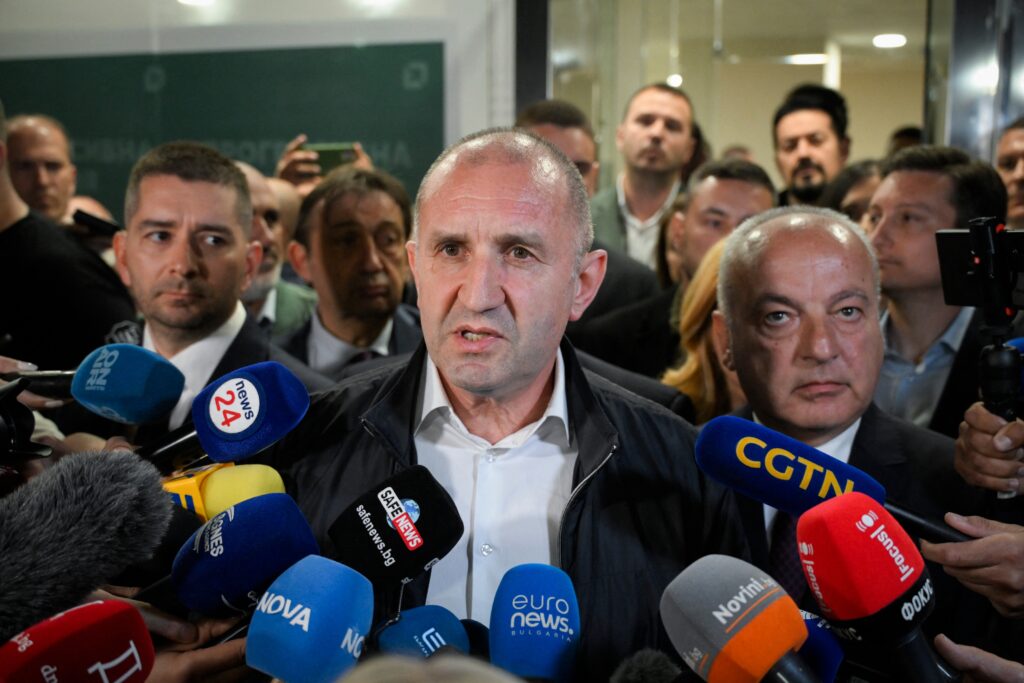
Russia looked set to regain a degree of leverage inside the European Union after Bulgaria’s Kremlin-friendly former president Rumen Radev won a resounding majority in an election that will allow his party to unilaterally form a government.
The outcome signaled an end to nearly two decades of political deadlock and rule-by-coalition in Bulgaria, an E.U. and NATO member. The Kremlin said it was “impressed” by Radev and the result, which came just one week after the landslide electoral defeat of Hungarian Prime Minister Viktor Orban, until then Moscow’s most important ally in Europe.
“It is still too early to conclude that the ‘pan-European climate’ toward Russia will change,” Kremlin spokesman Dmitry Peskov said on Monday. But he portrayed Radev’s statements as potentially guiding other European politicians toward a more “pragmatic dialogue with the Russian Federation,” despite the E.U.’s strong support for Ukraine.
Radev, a former fighter pilot who until January served as the country’s largely ceremonial president, positioned himself as the populist standard-bearer for anti-corruption protests that brought down the government in December and led to Bulgaria’s eighth national election in five years. But he also questioned Bulgaria’s entry into the euro zone in January, which led to price rises, and made clear he would take a more pro-Russian stance, consistently opposing aid to Ukraine and saying he wanted to restore relations with Moscow.
Following his victory, in a sign of future potential tension with the E.U., Radev said “a strong Bulgaria and a strong Europe need critical thinking and pragmatism,” and he called for a new security architecture in Europe, echoing a key Kremlin drive.
“Europe has fallen victim to its own ambition to be a moral leader in a world with new rules,” he told reporters.
With more than 91 percent of the vote counted Monday, Radev’s newly formed Progressive Bulgaria party had secured a majority of at least 135 seats in the 240-seat parliament. The pro-Western liberal Continue the Change Coalition, or PP-DB, had 15 percent of the vote, and the GERB party of Bulgaria’s long-standing former prime minister Boyko Borisov, had just 13 per cent.
Bulgaria’s economy is heavily dependent on E.U. funding. Analysts said that made it unlikely that Radev would act as stridently as Hungary’s Orban, who leveraged his country’s veto power to block major E.U. initiatives such as a proposed 90 billion euro loan to Ukraine.
But Radev’s better-than-expected result could strengthen his hand in opposing a proposed E.U. ban on imported Russian energy supplies. Bulgaria is a key transit country for Russian gas transported under the Black Sea to Hungary through the TurkStream pipeline, and it is also home to one of Russia’s biggest oil refining outposts in Europe.
“On the Ukraine aid package, I don’t know how he will play it,” said Dimitar Bechev, a senior fellow at Carnegie Europe. “The usual Bulgarian posture is that there is a clear difference with Orban: We don’t block the vote in Brussels and they don’t ask questions about what happens in Bulgaria.”
Although Radev had successfully leveraged his position as the country’s former president to become the most credible political force opposing the previous establishment, he could face protests from his own electorate if he was to take up a more extreme pro-Russian position once in power and block E.U. initiatives, analysts and a former senior Bulgarian politician said.
Kiril Petkov, a former prime minister from PP-DD, which came in second in Sunday’s ballot, said his party would back Radev for any effort to drive out endemic corruption in the country’s law enforcement system.
But Petkov added that his party would strongly oppose any Radev approach that would counter E.U. policies. “We will be a strong corrective if we see any anti-E.U. sentiment,” Petkov told The Washington Post.
The post A new foothold for Moscow in Europe after Bulgaria election appeared first on Washington Post.