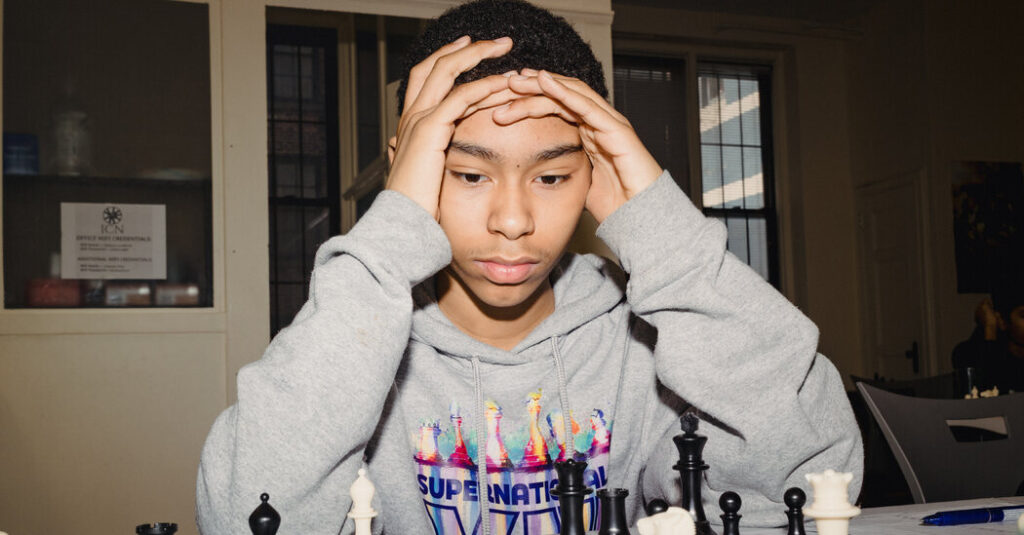
Leah Cai, a 10-year-old from Ridgewood, Queens, picked up chess during the Covid pandemic as an alternative to her normal activity: “All I did was yell at my brother,” she said.
She doesn’t like homework. But chess? “It’s pretty peaceful,” she said.
Leah, along with 53 other students, attended an intensive chess camp over spring break this month. It wasn’t open to just anyone. Players needed a rating of at least 1200 from the U.S. Chess Federation to participate, about average for a top first-grade player in the United States, which was not an issue for Leah. With a 1625 rating, she is one of the top 20 players in the country for girls in her age group.
She arrived at camp, which was hosted by Impact Coaching Network, a group that teaches chess in many New York City schools, wearing lilac glasses and a T-shirt featuring the name of her school’s chess team, “the Dragons of P.S. 130.” She was preparing for a girls’ national competition in Chicago, which was just a few days away.
Leah’s day began with a formal tournament-style game using score books and timers, which counted toward her official chess rating. She won after about 30 minutes of play.
“It was pretty easy,” she said.
Impact Coaching Network, or I.C.N., is seeing a surge in children’s interest in chess, which parallels a growth in adults playing the game in New York clubs and bars.
“We’ve been doing it for 20 years, and it’s never been more popular in New York,” said Russell Makofsky, the network’s founder.
When Ayden Spellman, an 11-year-old from Park Slope, Brooklyn, arrived at Saint Luke’s Lutheran Church in Manhattan where the camp was held, he was feeling good. He had recently attained a U.S. Chess Federation rating of 1900, a longtime goal. A 2000 rating is considered expert level, and 2500 is grandmaster status. But his public school team was going to nationals at the beginning of May, so he wanted more training.
“Spring break is a good time to do chess,” said Ayden, who arrived wearing a backward Chess Federation cap. “I can get the most of the coaches’ time.”
Ayden has been playing chess for three years. His mother, Qiana Spellman, a school counselor, said he had tried tennis, soccer and swimming, but chess became his obsession after he played in his first tournament in 2023. He plays tournaments every weekend unless he’s sick, she said.
“Chess teaches you how to think, on and off the board,” Ayden said. “You can come up with new ideas.”
Leah’s mother, Stella Lin, estimates that she spends more than $20,000 a year on coaching, travel and tournaments. Personal coaches charge between $75 and $100 an hour, Ms. Spellman said, and a week of chess camp costs $699. Parents think the investment is worth it, even if their children don’t become professional chess players, because the game teaches critical thinking and focus.
Many schools in New York host chess programs through I.C.N. or through another program, Chess in the Schools, and city schools consistently win national championships. Public libraries offer chess lessons and children can play “street chess” in Washington Square Park in Lower Manhattan or at chess clubs like the Chess Forum or the Marshall Chess Club.
“There are so many more good young players than there were 20 or 25 years ago,” said Kassa Korley, a 32-year-old international master in chess, who grew up in Harlem. He recently played a tournament at Marshall and noticed that he was one of the oldest people in the room.
Sebastian Goodrich started doing chess puzzles at age 2. His siblings are all top players, and now, at age 8, he’s ranked No. 3 nationally in his age group. He also went to the Impact Coaching Network camp over spring break and started the second day by winning his tournament-style game, pushing his rating even higher.
Ayden, Leah and Sebastian all play on public school teams: Leah at P.S. 130 in Chinatown, Ayden at I.S. 318 in Williamsburg (a school with a chess program that has won nationals so many times it was featured in the documentary “Brooklyn Castle”) and Sebastian at P.S. 77 Lower Lab on the Upper East Side in Manhattan. They’re all training for the national elementary school championships in Baltimore at the beginning of May. Their schools offer regular chess classes as well as after-school programs, and they all have private coaches.
Ayden goes to his after-school program three times a week and his personal coach oversees his daily study schedule, his mother said.
“He wants to be competing. He wants to be with his peers,” Ms. Spellman said, referring to his desire to play chess over spring break. “To keep him from it would be torture.”
I.C.N. runs training camps like these for the city’s top chess-playing youth when schools are not in session. The group’s goal is to turn New York students into national champions.
“You need a culture of excellence that builds and builds and builds,” Mr. Makofsky said.
Several top players — including 38-year-old Hikaru Nakamura, the No. 2-ranked player in the world, and Tani Adewumi, a 15-year-old up-and-comer who was a student in I.C.N. before his chess career took off — developed their skills as young children in New York. Tani has since been offered book and movie deals about his rise from a New York homeless shelter to chess greatness.
Ayden, Sebastian and Leah care a lot about their ratings, but they don’t yet aspire to be professionals. They just like chess.
At the camp, during free minutes between formal activities, attendees played quick, casual games, yelling moves and talking trash. “You’re tilted!” they said, slang for when a player gets stuck in an inexplicable losing cycle.
Ayden came over to watch Sebastian play, and as a group formed, they started debating the next moves.
“Go b2!” one onlooker shouted, referring to a position on the board.
“I’m going after a precious pawn,” Sebastian said.
Mr. Korley compared chess in New York to the city’s basketball culture.
“There’s trash talking and an edge and a competitiveness that’s more akin to other sports,” he said. “Some New York City kids carry that street chess edge as they play in the tournament chess.”
The Chess Federation has its headquarters in St. Louis, where the billionaire Rex Sinquefield founded the Saint Louis Chess Club, a hub for championship chess. But New York can hold its own.
“St. Louis is a better place for the top professional player, because there’s a lot of money and a lot of great top-level tournaments,” said Alex Lenderman, a grandmaster who grew up in New York. But he said that at the youth level, New York was much better.
“I don’t remember the last time you had a top young player coming out of St. Louis,” he said, adding, “But from New York, all the time.”
The post A Day in the Life of New York City’s Young Chess Stars appeared first on New York Times.