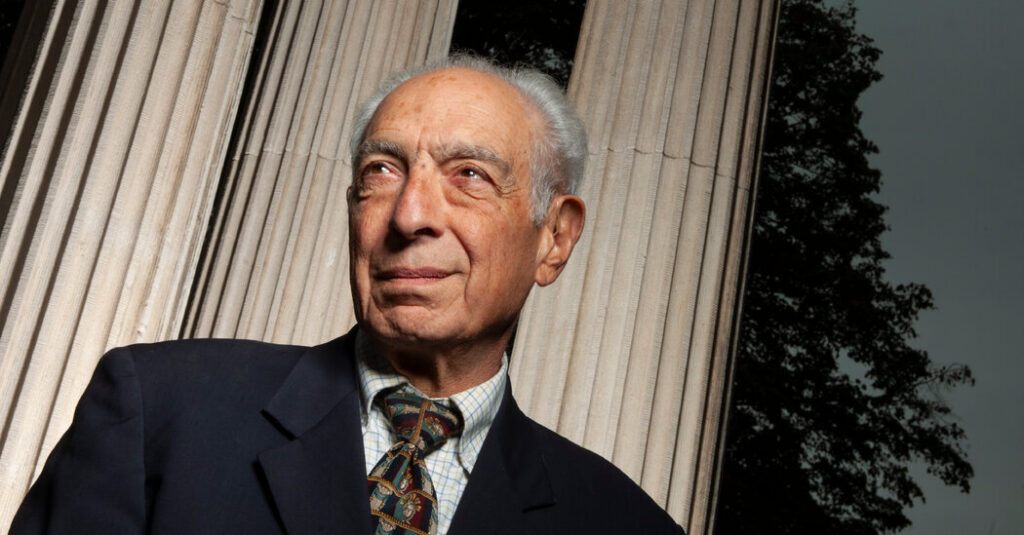
Harry Keyishian, one of five University of Buffalo faculty members who were dismissed in the early 1960s for refusing to sign a loyalty oath, a vestige of anti-Communist witch hunts, and whose legal challenge led to a Supreme Court decision that enshrined academic freedom with constitutional protection, died on April 4 in Morristown, N.J. He was 92.
His daughter Amy Keyishian confirmed the death in a hospital.
Professor Keyishian (pronounced kay-EE-shee-un) was in an early stage of his career when Buffalo hired him as an English instructor in 1961. After the school joined the State University of New York system a year later, staff members were required, under the state’s Feinberg Law, to sign the loyalty oath, swearing that they were not Communists or any other type of political subversive.
When Professor Keyishian’s contract was not renewed after he refused to sign the oath, he felt connected to Queens College faculty members he knew who had been fired in the 1950s for not answering questions about their Communist affiliations.
“What I still carried as a kind of burden into the ’60s,” Professor Keyishian later told the journalist Bill Moyers, “was a sense of frustration and impotence, to watch these very decent, these intellectually talented and dedicated teachers, vanishing from the system and being driven out and not being able to do anything about it.”
In 1964, Professor Keyishian — along with four other faculty members, George Hochfield, Newton Garver, Ralph Maud and George Starbuck — sued the New York State Board of Regents, seeking to declare the 1949 Feinberg Law unconstitutional.
After a federal judge dismissed the complaint, the U.S. Court of Appeals revived it. But the three-judge panel that heard the case, known as Keyishian v. Board of Regents, ruled for the state.
In 1967 the Supreme Court ruled, 5-4, that the Feinberg Law was unconstitutional. The court held that the government could only regulate the teachers’ First Amendment rights with “narrow specificity,” and that the Feinberg Law was overly broad and vague in prohibiting membership in the Communist Party without determining whether an employee agreed with illegal aims of the party.
“Our nation is deeply committed to safeguarding academic freedom, which is of transcendent value to all of us, and not merely to the teachers concerned,” Justice William J. Brennan Jr. wrote in the majority opinion. “That freedom is therefore a special concern of the First Amendment, which does not tolerate laws that cast a pall of orthodoxy over the classroom.”
Genevieve Lakier, a constitutional law scholar at the University of Chicago, said in an interview that Keyishian v. Board of Regents and Sweezy v. New Hampshire, a 1957 case, are two critical Supreme Court decisions “that recognize that the First Amendment protects academic freedom. Prior to Sweezy and Keyishian, academic freedom had largely been understood as a nonconstitutional right.”
But, she added, though it is frequently cited, Keyishian was an imprecise, even uncertain decision that “avoided reaching any conclusion about how the First Amendment specifically protects academic freedom.”
Harry Keyishian was born on April 9, 1932, in the Bronx and grew up in Flushing, Queens. His parents were Armenian immigrants; his father, John, imported and sold carpets, and his mother, Arax (Artinian) Keyishian, managed the home.
While attending Queens College, part of the City University of New York, he joined a committee to protest the firing of Vera Shlakman, an economics professor at the school who had refused to tell the Senate Internal Security subcommittee if she had been a Communist Party member. Oscar Shaftel, a Queens College literature professor and adviser to the protesters, was also fired by the Board of Higher Education, CUNY’s governing body.
Professor Keyishian, who had previously written a light column for the college newspaper, became a “puzzled and indignant member of the protest committee,” Marjorie Heins wrote in the book “Priests of Our Democracy: The Supreme Court, Academic Freedom and the Anti-Communist Purge” (2013).
He graduated with a bachelor’s degree in English literature in 1954, then earned a master’s degree in English from New York University in 1956. He was called to active duty that year by the Navy Reserve and served until 1958.
After teaching English at N.Y.U., City College of New York and Bronx Community College, Professor Keyishian was hired at the University of Buffalo.
In 1964, around the time that he was fired, Professor Keyishian was one of many professors at the university who picketed hearings held in Buffalo by the House Un-American Activities Committee, which investigated suspected Communists.
“The effect of the committee on American life,” he told The Buffalo News, “has been to hamper free discussion and disrupt people’s lives unnecessarily.”
Professor Keyishian didn’t wait long to get another job. After completing his Ph.D. in English at N.Y.U. in 1965, he was hired that year at Fairleigh Dickinson University in New Jersey.
Sixty years later, he told PEN America in an interview: “I wish I could play the hero in this matter but I never feared I was giving up my academic career. I was just losing a job (in a very good cause).”
He spent the rest of his career at Fairleigh Dickinson’s Madison, N.J., campus, building his reputation as a Shakespeare scholar; he also taught courses on politics in film. From 1976 to 2017, he was the director of the Fairleigh Dickinson University Press. He retired from teaching in 2010.
He wrote three books: “The Shapes of Revenge: Victimization, Vindictiveness and Vengeance in Shakespeare” (1996); “Screening Politics: The Politician in American Movies, 1931-2001” (2003) and a 1975 biography of Michael Arlen, a writer for The New Yorker. He also edited a collection of essays about the novelist and playwright William Saroyan, which was published in 1995.
In addition to his daughter Amy, Mr. Keyishian is survived by another daughter, Emily Keyishian; two stepdaughters, Sarah Keyishian and Elizabeth Wilks, who regarded him as their father; seven grandchildren; and his brother, Paul. His wife, Marjorie (Deiter) Keyishian, a writer whom he met in 1965 at Fairleigh Dickinson, where she was an instructor, died in 2022.
In 1987, 20 years after Justice Brennan wrote the opinion in the Keyishian case, he watched Professor Keyishian’s appearance on Mr. Moyers’s PBS series, “In Search of the Constitution.”
“It was fascinating,” Justice Brennan said in a 1990 New Yorker profile, expressing admiration for the courage Professor Keyishian had shown. “It was the first time I had seen him. Of course, it’s rare that I ever see the people in the cases we deal with.”
Richard Sandomir, an obituaries reporter, has been writing for The Times for more than three decades.
The post Harry Keyishian, Lead Plaintiff in Academic Freedom Case, Dies at 92 appeared first on New York Times.