This article is part of our Design special report previewing Milan Design Week.
A Protest Beneath the Surface
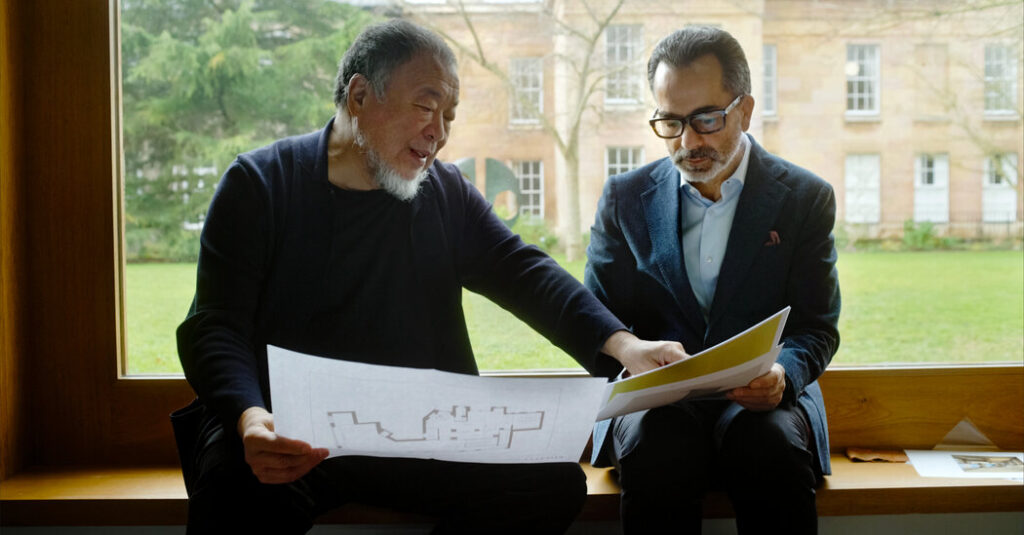
For Ai Weiwei, there is no separation between activism and art. Even the Chinese artist’s new textile collection, About Silk, a collaboration with the Italian luxury house Rubelli, is a political statement. “What we usually call ‘protest’ is in fact a way of protecting human nature: a cry or a voice, which is often completed by individuals,” he wrote in an email.
One form his protest takes is a richly figured lampas fabric called “The Animal That Looks Like a Llama but Is Actually an Alpaca,” woven with silk and metal threads depicting surveillance cameras, handcuffs and the Twitter bird logo. (The social media platform now known as X was permanently blocked by China in 2009.) There is an alpaca, too, an animal that is a protest meme in China because the Mandarin word that denotes it, “caonima,” literally “grass mud horse,” sounds like a vulgar phrase and thus is used to slip by the censors.
The textile’s difficult-to-discern gold pattern on a red background was adapted from a wallpaper Mr. Ai designed in 2015. Close attention is required to see beneath the lavish surface to pick out the underlying references to authoritarian suppression and imprisonment, including the artist’s own.
Another Rubelli lampas, called “Finger,” which is on display, reproduces the obscene gesture Mr. Ai has frequently used in his art to express his disdain for authority. Here, the protest symbol lies right on the surface.
About Silk is on view Monday through Saturday at Rubelli, 9 Via Fatebenefratelli, Milan; rubelli.com. — IFEOLUWA ADEDEJI
The Fluid Mille Fleurs Chandelier
The Mille Fleurs chandelier by the British designer and artist Bethan Laura Wood, a collaboration with Baccarat, will be shown this week in Milan’s Brera District. Ms. Wood, who is known for her use of vibrant decorative elements, created ring shapes out of crystal that suggest a team of partially drawn, futuristic android faces, their eyes peering in all directions. (The units can also multiply.)
“By breaking the chandelier into rings, the object becomes something fluid, a structure that can grow and adapt to different spaces while retaining the richness of Baccarat’s vocabulary,” Ms. Wood said.
This work is being presented alongside Baccarat’s immersive science fiction installation “Crystal Crypt,” which, as conceived by Emmanuelle Luciani, an artist and curator, brings together some of the French luxury company’s best-loved pieces in a “galactic cathedral.” (Baccarat was founded in 1764 by authorization of King Louis XV.) The exhibition marks Baccarat’s return to Milan Design Week after a five-year hiatus. Ms. Wood’s contribution reflects its “exceptional savoir-faire,” as its chief executive, Laurence Nicolas, put it.
Mille Fleurs comes with one ring, three rings or in custom sizes with as many rings as you’d like. Crystal Crypt and the Mille Fleurs chandeliers can be seen from Tuesday through Saturday at 10 Via Marco Formentini, Milan; baccarat.com. — STEPHEN TREFFINGER
A Debut for Wearstler and H&M
Kelly Wearstler is making her Milan Design Week debut this year, not, as might be expected, with a luxury brand or a prestigious design gallery, but with the home-goods division of the global fashion brand H&M. Several items from the Los Angeles designer’s 29-piece collection — which includes furniture, lighting, textiles, tabletop items and accessories — will be presented at Palazzo Acerbi, a 17th-century Baroque palace in the Porta Romana neighborhood that is not as a rule open to the public. Ms. Wearstler always wanted to show in Milan, she said, “but I wanted to do something really exciting and big.”
H&M Home, which has been around since 2009, is likewise making its inaugural appearance at Milan Design Week, and this is the first time it will offer furniture. Ms. Wearstler said the 18-month process of developing her collection had notable challenges. Because of H&M’s packaging and distribution system, there were constraints in the size of the pieces, which meant that typologies like seating had to be broken down or made modular. “It pushed us to be more creative,” she said.
Items range from a $29.99 candlestick to a $749 lounge chair and will be available in the United States on Sept. 3, online and in selected stores. The steel-and-linen Emera lamp, shown here, features a shade and base that can be illuminated separately and is priced at $429.
Kelly Wearstler’s H&M Home collection can be seen from Tuesday through April 26 at Palazzo Acerbi, 3 Corso di Porta Romana, Milan; hm.com. — RIMA SUQI
Respect Meets Whimsy
Laboratorio Paravicini hand decorates its ceramic plates, painting them with vivid, whimsical imagery — circus performers, animals in motion, naturalistic flowers — at its workshop in Milan’s medieval Cinque Vie district. That aesthetic is taking an experimental turn in a collaboration with Natalia Criado, a designer of minimalist metal tableware that she renders playfully at times, with colorful stones. Together, they’re setting a table with their Metalia collection: sculptural, sacramental creations that include less elaborate ceramic dishes, columnar metal cups and painted metal charger plates with sliding beads.
“We share a respect for artisanship and for the significance of these objects,” said Costanza Paravicini, who oversees the atelier together with her daughters Benedetta and Margherita Medici di Marignano.
As Ms. Criado explained, “We differ in imagery and material, but we’re adapting to each other’s worlds while maintaining our sense of fun, and the importance of returning ceremony to the table.”
Ms. Criado, who formerly designed jewelry, found fashion to be “too fast.” In her native Colombia, she developed an arty silverware set, and later launched a tableware collection after moving to Italy and learning production through its artisan workshops. Her designs channel the geometry and spirituality of pre-Columbian devotional artifacts, while also drawing on Italy’s slow-moving and communal approach to dining.
“What these objects really offer is time,” Ms. Criado said. “The time it takes to craft such painstaking works by hand, and the time spent together at the table.”
The Metalia collection will be on view Monday through April 26 at Laboratorio Paravicini, 8 Via Nerino, Milan; paravicini.it. — LAURA RYSMAN
Bathing Amid the Bees and Birds
Kohler is introducing just one product at Milan Design Week: a copper-clad version of its Rêve cast-iron bathtub. But it has created an immersive installation to launch it, in collaboration with Flamingo Estate, a lifestyle company that sells products for the body, home and pantry.
“I thought, wouldn’t it be the craziest thing in the world if we could build a bathhouse?” recalled Richard Christiansen, Flamingo Estate’s founder. “Then I held my breath and waited for them to say no.”
Kohler said yes.
The bathhouse, complete with pivoting stained-glass windows by Samuele Dossena, a Milanese artisan, is a scale replica of Mr. Christiansen’s own, a Brutalist structure on his seven-acre Los Angeles property.
The miniaturized translation installed in Milan sits in a meadow of flowers, along with four custom-made pollinator baths. As shaped under Mr. Christiansen’s direction, the form of these coffee-table-size baths — each is about 32 inches square — accommodates a variety of creatures. “Bees and butterflies need a very shallow surface from which to drink,” Mr. Christiansen said, while traditional bird baths are deep basins that offer no purchase for smaller winged pollinators. These vessels have “something for everyone — a shallow space, a ridge, and a deep part for the birds.”
The pollinator baths were cast at Kohler’s foundry in Wisconsin and complement the installation’s Brutalist aesthetic. They are not for sale, but a Pollinator bath soap brick ($58) and Golden Pollinator candle ($75), created by Flamingo Estate for the occasion, are available on its website.
The Flamingo Estate Bathhouse by Kohler is on view from Tuesday through April 26 at Padiglione d’Arte Contemporanea, 14 Via Palestro, Milan; kohler.com,flamingoestate.com. — RIMA SUQI
The post Group Efforts Succeed During Milan Design Week appeared first on New York Times.