The stock market has been trying to ignore the war in Iran. That’s been true over weeks of escalation and de-escalation, cease-fires, a blockade, and a blockade of a blockade (now just a U.S. blockade). Markets have barely flinched, even as crude oil prices swing wildly each day and the world’s supply chains begin to shake.
The word to describe what is happening is “shrug.” The problem is not a lack of information. There is too much information, arriving in late-night social media posts and endless push notifications. These days when I see “Breaking News,” it feels like there’s an emphasis on “breaking,” in the sense of “Things are broken.”
The stock market has decided this available information is not relevant. That is a problem for all of us. President Trump deeply cares about the stock market, and if the stock market had been selling off, there is a good chance that this war would have been over a while ago. More broadly, the markets are showing the single lesson that the past 40 years have taught them.
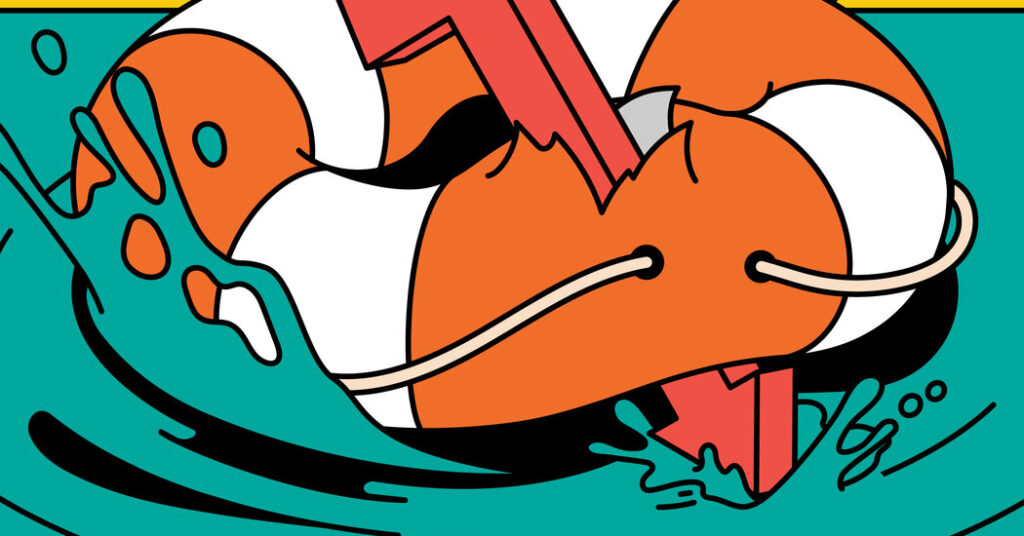
It will always be saved.
Markets are not properly pricing risk, because they really don’t have to. They have assumed that the U.S. government will not allow them to implode, and that assumption is putting the world economy at stake. What’s more, the new rescuer investors are counting on — artificial intelligence — is vulnerable to the exact risks markets are ignoring.
This has huge consequences.
When Paul Volcker took the reins of the Federal Reserve in 1979, he showed that the central bank was willing to use rates as a blunt instrument. He hiked the federal funds rate above 20 percent to crush inflation, deliberately inducing a recession. It was brutal and effective, with unemployment rising and inflation cratering. His efforts saved the economy by destroying it, while establishing the precedent that the Fed could and would move the economy.
Alan Greenspan imparted the same lesson, but in an inverted way. Where Mr. Volcker disciplined markets, Mr. Greenspan rescued them. When the stock market crashed in October 1987, on a day known as Black Monday, Mr. Greenspan flooded the system with liquidity and cut rates.
The market recovered — and a template was born. In the late 1990s, the potential of a Long-Term Capital Management collapse and the dot-com bubble were met with Fed support. The markets learned: When things break, someone saves us.
That implication has a nickname — the “Greenspan put.” The implicit understanding (never written or formalized) is that the Fed would ease monetary policy whenever asset prices fell hard enough. It was necessary in many situations, but it also created a reflex.
For example, in 2008, Ben Bernanke, then the Fed chair, took rates close to zero and carried out three rounds of quantitative easing in response to the financial crisis. The Fed deployed trillions of dollars in asset purchases at a staggering scale and became a direct buyer in markets.
The markets came to expect a form of salvation. In fact, markets expected so much support that they threw what were called “tantrums” when they didn’t get it — as in 2013’s “taper tantrum,” when Mr. Bernanke suggested (suggested) that the Fed would be buying up fewer bonds. The bond market freaked out, with the 10-year yield jumping from 2 percent to 3 percent in a few months, setting off a cascade of depreciation in emerging-market currencies. The markets learned: They could demand rescue.
Then Covid happened. Both Congress and the Fed deployed trillions in combined and coordinated fiscal and monetary support within weeks at breakneck speed and scale. The stock market hit all-time highs within months of the worst economic shock since the Great Depression.
Markets inferred a guarantee. They’re running the same pattern: This is really bad, but we’ll get saved, so buy the dip.
The problem is that the rescue infrastructure is exhausted. The Fed is trapped. Inflationary pressures mean that rate cuts, the most powerful tool in the monetary tool kit, could risk making things worse. The Greenspan “put” is not really in the cards.
Fiscal policy is equally constrained. U.S. debt levels have reached a point at which any new spending programs face real limits. The dollar’s role as the global reserve currency is showing cracks. Foreign holders of Treasuries are watching U.S. policy with increasing skepticism.
What’s left? TACO, short for Trump Always Chickens Out: the strategy, if it can be called that, of substituting narrative for economic reality. Announce a tariff pause, stocks go up. Leak a deal, stocks go up. Post that “a whole civilization will die tonight,” stocks go up. The crisis becomes content, something to produce and consume and trade around, the way one trades around earnings or the weather.
But narrative management isn’t a functioning policy tool, because it doesn’t do anything other than distract and delay. It doesn’t restructure debt, lower interest rates, secure supply chains or produce more oil.
The only real backstop, if you look at where the money is going, is artificial intelligence.
This reliance on A.I. looks like an extraordinary concentration of bets. The Magnificent 7 (Google’s parent, Alphabet; Amazon; Apple; Facebook’s parent, Meta; Microsoft; Nvidia; and Tesla) are over 30 percent of the S&P 500, up from about 12 percent a decade ago. The four largest hyperscalers — Alphabet, Microsoft, Meta, Amazon — are projected to spend nearly $700 billion combined in 2026 on A.I. infrastructure, an increase of more than 60 percent from last year, and are spending so aggressively that they’re likely straining their cash cushions.
The implicit argument embedded in current valuations across both public and private markets is that A.I. will be productive enough to offset an economic downturn as the economy loses jobs from A.I. The valuations also suggest that the A.I. industry will be efficient enough to navigate an energy crisis with the knowledge to reroute supply chains disrupted by, say, war.
Behind that sits an even deeper assumption: that if A.I. falters, the government will do everything it can, even with its constraints, to save the industry through all elements of support. We already see this with accelerated data center permitting, major Pentagon contracts, a largely hands-off regulatory approach and state data center tax breaks. This redirects moral hazard from “the Fed will bail out the banks” to “the government will bail out A.I.” Call it the A.I. put — and this isn’t a critique of A.I. companies. They are responding to the incentives of a favorable policy environment.
But A.I. is not at all safe from the risks that markets are ignoring. If anything, it’s extraordinarily exposed to them.
A.I. is one of the most energy-intensive technologies ever built. In Virginia, where data centers are most concentrated, they already consume 26 percent of the state’s electricity. Nationwide, data centers consumed more than 4 percent of electricity last year, and that’s projected to reach as much as 12 percent by 2028. The technology that markets are counting on to save them is one of the first things to get squeezed if we have a full-blown energy crisis.
A.I. is also enormously dependent on stable global supply chains, particularly for advanced semiconductors. The chips that power these models are manufactured in a small number of facilities, mostly in Taiwan, and are largely shipped through contested waterways and subject to geopolitical leverage (like blockades).
The productivity miracle hasn’t come close to what valuations require. Now, it may happen. But the distance between “may” and “has” is the distance between a thesis and a prayer, and markets are very much pricing the prayer.
What do we do about it? Risk pricing needs to be honest and reckon with reality. We need insurance in case A.I. doesn’t deliver, as Asad Ramzanali, my colleague and the director of artificial intelligence and technology policy at the Vanderbilt Policy Accelerator, suggests in a paper, “After the A.I. Crash.” He proposes solutions like a piece of legislation akin to the Glass-Steagall Act (which limited the power of commercial banks to engage in securities transactions) for A.I., which would separate model makers from data center owners. He also suggests a digital Works Progress Administration for workers who lose their jobs. And he argues that if the government does end up rescuing A.I. companies, any financial relief should come with public equity stakes, so that the public, which is already underwriting much of the risk, also shares in the upside.
The problem isn’t just the war, or the energy crisis, or the debt levels, or the trapped Fed, or the fragility of the A.I. supply chain. It’s all of them simultaneously, potentially compounding one another, processed by a market that believes it will be saved.
Kyla Scanlon, a contributing Opinion writer, is the author of “In This Economy? How Money & Markets Really Work” and Kyla’s Newsletter.
The Times is committed to publishing a diversity of letters to the editor. We’d like to hear what you think about this or any of our articles. Here are some tips. And here’s our email: [email protected].
Follow the New York Times Opinion section on Facebook, Instagram, TikTok, Bluesky, WhatsApp and Threads.
The post Why the Stock Market Makes No Sense Right Now appeared first on New York Times.