Vanity among male politicians is nothing new, with big egos as commonplace as primary campaigns.
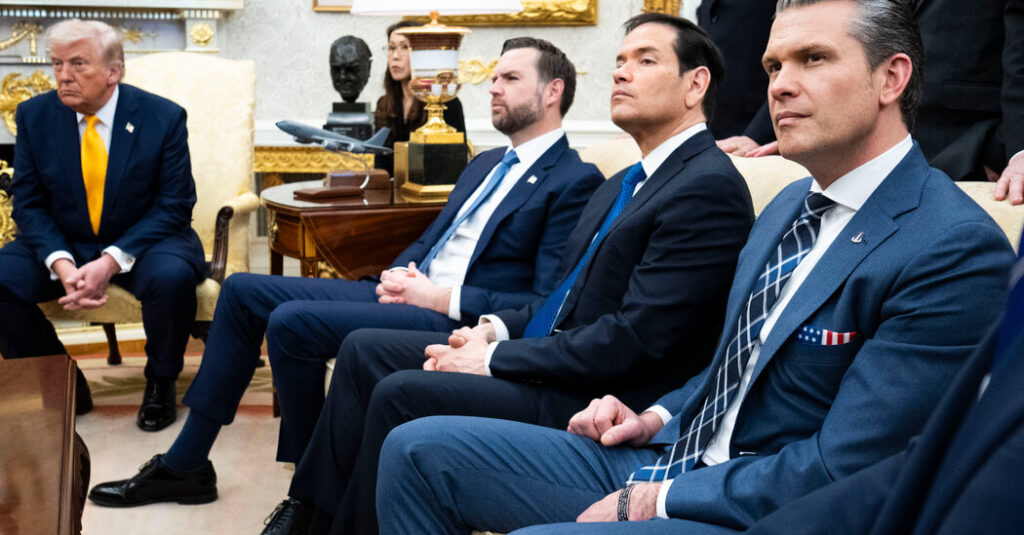
For the men of the Trump administration, however, the concentration on their appearance is a constant, with policy pronouncements and social media feeds suffused with displays of physical strength, tough-guy talk and masculine mojo.
At the same time, those traditional tenets of masculinity have been accompanied by flashes of vulnerability about how the men look and dress: Last fall, for instance, the president groused about a photo from Time magazine for a shot that he suggested made him look bald.
“They ‘disappeared’ my hair,” the president said on Truth Social, adding that the photo was “a super bad picture, and deserves to be called out.”
In December, a raft of photos for Vanity Fair — including close-ups of Secretary of State Marco Rubio and Vice President JD Vance — were harshly criticized by Mr. Rubio, who called them “deliberately manipulated.” (The magazine denied any alteration of the photos.)
And allegations of photographic malpractice surfaced anew last month, when the Washington Post reported that Defense Secretary Pete Hegseth had barred press photographers from Iran-war briefings because he found their snaps of him “unflattering.” (The Pentagon denied this, saying they had made accommodations for multiple photographers during recent briefings, and calling the premise of the Post story “false.”)
For all the talk about Mar-a-Lago-inspired cosmetic surgery for women in the Trump orbit, the attention paid to, and efforts to safeguard, the male ego also stand out.
“It’s constant attempts at trying to cultivate a persona that in their eyes seems strong and powerful and dominant and stoic,” said Zac Seidler, a clinical psychologist and the global director of research at Movember, a men’s health charity. “But once you scratch the surface of that, all you see is fragility.”
President Trump, of course, has long been obsessed with personal aesthetics and known for unforgiving and sometimes offensive takes on women’s appearances.
But Mr. Trump has also normalized talking about and critiquing men’s looks, ushering in a new era of fawning assessments and regular commentary about the appearance of his cabinet members and others.
Anna Kelly, a White House spokeswoman, said that “President Trump has assembled the most talented and accomplished administration in history.”
“And,” she added, in an email, “They just happen to be straight out of central casting!”
The focus on looks could be seen as part of a larger trend with men — particularly younger men — including ideas like “looksmaxxing” (trying to amplify one’s good looks, with surgery and other methods) and “mogging” (dominating another male in appearance), which are steadily percolating through the so-called manosphere.
Whatever the case, Mr. Trump’s interest in outward images has been adopted and echoed by his staff, said Dan Cassino, a professor of government and politics at Fairleigh Dickinson University, who has studied the president’s approach to masculinity.
“Men in the Trump administration are performing a very specific type of masculinity in order to try and appeal to Trump,” Mr. Cassino said.
Of course, women in the workplace have been accustomed to — and concerned about — comments and judgments about their looks.
Now, it seems, men are, too.
“Commenting on someone’s look or looks is one of the most basic forms of power play we have,” said Rose Hackman, the author of “Emotional Labor,” a study of women’s often-underestimated role in the workplace and elsewhere.
Ms. Hackman added that what Mr. Trump has said about men in his inner circle “effectively reduces them to assets,” which can “make them feel like they have to be jumping around him, or else their status in his eyes could change at any time.”
Mr. Trump himself is almost always in a suit and seems to like the formality of previous eras. He cultivates a look reflecting a seeming obsession with the ’80s, including the suits and red power ties his close advisers often wear and swept back hair, Gordon Gekko style (as currently sported by Mr. Hegseth).
The president said he didn’t want sneakers on his cabinet members and recently exhibited his penchant for a certain brand of $145 dress shoes by purchasing pairs for Mr. Rubio and Mr. Vance. He also has a distinct appreciation of physically fit men, recently complementing the muscles of a Navy lineman and federal agents, and calling a U.F.C. fighter “a beautiful guy,” who “could be a model.”
“You’re too good looking to be a fighter,” Mr. Trump told Paulo Costa, who thanked Mr. Trump for the compliment.
On the flip side, that sort of presidential evaluation can also trigger men’s insecurities, part of “this overarching belief that you must look and appear a certain way or you have failed,” said Mr. Seidler.
“When the image is threatened,” he said, “the whole edifice shakes.”
Over the last decade, Mr. Trump has made his aesthetic evaluations a potent if crude political tool, belittling opponents for everything from their weight (including Chris Christie, the former governor of New Jersey) to their height (mocking Rep. Adam Schiff of California as “little”).
Mr. Trump’s political theory seems to hold that being less attractive, or flawed, is weak and thus marks a loser. It’s a viewpoint perhaps drawn from his fixation on television, where looks and appearance are paramount.
And Mr. Trump, himself a former reality TV star, has for years prized individuals who vocally support him in front of cameras, especially those who combine the look of newscasters with the ease of entertainers.
It’s a list that includes Mr. Hegseth, a former Fox News host; Sean Duffy, the secretary of transportation and a past participant on MTV’s “Real World”; and Dr. Mehmet Oz, who made his name as a television doctor before leading the Centers for Medicare and Medicaid Services.
Presidents have often sought to project strength and downplay their physical challenges: Franklin Delano Roosevelt, for example, hid his wheelchair use. John F. Kennedy concealed severe pain and other ailments.
But Mr. Trump has taken that image control even further. His surrogates frequently tout his vitality, and the president often connects himself with men who evince masculine traits, including musclebound influencers.
He featured Hulk Hogan, the histrionic pro wrestler, at the Republican National Convention in 2024, where he tore off his shirt, and he is hosting — and promoting — a U.F.C. fight at the White House in June, hot off the heels of an “exclusive training seminar” the fighters held with F.B.I. agents in March.
The second-term machismo is also evident in a series of demonstrations of gym-rat toughness, including a recent video — harshly criticized by some Democrats —of Robert F. Kennedy Jr., the health secretary, and the veteran rapper Kid Rock that shows them working out alongside each other.
All of which is seemingly applauded by Mr. Trump, despite his own aversion to such alpha-male activities: With the exception of frequent rounds of golf, Mr. Trump himself does not exercise.
At the same time, there are signs of a common insecurity for many men: hair loss. Those concerns led to Mr. Trump’s complaints about the Time cover, as well as him using a hair-growth drug and making the occasional joke about hiding his “bald spot.”
Tom Wooldridge, the founding dean of the school of psychology at Golden Gate University who has studied the emotional impact of baldness, said such fears are sometimes deeply primal.
“Many of us die without much hair.” Mr. Wooldridge said. “So for many men, it’s a symbol of aging and mortality.”
Experts say that masculinity is often “earned” from other men. They constantly assess one another’s apparent manliness against stereotypical ideals like toughness, aggressiveness and dominance, and, by extension, revoke it when a man fails those subjective tests.
“It’s fragile,” said Maryam Kouchaki, a professor of management and organizations at Northwestern University who has studied the phenomenon of what she called “precarious manhood” in the workplace. “And it’s easily lost.”
But that process of evaluation has been supercharged in the Trump era, said Michael Kimmel, the author of “Manhood in America,” adding that many male members of the Trump administration are seemingly “cosplaying their Rambo-ness” to impress the president.
Part of flattery, presidential or otherwise, is simply timeworn politics: complimenting people as a means of ingratiation. And Mr. Trump himself continues to lavish praise, whether it be the physical size of the U.S. men’s hockey team or the attractiveness of a wounded veteran at the State of the Union.
That said, the president has also shown an occasional hint of sensitivity about other men’s looks, including in February, when he offered a compliment, of sorts, to Santiago Peña, the 47-year-old president of Paraguay as a “young, handsome guy.”
“It’s always nice to be young and handsome,” the president said. “Doesn’t mean we have to like you.”
Jesse McKinley is a Times reporter covering politics, pop culture, lifestyle and the confluence of all three.
The post In Trump’s Orbit, Women Aren’t the Only Ones Concerned About Their Looks appeared first on New York Times.