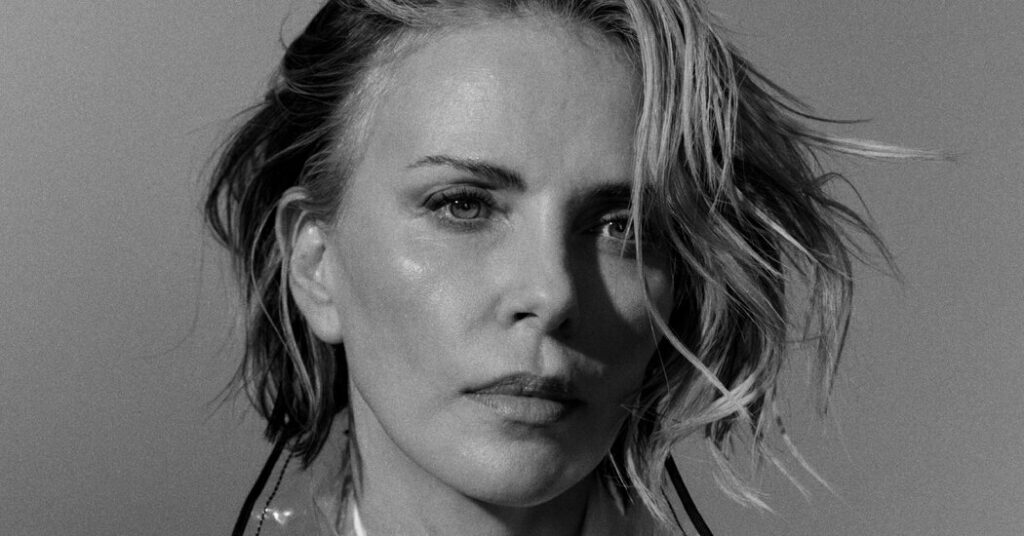
I’ve never had an interview quite like this one with Charlize Theron. I came in wanting to talk about her storied acting career, which began after she moved on her own to New York to be a ballet dancer, quit because of an injury and was discovered barely out of her teens at a bank in Los Angeles. By her late 20s she had produced, starred in and won an Oscar for the film “Monster,” in which she completely transformed herself to play the serial killer Aileen Wuornos. Since then, she’s been in dark comedies like “Tully” and big-budget fantasies like “Snow White and the Huntsman,” but I was most interested in her latest turn as an action star in films like “Mad Max: Fury Road,” the “Old Guard” franchise and her newest film, “Apex,” in which, at age 50, she kicks butt again, this time while being chased through the Australian wilderness.
But while we did talk about her roles past and present, our conversation almost immediately took a revealing turn. Theron has spoken publicly about the fact that her mother killed her father in self-defense when she was a teenager. But when we talked about it, and the repercussions she’s lived with ever since, memories of her childhood flooded in with a vividness that surprised us both.
Subscribe: Apple Podcasts | Spotify | YouTube | Amazon | iHeart
I was watching your acceptance speech when you won your Oscar for “Monster” in 2004. You’re standing onstage, tearing up. Your mom is sitting in the audience and you thank her for all her sacrifices. When you look back now, what do you think about that young woman? The first thing that came to mind was just, This is not something that happens to girls in South Africa. I remember looking at a map and I was like, God, we’re all the way down here, what’s going on up there? My greatest dream would have been to be able to support myself as an actor and not have a second job. That was literally what I was aiming for. I just wanted to be able to not depend on my mom or a guy. But the thing with my mom is she did sacrifice a lot.
Yeah, and we’re going to talk about that. I’m a mom now, and I don’t have to sacrifice the things she did. I know what she did, and I’m very grateful.
Since we’re already talking about your family and where you came from — you grew up in South Africa on a small farm. What do you remember about growing up there and what your life was like? I remember very vividly moving to that farm. I was 4 years old. I remember it feeling so vast when I was that age. There was this big tree that greeted you as you were driving in. I have very vivid memories of this tree and climbing it recklessly, barefoot, and just feeling a sense of freedom. I loved adventure. I liked getting into trouble. I liked to do things that I knew I wasn’t allowed to do, but I was allowed to do so much. I could take my BMX and go to the closest little town to rent movies.
Did that make you independent? I was super independent. My friends grew up that way, too, but my independence also had to come from an emotional place. My house wasn’t always stable. And so I felt very responsible to make sure that I was taken care of. By the time I moved out of the house, I knew how to take care of myself on many levels.
Before we get to what was going on inside the house, outside the house there was also a lot of instability. The mid-1980s were a time of violent uprisings against apartheid that led to a state of emergency in your hometown, Benoni. There was a lot of state repression, resistance. You were a very young kid, but do you remember any of that? You couldn’t avoid it. Violence and turmoil was something that was everyday life in South Africa. I saw things that I shouldn’t have seen at a very young age.
Do you remember anything in particular? It’s tough stuff to talk about. I saw a man burn inside a car on the side of the road. I also later saw what H.I.V. and AIDS was doing. I remember people being wheelbarrowed into our house because they knew my mom would take them to a clinic.
You’ve spoken about the turbulence inside your family. Your father was an alcoholic. As someone myself who has dealt with alcohol abuse in our family, it is an incredibly difficult thing, especially for a child. When did you realize that your own home life was different from your friends’? Pretty young, I would say. I have memories from when I was really young, seeing really drunk people, and it scared me. Like, people crawling on the floor drunk. But that became so consistent that it was every Friday, Saturday, maybe even every Wednesday. My dad had built this big bar inside the house. That wasn’t unusual. A lot of South Africans create a space in their house where they can drink. But it became where he lived. He was a full-blown functioning drunk, but he had moments where he would go missing, we wouldn’t know where he was, and he would usually return in a state that was pretty severe. It would get messy and loud, and my mom’s not a wallflower either. She wasn’t just sitting and taking it. She made it known that she wasn’t happy about his lifestyle. So it really caused a lot of verbal abuse. Personally, for me, the worst thing was they would ice each other. There would be a big fight, and then they wouldn’t talk for three weeks. I didn’t have siblings, and that house just went silent.
Was he violent toward you? He was scary. He didn’t hit me, he didn’t throw me against a wall, but he would do things like drive drunk. There was a lot of verbal abuse, a lot of threatening language that just became normal. When I was around 12 or 13, I remember my mom using the word “divorce” for the first time. We didn’t know people who were divorced. My parents weren’t religious, but it was culturally one of those things you didn’t do. They had been married for 25 years. So when she said, “I think the best thing for us is for me to separate from him,” it was scary because I didn’t know what that would look like. I was almost talking her back into staying, because the alternative felt so foreign to me. But I think she knew and she was trying to figure out ways to get me out of the house. She sent me to a boarding school specifically because she wanted me to get out of the house. She was very aware of what it was doing to me.
It’s so strange — all the memories are there. And it’s not that I don’t try and think about it, but going in such a linear manner, it becomes almost more clear when you talk about it this way. Because people tend to just isolate it and want to talk about one thing. But it helps to explain that these things build, and they build, and it takes years for things to go as wrong as it did in my house.
The reason I wanted to go linear is because you have mentioned in other interviews how everyone focuses on what we’re about to talk about. But that everything that came before was actually where the real trauma lay. We better talk about some fun things after this!
We are going to. I didn’t mean to start here. No, no, not at all. I was 15 years old. My mom and I had gone to see a movie, and my dad had taken the key to the front steel door. Every room in our house had a steel door. So if you got into the front door, the kitchen had a steel door that you had to unlock, because that’s the kind of violence that we were living in. Our country was on the brink of civil war. So my mom couldn’t get into the first lock. We always knew where my dad was. His brother lived a couple of streets away, and if he wasn’t home, he was there drinking. Nothing out of the usual. We went over, they were pretty loaded, and I had to pee really badly. So I ran into the house to get to the toilet, and he took that as me being rude, because I didn’t stop and say hello to everybody. Big thing in South Africa, the kind of respect that you have to have for elders. And he was in a state where he just spiraled. Like: “Why didn’t you stop? Who do you think you are?”
We left, but you could just tell something was different. When we got home, I sat down with my mom and said: “I think you’re right. I think you should separate from him.” I had never imagined that those words would come out of my mouth. Leaving that house, I knew something was just different. She knew it, too. I knew he was mad at me. So I said to her, “When he eventually decides to come home, please tell him I’m asleep.” I went into my room, I turned my lights off, and I was scared. My window faced the driveway, and I could tell the level of anger, frustration or unhappiness by the way he drove in. The way that he drove into that property that night, I can’t explain it to you. I just knew something bad was going to happen.
To get to the point: He finally broke into the house. He shot through the steel doors to get in, making it very clear that he was going to kill us. His brother was with him as well. We knew it was serious, and so by the time he broke into the first gate, my mom ran to the safe to get her gun. She came into my bedroom. The two of us were holding the door with our bodies because there wasn’t a lock on it. And he just stepped back and started shooting through the door. And this is the crazy thing: Not one bullet hit us. It’s insane when you think about it that way. But the messaging was very clear. I’m going to kill you tonight. You think I can’t come into this door? Watch me. I’m going to go to the safe. I’m going to get the shotgun. Encouragement from the brother. He walked to the safe, and my mom pulled the door open while the brother was still standing there. The brother ran down the hallway, and she shot one bullet down the hallway that ricocheted seven times and shot him in the hand. It’s stuff you can’t explain. And then she followed my father, who was by then opening the safe to get more weapons out, and she shot him.
Unfortunately, this is not an isolated story. These things are prevalent in a lot of homes. Women really get a very, very unfair shake, even in this country. Nobody takes it seriously, the situation that they’re in. And I don’t think anybody took my mom seriously.
In advance of this, you mean? Yeah, how bad it was. When you’re dealing with a charming drunk, who was always looking for buddies to come join the party, and a culture that just accepted it — that was part of being South African. Men drink. I remember my little nephew, when people asked, “What are you going to do when you grow up?” saying, “I’m going to drink.” That’s when you become a man.
I just want to say, I wasn’t going to start here —— I think these things should be talked about because it makes other people not feel alone. I never knew about a story like that. When this happened to us, I thought we were the only people. I’m not haunted by this stuff anymore.
In fact, you’ve become a campaigner to prevent gender-based violence and have been very clear that that trauma does not define you. It does, though, bind you and your mother. How would you say it changed your relationship to her? It’s a very good question because it really did change our relationship. We were always very close. We felt like a team. But that night changed it because in retrospect, once I got out of the shock of it, I realized that she saved my life. Which is a big thing.
It’s the ultimate sacrifice a mother can make. And then she picked right up. The next morning she sent me to school. She was just like, We’re going to move on. Not necessarily the healthiest thing, but it worked for us. She wanted me to forget about it. She didn’t want me to sit in it. We didn’t have therapists around, so in her head the best therapy was, We’ve got to move on.
And did you? Did you lock it away? I did. There was a lot of shame surrounding it because everybody knew. I felt like kids had this attitude towards me.
You felt like they judged you? Yes. There was only one time I became violent, and it was a girl who had taunted me with it. She was walking around telling everybody how she had seen my dad drunk. This was something that was super sensitive to me because he would show up at school events really drunk and it was embarrassing. I always felt like I had to make excuses for him, to tell some story to soften the edges a little bit. I also tried to sweep it under the rug because I hated people feeling sorry for me. I hated it. I almost feel like that was the worst thing, that now, for the rest of my life, people are going to feel sorry for me. So for the first couple of years, for as long as I could, I told this story that he died in a car accident. I couldn’t tell it to my school friends, but by the time I left South Africa, that’s the story I told. Because I just didn’t want pity. It made me so uncomfortable.
So you end up leaving South Africa. And you’re young. I had just turned 16.
You go to model initially in Italy. What was it like to be that person at 16 with everything that had happened? It was amazing because it was escape. The only thing that was hard for me was leaving my mom behind. But she was the one that said: “Go and make a life for yourself. There’s nothing for you here right now.”
Out in the world at 16, did you feel equipped? I was so equipped. I knew how to take care of myself. That’s just something my mom instilled in me, my lifestyle instilled me, my country did. You know how to cook, how to sew. I knew more than my kids will ever know as adults about taking care of myself. So I knew I would be able to survive. And I also had this real drive. I was so determined to do this on my own and not to fail, because I didn’t want to go back.
This brings me to your new movie, because you’ve been doing a lot of tough roles lately and you are what I consider to be our modern-day action hero. Do you consider yourself to be an action hero? I don’t know about the hero part?
My words. I’m making a kind of obvious assumption, considering where we’ve started, but I’ve heard you just say words like “independent,” wanting to do things your own way, and to me, there’s just a very clear through line to this part of your career. Why was it something you were attracted to? I had had little moments in movies where I had to do an action scene. I made the connection pretty quickly to my dance career, and I had missed telling stories through my body.
OK, you said you wanted to get to the fun stuff. In a recent interview, you said, “I have surgery after every movie.” I looked into it and went down a rabbit hole. Oh, boy.
After this new movie, “Apex,” you got elbow surgery. Two elbow surgeries.
You also fractured a toe. While making “The Old Guard,” you filmed through injuries and got three surgeries on your left arm afterward. Yes.
Making “Atomic Blonde,” you cracked two teeth and got root canals. Yeah, two in the back they had to remove. They were so crushed.
You spent five days in the hospital after laughing too hard watching “Borat”? I didn’t quite understand that one. Was it a hernia? [Laughs] I had herniated a disk in my neck making a movie, “Aeon Flux.” I landed on my neck and it was a really severe injury. I was moments away from being paralyzed. They had to shut the movie down. I was on bed rest and doing P.T., and they didn’t want to do surgery. I think it was a big mistake because I suffered for eight years and had chronic pain. That disk sat so close to all of my nerves that if I did anything wrong with it, it would just sit on nerves and I would be locked for weeks. I lived my life like that for eight years. The “Borat” thing is funny because I laughed so hard that I locked that disk into the nerves. It was actually really bad.
That’s not a funny story! That’s a horrible story. It’s a funny story now! We still laugh about it, but I had to get flown on a private plane that night and came back to L.A. When I had my first baby, I said to the doctor, “I want to have the surgery because I don’t want to live in this place where I have a child and I can’t pick her up because my neck is out.” It was the best thing I ever did.
I know a lot of people who’ve lived with chronic pain, and it’s really debilitating and hard to think about anything else. What was it like for you? It was horrible. There’s this constant fear of I don’t know if I should do that. And I’m in the prime of my life! I was so worn down by the end of the eight years that if they weren’t going to do the surgery, I was going to go to another country and get it done. I was that desperate. Also, I was on a lot of opioids, and with my dad, the worry of addiction — thank God I didn’t become addicted, but I think back now and I just go, That was so irresponsible.
If that were my reality, I probably would not want to throw myself into becoming an action star. I would want to protect myself from injury. Why do you think you went in the opposite direction? I wasn’t going to let anything take away from my life. I think some of it has to do with the fact that I experienced so much death early on. I’m very aware that time runs out really quickly. Time can run out as soon as I walk out of this building. I can cross the street and it’s done. I didn’t want to live a safe life because of that. I mean, I’m not a reckless person. I get scared. But if I get to be on my deathbed one day, I want to say I did everything that I really wanted to do.
I can see you getting teary. No, I’m not! [Laughs] I don’t know what you’re talking about.
What made you emotional? Because life is so valuable, and life is so beautiful. [Tearing up more] Stop it! No, this is not in the interview. You are not putting this in the interview. It’s so sappy and stupid.
It’s not. It’s so stupid. It’s really stupid.
I feel like I’m getting the real you, which is a person who still doesn’t want to be in touch with her emotions. It’s funny because people think I’m a tough bitch. A lot of people think I am very cold because I come across as self-affirmed, like I can take care of myself. I’m sometimes a little brash, and people take that as, She’s so tough. And it’s the complete opposite. My kids are so embarrassed by me because I will cry at the drop of a hat. I think that’s why I’m OK at acting. I can go to those places very easily. I have an ability to really feel deeply sometimes.
OK, we keep going in a different direction, but I want to talk about the new movie. You play a mountain climber who ends up being chased through the Australian jungle. Rock climber. Do your research.
[Laughs] Thank you. What are the mental challenges of doing movies like that? Because it’s not just a physical game, it’s mental. Dance is probably one of the hardest things I ever did. Dancers are superheroes. What they put their bodies through in complete silence.
Sorry, Timothée Chalamet. Oh, boy, I hope I run into him one day. That was a very reckless comment on an art form, two art forms, that we need to lift up constantly because, yes, they do have a hard time. But in 10 years, A.I. is going to be able to do Timothée’s job, but it will not be able to replace a person on a stage dancing live. And we shouldn’t [expletive] on other art forms. Dance taught me discipline. It taught structure. It taught hard work. It taught me to be tough. It’s borderline abusive. There were several times that I had blood infections from blisters that just never healed. And you don’t get a day off. I’m literally talking about bleeding through your shoes. And that’s something that you have to practice every single day, the mind-set of just, you don’t give up, there’s no other option, you keep going.
In “Apex,” the tension doesn’t only come from the thrills and physical extremes. It also comes through you as a woman feeling threatened by the circumstances around you. Do you think female action heroes get dramatic tension from other sources than men? For sure. It’s hard for some men to understand that when we go down into a parking garage, it’s one of the most frightening things. I’m constantly looking over my shoulder and trying to get into my car as quickly as possible. I don’t know how many men think about that. We just have a different mind-set. We have to. I think that makes us interesting action stars or action subjects. We attack action differently. We can’t fight like men, but that doesn’t mean we can’t fight. I don’t ever aspire to go into these movies trying to outdo the male counterpart.
Can you fight in real life? Could you take someone down? I feel like I’m scrappy. I’m scrappy and I’m a survivor. Sometimes that’s the thing that sets you apart from actual skill. There are people that would probably take somebody down way better than I can, but if my life depended on it, I’m going to bet on me.
This interview has been edited and condensed. Listen to and follow “The Interview” on Apple Podcasts, Spotify, YouTube, iHeartRadio or Amazon Music. Follow us on Instagram and TikTok.
Director of photography (video): Timothy Shin
Lulu Garcia-Navarro is a writer and co-host of The Interview, a series focused on interviewing the world’s most fascinating people.
The post Violence Shaped Charlize Theron. It Doesn’t Define Her. appeared first on New York Times.