With German bombs falling around them during World War II, Jaguar engineers on fire-watch duty atop the roof of the automaker’s factory in Coventry, England, planted the seeds for development of an engine that would dominate on the racetrack and power the company’s passenger cars for decades.
Known internally and later universally as the XK engine, the power plant that the chief engineer, William M. Heynes, and his team created was meant to be not a racing engine but rather a future-proofed passenger car engine. For 42 years, the XK was Jaguar’s secret weapon.
Two years ago, in a move at least as bold as the plan hatched on that factory roof, Jaguar decided to “reimagine” the brand and produce only electric cars. The early results have been uneven.
Yet, in Jaguar fashion, a successful racing program supports the move, and the brand has made major strides in Formula E electric-vehicle racing. Last month, electric Jaguars finished first and second at the Madrid ePrix. “The race was a truly special moment for everyone at Jaguar TCS Racing,” said Ian James of the Jaguar Racing Team.
It has been a rocky road between the end of the XK engine and Jaguar’s new electric era. In 1999, Ford Motor bought enough Jaguar shares to make the British automaker part of its Premier Automotive Group. Ford expanded the range of products bearing the Jaguar name, but the business never showed a profit. A subsequent sale to Tata Motors of India resulted in a short-lived sales increase.
Whether the electric commitment and the electric racing program revive the brand as the XK project did so many years ago remains to be seen, but it will be hard to recapture Jaguar’s successes of 75 years ago.
In 1953, Mr. Heynes, the company’s chief engineer, outlined the nitty-gritty of the power plant design in “The Jaguar Engine,” a paper published by Britain’s Institution of Mechanical Engineers.
Given the technology of the day, Mr. Heynes prioritized both hemispherical combustion chambers and a simple, durable dual-overhead-cam valve train. In his paper, he cited the success of the prewar BMW 328 engine, an overhead valve design incorporating elements of that technology.
He wrote that he didn’t understand why the hemispherical design wasn’t more widely used, noting that one American manufacturer had embraced the technology: Chrysler, whose hemi V8s, pumping out prodigious horsepower, would come to dominate American motorsports.
Jaguar’s XK cylinder heads were cast in aluminum, which Mr. Heynes pointed out would aid in cooling as well as saving 70 pounds over traditional cast iron.
The XK engine was introduced to the world at the 1948 London Motor Show under the hood of the Jaguar XK120 sports car. That first engine in relatively mild street trim produced about 160 horsepower. The “120” designation was indicative of the car’s top speed, which made it the world’s fastest production automobile. A stouter performance version of the sports car, the XK120c, soon followed.
With some adjustments and design tweaks, Jaguar kept pushing more horsepower out of its workhorse engine. In 1951, Jaguar notched its first Le Mans victory in a more streamlined version of the XK120 called the C-Type. In 1953, with vastly improved cornering thanks to newly developed Dunlop disc brakes, C-Types finished first, third and fourth at Le Mans. Jaguar D-Types continued the record of success, winning the world’s most prestigious race in each year from 1955 to 1957.
On the consumer side, XK140 and XK150 sports cars would follow, each sold with higher-horsepower versions of the XK engine and embraced by racers in the United States and elsewhere. Overall, XK-powered Jaguars won the 24 Hours of Le Mans five times in the 1950s.
Mr. Heynes was initially hesitant to embrace auto racing as a product refinement tool but eventually came to see it as a distinct advantage. “The fact we have always kept our racing engines as close as possible to our production engines has been of considerable advantage in carrying out development work,” he wrote.
While motorsports competition had proved rewarding in terms of both Jaguar product development and brand image, it was never the goal. The XK engine was meant to be the long-term answer to the “what goes under the hood” question, and in that it succeeded to a degree that overshadowed its racing success.
So, when Jaguar ended its official motorsports participation, the engine that conquered Le Mans was its mainstay, propelling many of its models into the 1990s.
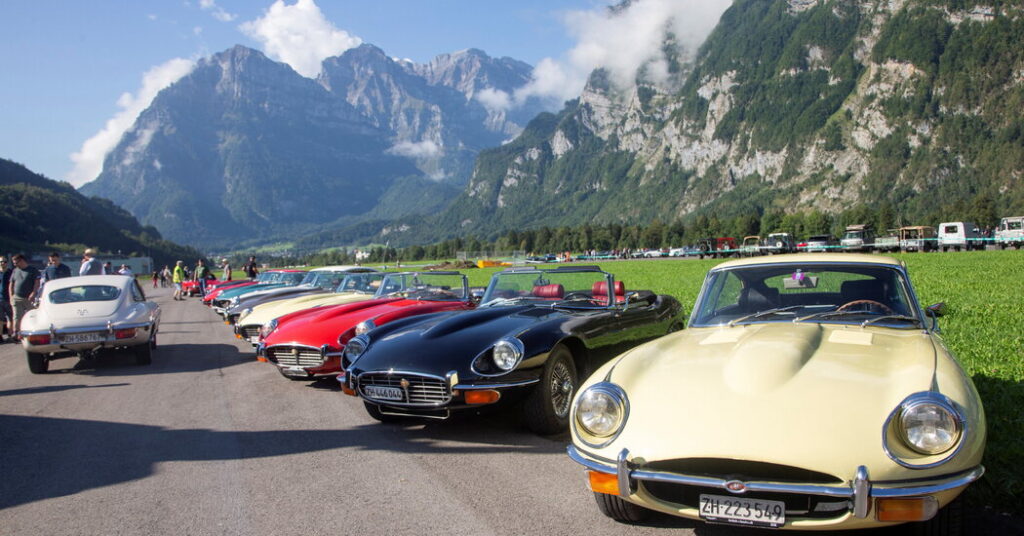
One of Jaguar’s most memorable aesthetic and commercial successes came with the introduction of the E-Type sports car in 1961 at the Geneva International Motor Show. Independent racers coveted the groundbreaking new E-Type, as did motorists who merely wanted to be seen driving what was quite possibly the world’s most beautiful car, an opinion said to have been voiced by Enzo Ferrari. A 12-cylinder version of the E-type would be added to the mix 10 years later, but the XK-powered Series 1 cars are most highly valued today.
The XK engine would soldier on in the much heralded XJ sedan until 1987 and in Daimler limousines until 1992. It was the cornerstone on which the brand was built.
The post The Mighty Engine That Jaguar Built, and Built Jaguar appeared first on New York Times.