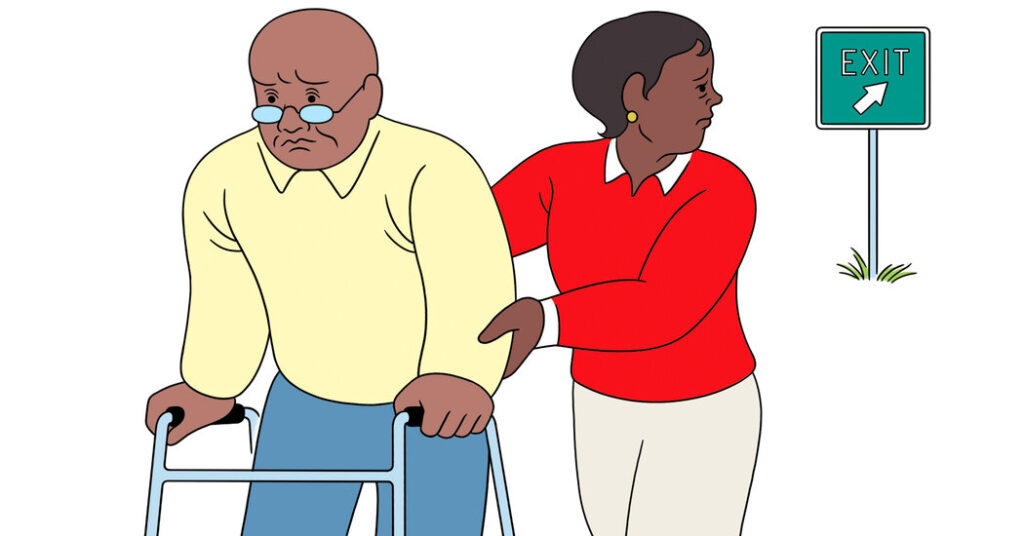
My husband and I have been married for decades. Almost 10 years ago, he was diagnosed with a progressive disease that affects his mobility. Though it started slowly, in the past few years he has had a steep decline.
He is now mostly housebound; although he can drive, getting around once he arrives somewhere is a challenge. He uses a walker and a scooter and he cannot raise his arms well. He falls often, and we recently called 911 for help after he fell and I couldn’t get him up. He gets no exercise and he has gained a lot of weight. We sleep in separate rooms because of his snoring and his needs. I am effectively his caregiver. I am also the housekeeper, laundress, cook, grocery shopper and more. At one time these were tasks we shared; now it’s all on my shoulders.
Mentally he is still functioning, but it has been sad, stressful and difficult for me to watch his decline. It’s also lonely; I feel I no longer have a partner to enjoy activities with. My husband and I traveled extensively during our marriage, and I’m grateful for that as it is no longer possible for us to travel together.
Right now I feel like a shut-in with my husband. We don’t go anywhere or do anything because it’s too difficult. Some friends remain, but others have drifted away because his disability makes people uncomfortable.
I am in good health and have been active all my life. If I left my husband, I would have a more peaceful, less stressful life with more independence and less responsibility. It seems like living single again would be an immense relief, and I would probably be happier. I would like to do it, but I don’t feel morally that I could — to walk out on him now seems selfish. But I have healthy years ahead; it’s my life, and I wish to enjoy what’s left.
My quandary is: Do I stay or do I go? — Name Withheld
From the Ethicist:
Even nowadays, when so many couples choose to write their own wedding vows, those vows typically include some version of the promise to love and to cherish in sickness and in health. There has always been something slightly odd, though, about vowing not only to act in certain ways but also to feel in certain ways. Love isn’t a performance. And while cherishing can be expressed through action, it also involves seeing and feeling that another person is precious. We can try to preserve those feelings, but we can’t guarantee that they will endure. And the emulation of loving behavior motivated by duty alone isn’t what we hope for in a spouse or, for that matter, in a friend.
I say all this because you don’t describe your husband as someone you still love, even as you grieve his limitations. In your account, he emerges as a list of chores, an unliftable burden, as someone whose needs have come at the expense of your own. For many spouses in circumstances like yours, the experience is different: Sorrow and devotion are both present. The caregiving can be lonely and draining, but it can also be a source of meaning. Without that sustaining love, by contrast, the responsibilities of care can result in sheer depletion.
Still, I’m not convinced that your only choices are to stay or to go. Life is usually too complicated for such either-ors. What’s obvious is that too much has fallen on you, and you are buckling under the strain. But the first question to ask isn’t whether to stay the course or plot your escape. The first question to ask is whether you can carve out a more livable existence within the marriage you have.
This would probably begin with practical changes. You’ll want to explore every available form of additional care and support. You’ll want to figure out how to spare yourself some of the labor you describe so that you have time outside the house, time with friends, time for the activities that restore you, perhaps time for the occasional trip on your own. You don’t mention financial hardship; if you have the resources, arranging dependable care could improve not only your life but your husband’s, as well. He may, in fact, be better served by responsible helpers than by a wife who is dejected and nearing her limit.
In your current state, you’d be wise not to make any irrevocable decisions. If cherishing can’t simply be summoned by force of will, then honesty and mercy can still guide you. Consider speaking candidly with your husband — perhaps with the help of a couples counselor — about what this arrangement has become for you and what each of you now needs. What you are facing is an especially painful version of something many long marriages eventually encounter: When one partner becomes far more frail than the other, the life they have shared must be reimagined. The pressing task for you is to see whether that life can be reshaped enough that you aren’t lost inside it.
Readers Respond
The previous question was from a reader who was struggling with how to address her housekeeper’s declining work. She wrote:
My husband and I are both over 50 and work full time. For the past seven years, we’ve employed a woman, slightly younger than we are, to clean our house. … Every few years, she goes through periods of mental health difficulty. During those stretches, she stops working and disappears from contact, leaving us unsure whether or when she’ll return. … Eventually she comes back and resumes a regular schedule. Over the past year, though, the quality of her work has declined sharply. She spends less time at our house, does less overall and often leaves the job unsatisfactorily done. … Any conversation about her performance would be uncomfortable, especially because she used to do the job extremely well. Still, the present arrangement is not sustainable, and we do not know how to proceed. What are our ethical options? — Name Withheld
In his response, the Ethicist noted:
People who work regularly in other people’s homes can come to seem less like employees than friends or even dependents. And the truth is that, in a wide range of relationships, there isn’t a bright line between the transactional and the personal. But that lack of clarity often serves neither party well in circumstances like these. … At the moment you’re dissatisfied, and your cleaner may be at risk of losing her job without ever being told why or having a chance to address the problem. You don’t owe her tenure; you do owe her a direct, respectful conversation. … The question is whether the job can still be done in a way that meets your needs and acknowledges hers. If, after that conversation, it becomes clear that the work can’t be done at the level you need, you should give her reasonable notice and let her make other plans.
(Reread the full question and answer here.)
⬥
I worked as a housekeeper in my youth, and the best jobs I had were the ones where my employers gave me a checklist of what they needed to be done. One employer had a list on a clipboard, and I checked off the items as I did them. Another had them on a laminated sheet of paper that I brought with me around the house. The most frustrating employers were the ones who just said, “Clean the house,” and then would ask me why I didn’t clean X, Y or Z. Clear guidelines aren’t controlling — they set a standard to follow. — Margaret
⬥
I agree that the housekeeper needs, and is entitled to, a long talk — perhaps over a cup of tea, or some other nonconfrontational way. I bit my tongue for two weeks when a good, hard-working employee came in a half-hour late every day for nearly two weeks. Then she apologized and explained that she and her beau shared a tiny kitchen and bathroom and it was impossible for them both to get ready at the same time. She asked if I could let her come in later and stay into the second shift to make sure everything got done. Yes, sometimes it’s that simple. Maybe the housekeeper is falling apart. Maybe there are issues to figure out. But the talk needs to be held to find out. — Mike
⬥
I agree with the Ethicist that a frank discussion is the right thing to do. I would just add that I also recommend the employers put their expectations in writing. Most regular employees (myself included) get an annual performance review. The letter writer’s housekeeper is their employee and should be provided fair notice of expectations for the job. The fact that this hasn’t been provided before shouldn’t make it awkward to do so now — indeed, the lack of expectations may be part of what’s led to the decline in the first place. — Lisa
⬥
As the daughter of a housekeeper, I can say: Talk to your housekeeper! Communication is key. Over the years, previous employers have unceremoniously replaced my mother (though with generous payouts) without talking to her, just to avoid much-needed conversations. This is a job I’m sure your housekeeper wants to keep, so as uncomfortable as it might feel, please speak up. Ethical next steps can only be taken once both of you have been heard. — Nicole
⬥
We had a building custodian whose work was obviously slipping well below what was acceptable. We ultimately broached the topic and told him we needed to replace him. He was so relieved! He knew he couldn’t do the job anymore, but he feared he’d be “letting us down” if he resigned. So for months, everybody was dissatisfied but afraid to bring it up to the other party. — Jeff
The post My Husband’s Illness Has Me Feeling Trapped. Do I Have to Stay? appeared first on New York Times.