Like many K-pop fans around the globe, Yuroy Wang, a 22-year-old retail worker in Taipei, loves Korean culture but doesn’t speak the language. So when he went last fall to a touring production of “The Second Chance Convenience Store,” a play based on a Korean novel that was a best seller in Taiwan, he expected to follow the dialogue via supertitles.
Instead, he was offered a more high-tech alternative: a pair of A.I.-powered glasses.
“As soon as I found out they were available,” Wang said, “I couldn’t wait to try them.”
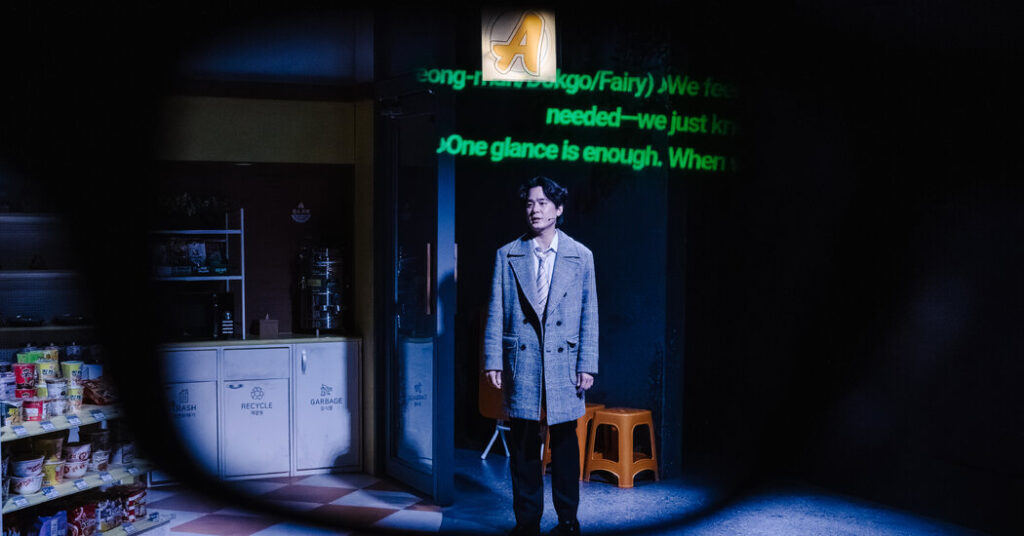
The setup includes a pair of thick black-framed glasses that connect to an app on a smartphone. You choose from Korean, English, Japanese or Chinese, set the font size and decide where on the lenses you want to see the text. When the lights go down and the actors start speaking, an A.I.-powered program listens for cue words and matches a translation to the dialogue, allowing you to follow the action onstage seamlessly.
Wang said the glasses were a novel viewing experience that allowed him to follow the story more easily, although there were a few technical glitches. “I would definitely use them again,” he said, “at least until I become fluent in Korean.”
A growing number of South Korean theater productions, at home and on tour, are making these glasses available thanks in part to the Korea Tourism Organization. Last year, a four-month-long program from the agency called Smart Theater financed the use of the glasses in Seoul and at select overseas events.
Many of the producers involved saw the promise in the tool and are now paying for it out of pocket. Along with the country’s cultural authorities, they are hoping that the glasses can help overcome a language barrier and turn Korean theater into a force as powerful as Korea’s music, film and beauty industries.
Hwang Ki Hyun, the chief executive of Project Jiwoo, the production company behind “The Second Chance Convenience Store,” said the growing number of foreigners interested in Korea was a huge untapped market.
“Maybe I’m being stubborn, but it doesn’t feel right for something to be Korean only visually,” he said. “I think the Korean language can be a part of that charm to foreigners, too.”
As a producer who dreams of Broadway, he wonders: How far can the glasses take him?
Ready for Export
The technology for the glasses was developed by Xpert Inc., a Korean start-up company that originally set out to make glasses for people who need help hearing but tweaked its software for theatrical performances last year. Its system, called Owl, is programmed into glasses by a Chinese partner that manufactures the frames and hardware.
Unlike onstage supertitles and some other subtitle glasses, which require a human operator to match the text with the action, Owl uses A.I. to listen for word cues and keep everything in sync. The current system has some glitches and still sometimes requires human intervention to resolve those, but Brian Kim, Xpert Inc.’s director, said the ultimate goal was to translate dialogue into any language in real time.
While Korea has been a major exporter of theater within Asia for over a decade, the rise of its soft power and the recent success of the show “Maybe Happy Ending” is changing how Korea’s industry sees its potential. That musical premiered in a small theater in Daehangno, Seoul’s theater district, in 2016 and went to Broadway in an English translation in 2024, sweeping up six Tonys the following year.
Suh Hong Seok, the writer and producer of “Inside Me,” a musical about a social media star, said the success of “Maybe Happy Ending” in New York had unlocked a wave of funding. “People began to think ‘Oh, a domestic small-theater musical could go to Broadway, win awards and make money,’” he said. “And suddenly, investments and grants opened.”
According to a budget proposal released last fall, Korea’s Ministry of Culture, Sports and Tourism plans to allocate $18 million in funding for Korean musicals this year, up $14 million from 2025. Jang Kyung-min, the chairman of the Korea Small Theater Association, said government grants can be a lifeline to small playhouses, which make up the bulk of Korea’s theaters, but generate only a fraction of the sector’s revenue.
Lee Jeehyun, who helped coordinate the A.I. glasses program, said the shows involved are chosen based on their potential to attract foreign audiences. “The Second Chance Convenience Store” was selected in part for the international popularity of the novel. “Inside Me” and another show called “Finding Mr. Destiny,” a musical about searching for a missed connection, garnered points based on their accessible themes and K-pop music, Lee said.
While many of the producers applied with a hunch their shows would do well, some said they were pleasantly surprised by how effective the program — which also included promotional events and advertisements — was in bringing in new audiences. According to the producers of “The Second Chance Convenience Store,” “Inside Me,” and “Finding Mr. Destiny,” non-Korean visitors to their shows have increased from almost none to an almost daily presence.
Promising Tech, Room for Improvement
Most users of the glasses had fairly positive reviews, remarking on how much better they were than other alternatives. Unlike with supertitles or tablets, the audience members no longer had to move their eyes from a screen to the stage and back. Everyone interviewed said they would use the glasses again, but pointed to minor issues when asked.
Josh Chua, a tourist from the Philippines at “Finding Mr. Destiny,” said he was happy overall with the experience, but found putting the A.I. glasses on over his own spectacles a little cumbersome.
Zhala Huseynova, an Azerbaijani resident in Korea, said she saw “Inside Me,” free, as part of a group called Global Seoul Mates — a Seoul Tourism Organization program that invites foreigners to events in exchange for social media posts. While the glasses were helpful, she said, there were some sync issues, inaccurate translations and ad-libbed moments that the technology couldn’t capture.
Upgrades, from Xpert Inc. and competitors, are on their way. This spring, Xpert Inc. is rolling out a lighter model that sits more easily atop a primary pair of glasses. The company said it’s next step is improving its accuracy. Elsewhere, smart caption glasses by Built for Good and real-time translations by Xrai Glass, both British companies, are entering theaters in the United States and across Europe.
Kim Jae Woo, a “Finding Mr. Destiny” producer, acknowledged that the Xpert Inc. software had a ways to go, but said he viewed the technology as a long-term investment that he hoped would ultimately pay off. Many other producers said they were patient about the technology and were looking into exporting their shows in translation.
Hwang was an exception. He said he had twice rejected proposals to stage “The Second Chance Convenience Store” in other languages. While he admitted there could be a dollar amount that would persuade him otherwise, he said he was taking a calculated risk on the idea that non-Koreans want Korean content in its original language — which means he needs technology to bridge the language gap.
Beyond the Barrier
There are other hurdles to clear before Korean shows reach Broadway. Ji Jae Hyuk of Acom, a producer of large-scale Korean musicals, said that while the company’s show “Arang” — which is playing in Korea with A.I. glasses — is in talks about a New York run, union rules would most likely mean an English-language performance.
Experts overseas expressed cautious optimism about how the A.I. glasses could boost Korea’s cultural exports.
Sarah Bay-Cheng, a professor of emerging technologies in theater at the University of Toronto, said she saw Korea as an interesting test case. If the glasses take of there, she said, it could mean that anyone — regardless of what language they speak — could become open to a new range of live performances, she said. Pointing to the international fandom of BTS, who often long to hear the song in its original Korean, she suggested there was already a thirst for content in other languages.
Heather Shields, a founder of the educational organization Business of Broadway, has run several workshops with Korean producers over the years. She said she believed a growing interest in Korea could translate to growth for Korean musicals.
“Whether it’s K-beauty, K-pop or K-movies, one of the hallmarks across the board is quality,” Shields said. “And the more that people begin to make that association, the more it can help in the translation of ‘I love K-pop’ to ‘I’m willing to take a gamble with my time on a K-musical.’”
The post With A.I. Glasses, Korea’s Theaters Hope for a K-Pop Moment appeared first on New York Times.