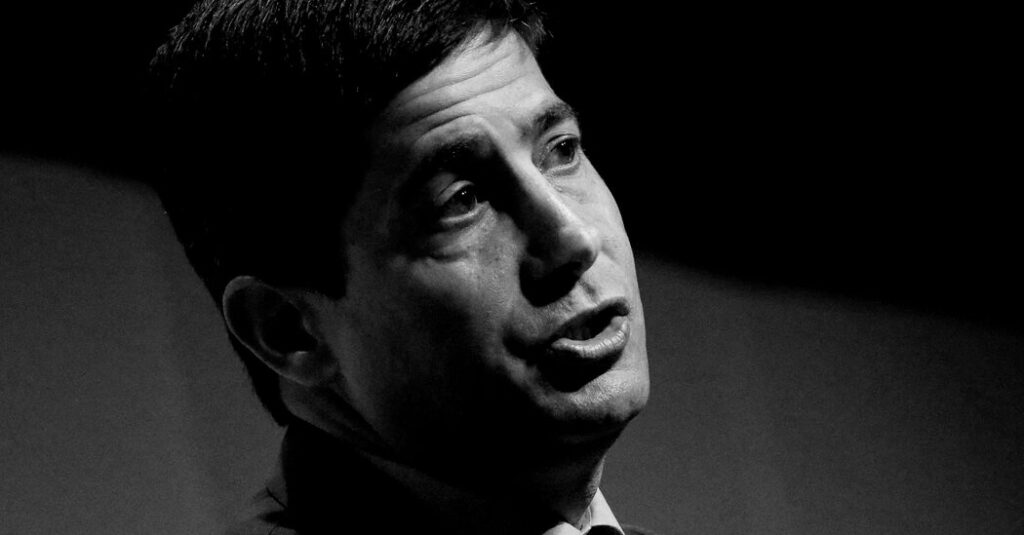
Kevin Warsh looks great on paper. President Trump’s pick to serve as the next chair of the Federal Reserve is a former Fed governor with extensive experience in the financial industry. He has many admirers both on Wall Street and in Washington.
But Mr. Warsh has a credibility problem. Central to the Fed’s mission of managing the American economy is the institution’s independence. The Fed’s board, like the Supreme Court, is composed of a group of experts who are chosen by presidents but who do not take directions from the White House. That operational freedom allows the central bank to make policy decisions that are in the nation’s economic interest, even when those decisions are politically unpopular.
Mr. Trump has trampled on the Fed’s independence. He has tried to bully its leaders into cutting interest rates to boost economic growth now, even at the expense of inflation later. He has repeatedly said that he would nominate a Fed chair who agreed to comply with his demands. “If I think somebody’s going to keep the rates where they are or whatever, I’m not going to put them in,” the president said last summer. “I’m going to put somebody that wants to cut rates.”
This vow meant that any subsequent choice of Mr. Trump’s would be suspect. When senators question Mr. Warsh at a confirmation hearing scheduled to start Tuesday, they must assess whether he would perform his duties as a public servant or serve the interests of the president. Hanging over the hearing is the Justice Department’s sham criminal investigation of the current Fed chair, Jerome Powell. The investigation was an attempt to intimidate Mr. Powell into cutting rates and to punish him for not having done so. Senator Thom Tillis, the North Carolina Republican who will preside over the hearing, has promised to block Mr. Warsh’s confirmation until the investigation ends. Mr. Tillis should keep his promise.
In the meantime, we believe that three questions for Mr. Warsh require particular attention from the Senate.
1. Is Mr. Warsh committed to Fed independence and to fighting inflation?
As a Fed governor from 2006 to 2011, Mr. Warsh built a reputation as a determined inflation fighter. He argued against interest rate cuts in 2008 even as the economy tipped into crisis. He continued to warn that the Fed was overstimulating the economy for years after the crisis, even as the persistence of high unemployment made clear that, if anything, the Fed had failed to do enough to increase growth.
But in recent years, Mr. Warsh has sounded less worried about inflation and more worried about pleasing Mr. Trump.
In 2018, during Mr. Trump’s first term, Mr. Warsh went to bat for the president, arguing that the central bank should extend the stimulus campaign he had once opposed. Since Mr. Trump’s return to office last year, Mr. Warsh has resumed his advocacy for easy money. Last summer, he criticized the Fed for keeping interest rates too high. “Economic growth in the U.S. is poised to boom, but it’s being held down by bad economic policies coming from the central bank,” Mr. Warsh said on Fox Business. “Interest rates should be lower.”
Mr. Warsh has offered a rationale for his newfound enthusiasm for lower rates. He argues that productivity gains fueled by the rise of artificial intelligence will allow the Fed to keep rates low without fueling inflation, as it did during the 1990s boom.
That would be a gamble. Mr. Warsh himself acknowledges those productivity gains are not yet visible in the economic data, and inflation has remained above the Fed’s preferred 2 percent annual pace since 2021. The war with Iran pushed the inflation rate up to 3.3 percent in March, the highest since Mr. Trump returned to office. To keep prices under control, the nation needs a Fed chair who is willing to defy the wishes of the president.
When central bankers instead try to please presidents, everyone suffers. The outstanding example in American history is the case of Arthur Burns, the Fed chair whose deference to President Richard Nixon unleashed the Great Inflation of the 1970s. Mr. Warsh needs to demonstrate a willingness to make decisions that Mr. Trump does not support.
2. Does Mr. Warsh plan to hand over the Fed’s keys?
In a worrying sign for the Fed’s independence, Mr. Warsh has proposed to involve the Treasury Department in decisions about the central bank’s balance sheet.
The Fed makes investments to manage interest rates, raising or lowering borrowing costs for businesses and consumers. It currently holds $6.7 trillion, mainly in bonds issued by the federal government and in mortgage-backed securities.
Mr. Warsh wants a smaller balance sheet, and he wants to sell mortgage bonds. He argues that investing in mortgage bonds encroaches on the role of fiscal policymakers, because it targets interest rates in a specific sector of the economy.
There are reasonable arguments on both sides of that issue. But Mr. Warsh goes further. He says that he wants the Treasury to participate in the decision making. “The Treasury secretary would need to find the proposed change in Fed holdings acceptable, given that it is partially fiscal policy in disguise,” he told Barron’s in October.
The proposal is narrow and technical, but the precedent is dangerous. It would give Treasury officials, who answer to the president, a formal role in shaping the Fed’s monetary policy.
3. Does Mr. Warsh have too much faith in financial markets?
In addition to setting interest rates, the Fed is charged with keeping the financial system in good health. Republican presidents, and their Fed appointees, have tended to discount this responsibility. A key cause of the 2008 crisis was the almost religious conviction of the Fed’s longtime chair, Alan Greenspan, that regulation was often unnecessary because market discipline would keep financial firms in line.
Mr. Warsh has acknowledged that he was among those who failed to understand the weakness of the financial system before the 2008 crisis. So did many experts. We are more concerned that he does not seem to have grasped a central lesson of that crisis — that vigorous government oversight is necessary for markets to remain healthy and to function properly.
In the aftermath of the crisis, the Fed embraced its regulatory role with the conviction of the newly converted, and with the aid of new powers granted by Congress. Mr. Warsh, however, has described some of the key safeguards the Fed put in place as unnecessary or unduly burdensome to the financial industry. For example, he has argued that annual stress tests for large banks like JPMorgan and Citigroup have become ineffective, which is not the case. He also has suggested that those banks should be allowed to rely more heavily on borrowed money to fund their operations, reversing another of the Fed’s post-crisis stringencies. Both moves would leave the financial system more vulnerable to crisis.
His distaste for regulation is particularly concerning because financial innovation is straining the current system. Crypto and private credit are moving a growing share of financial activity beyond the reach of existing rules and regulators. The rise of new, unregulated forms of finance is a longstanding pattern. The moment requires a Fed chair who understands the need for new rules to prevent meltdowns.
The modern financial history of the United States is divided between periods of strict regulation, during which tranquillity has been the rule, and periods of lax regulation punctuated by destabilizing crises. By catering to the financial industry, Mr. Warsh would increase risks to the health of the broader economy.
These are not the only issues that deserve the Senate’s attention. The Senate should also ensure that Mr. Warsh has a plan to avoid financial conflicts of interest. He owns more than $100 million in assets, which can lead to many potential conflicts. Avoiding them is feasible, but he needs to offer a more credible strategy than senior members of the Trump administration, including the president, have for their own holdings.
The next Fed chair will shape not just the institution but also the nation’s economic path for years to come. The importance of reserving that role for someone who is both independent and principled has long been a matter of bipartisan consensus. Senators must press Mr. Warsh so they can decide whether he meets that standard.
The Times is committed to publishing a diversity of letters to the editor. We’d like to hear what you think about this or any of our articles. Here are some tips. And here’s our email: [email protected].
Follow the New York Times Opinion section on Facebook, Instagram, TikTok, Bluesky, WhatsApp and Threads.
The post Three Questions for Kevin Warsh appeared first on New York Times.