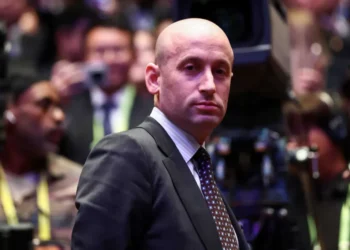
House Speaker Mike Johnson convened a vote in the dead of night on Friday, calling lawmakers back to the floor after midnight in a push to preserve a surveillance program that allows federal agents to read the communications of Americans without a warrant. Twenty Republicans broke ranks and sank it, a sharp rebuke of both Johnson and President Donald Trump, who had spent the week personally working holdouts to back the bill.
The failed vote caps weeks of bipartisan resistance to a clean reauthorization of the surveillance program, authorized under Section 702 of the Foreign Intelligence Surveillance Act. The 702 program permits wiretaps of communications ostensibly belonging to foreigners overseas, but is also known to intercept vast amounts of Americans’ emails, texts, phone calls, and other data—private messages that the FBI and other agencies routinely access without a warrant.
Congressional authorization for the program will expire on Tuesday. The White House and GOP leadership have spent weeks pressing for a “clean” reauthorization, fending off a bipartisan alliance of House Freedom Caucus Republicans and progressive Democrats demanding, variously, that the FBI obtain warrants before searching Americans’ messages and that Congress ban the government from buying Americans’ personal data from commercial brokers.
A handful of Democrats led by Congressman Jim Himes of Connecticut, the top Democrat on the House Intelligence Committee, have joined the White House in lobbying against new restrictions.
House Republicans revolted twice in the small hours of Friday morning, ultimately sinking the bill. Shortly after 1 am ET, a dozen Republicans joined nearly every Democrat to kill a leadership-backed amendment that would have extended Section 702 for five more years.
The amendment contained a provision that was in essence a fake warrant requirement. It would have prohibited government officers from “intentionally” targeting Americans’ communications without a warrant—conduct that is already banned by the statute. It also offered the government a warrant path if agents had probable cause to suspect the subject is an agent of a foreign power—an authority that already exists independent of the Section 702 program and adds functionally nothing new to the law.
The final blow came after 2 am, when the 20 Republicans voted again to block the original version of the bill, which seeks a shorter 18-month extension. Those 20 votes were drawn almost entirely from the House Freedom Caucus and the party’s libertarian wing, including Andy Harris of Maryland, the caucus chair; Thomas Massie of Kentucky; Chip Roy of Texas; Warren Davidson of Ohio; and Lauren Boebert of Colorado.
In a rare defeat on a procedural vote that typically passes along party lines, GOP leaders walked away with only a 10-day extension, pushing the fight to the end of the month. The House’s failure leaves the Senate to sort out what comes next, starting with whether to approve the extension next week.
The vote’s collapse followed a week of hard effort by the Trump administration to assuage Republicans who’ve objected to the FBI’s warrantless access and its documented history of querying that data for political purposes. Trump hosted Freedom Caucus holdouts at the White House on Tuesday, trying to close the deal. Democrats, meanwhile, were briefed Monday by two former senior Biden officials urging them to back the extension, according to a person familiar with both events.
The FBI has used Section 702 data to run warrantless queries on a US senator, 19,000 donors to a congressional campaign, Black Lives Matter protesters, and both sides of the January 6 Capitol attack, according to declassified court rulings and government transparency reports.
Congress’ votes on extending Section 702 authority this week are not strictly necessary to keep the program operational in the short-term. The Foreign Intelligence Surveillance Court quietly recertified the program in a classified ruling on March 17, authorizing collection to continue through March 2027 even if Congress fails to act. Running the program on court authorization alone, with the underlying statute expired, would leave it on politically thin footing, however, and on untested legal ground.
That legal footing depends on an oversight system that is currently in shambles. The surveillance court itself relies on the US Justice Department to self-report violations. But the agency has been repeatedly rebuked by federal courts over the past year for inaccurate filings. FBI director Kash Patel has shuttered the bureau’s Office of Internal Auditing, the unit whose data previously surfaced hundreds of thousands of improper searches. And civil service protections for the FBI attorneys and supervisors who approve sensitive queries have been stripped by executive order.
According to The New York Times, which first reported the surveillance court’s recertification, the same court also found serious compliance problems with how intelligence agencies query the 702 database, including the use of so-called “filtering tools” that allowed analysts to pull up Americans’ messages while evading oversight the law requires. The court has reportedly ordered the FBI and other agencies to rebuild the tools or stop using them. According to the Times, the administration is weighing whether to comply or appeal.
Senator Ron Wyden, an Oregon Democrat and the Senate Intelligence Committee’s most persistent critic of the program, issued a rare cross-chamber letter to House members on Monday, urging them to delay reauthorization until the court’s ruling is declassified.
“There are multiple issues related to Section 702 that the American people and many Members of Congress have been left in the dark about,” Wyden wrote, “including a FISA Court opinion from last month that found major compliance problems. These matters should be declassified and openly debated before Section 702 is reauthorized.”
In a separate statement on Tuesday, Wyden warned that the administration’s apparent plan to appeal the ruling rather than comply was “a highly aggressive and unusual move indicative of an administration that would exploit every angle to expand its surveillance at the expense of Americans’ rights.”
The post Republican Mutiny Sinks Trump’s Push to Extend Warrantless Surveillance appeared first on Wired.