Lena Dunham returned to social media this month after a yearslong absence. “So I wrote a memoir,” she posted on X, with a looping GIF of herself as the Brooklyn imp Hannah Horvath of “Girls,” the show she created, scripted and starred in. She’s waving her fingers like a boogeyman as she confronts a smiling Patrick Wilson, whose pretty face instantly falls. The clip is from “One Man’s Trash,” an exhilarating episode from the show’s second season, in which Wilson plays a handsome doctor who spins with Hannah into a brief and frantic affair.
It was a canny reintroduction for Dunham: the GIF form itself, a relic of the “Girls” era; the callback to the passive-aggressive affectation once observed by millennials sharing their latest online piece, “So I wrote a thing”; her self-aware jump scare, winking to the fact that many of her previous public engagements created firestorms so intense they seemed to singe the fingers of the audience scrolling along. Now she was back to charm us once again, coaxing us under the covers of her inner life.
It’s stunning to recall how quickly Dunham’s name gained headline recognition, and became weighted with significance that one person alone could not bear. She became a synecdoche for a whole tangle of identities — white, millennial, liberal, feminist, hipster, brilliant, fat, naked, privileged, self-centered and oblivious — only some of which she could credibly be accused of embodying at any given time. (“One Man’s Trash” itself was, like so many things she touched, bizarrely controversial.) The new memoir is titled “Famesick,” after what she believes this did to her. It begins with Dunham’s reflection on how it felt first for her own name to slip out of her grasp, and then for it to grow into a kind of golem that stalked her success and occluded her artistic vision.
The announcement of “Famesick” was met with both excitement for Dunham’s return and grumbling at the return of a certain type of discourse, one that I contributed to as a blogger for women-focused sites in the early 2010s. My phone shuddered as that long-dormant internetwide discussion creaked back into motion — and delivered a Slack message from an editor, asking if I, a 40-year-old woman who long ago left such youthful pursuits behind, was interested in writing about the peculiar media environment that made, and then unmade, Lena Dunham.
I read the book, my heart pulsing with envy at the creative life she claimed, anxiety at how she lost it, and recognition of myself all over. Internet commenters have staked out their positions. Some rustle through their memories to retrieve old lists of Dunham grievances; others claim they loved her all along. When Dunham held up her fun-house mirror to young millennials who were uncomfortable in their skin and confused about their place, many became entranced by her vision, jealous of her success, pained by her missteps and obsessed with how “real” every facet of the show was. Now they are old enough to appreciate what Dunham did. As one podcaster put it on X, “She’s like the collective millennial id.” And for a moment in the early 2010s, we were her pitiless superego.
The World That Made Her
Dunham arrived, in threadbare flats, at the last gasps of the monoculture and the first breaths of the social internet. New-media start-ups like BuzzFeed, Vox and Vice News were collapsing news into entertainment and creating jobs for young writers for as long as the Facebook algorithm would support them, and scrambling the lines between celebrity, critic and fan. BuzzFeed produced many journalists, but also Alison Roman and Quinta Brunson, and everyone with a Twitter account was made to feel as if it were possible to post one’s way into their club.
It was the height of what was called ladyblogging, a word that now carries the funk of millennial jargon, but at the time represented a fresh outlet for young women who had something to say, whether political snark or self-conscious sex diaries. “Girls” was met by a generation doing almost real-time memoir and criticism, which became a vehicle for certain internet writers to develop their own personae — voicey and agenda-setting, despite their youth and inexperience. The publications attracted their own self-branded fans: Jezebel had its Jezzies, The Hairpin its ’Pinners, The Toast its Toasties.
The “Girls” discourse was so generative because “Girls” was such a juicy text, enriched by Dunham’s public character. She was just as interesting to feminist writers as she was to gossip bloggers and misogynistic trolls, who were coming into their power through the coordinated harassment campaign of Gamergate (and would soon move on to the conspiratorial world-building of Pizzagate). There was some confusion in that moment about how to read work of the kind that Dunham was making, but it was read — insistently, immediately, often intelligently, but increasingly unsympathetically.
This was a fecund period of first-person writing by women that had a transgressive and self-revealing quality, which also had the consequence of creating a kind of adrenalized form of commentary. Blogging was personal, but also a job, often a grind. It created cycles of argument that were rapid, intense and often punishing for the people at the center — both the subjects and the writers. As post quotas were filled, a slippage occurred between the artist and her public, the blogger and her commenters, the internet-famous and the real stars. “Girls” permeated this media ecosystem from Episode 1, which turbocharged its success and rattled the woman at its center.
“I hadn’t expected the swift and vicious hammer of the people who were ostensibly my peers,” Dunham writes in the book. “‘New York media’ in the early 2010s was a very specific kind of shark tank,” where a story with a hurtful headline was “usually written by someone I had once casually known, laughed with at a party, slept with the same cringey guy as.” Her critics were more likely to resemble Hannah, her normie alter ego with Midwestern parents, than Dunham, who was raised by avant-garde artists in a doorless TriBeCa loft and landed a TV show at 24. But like the clichéd hero and villain who are not so different, you and I, Dunham and her critics became enmeshed in a codependent saga.
Neither could let go. An inveterate poster, Dunham lived online and seemed determined to step on the rake of commentary as her influence scaled. Dunham and her then creative partner Jenni Konner launched their own media project, Lenny Letter, a year before the 2016 election; Dunham interviewed Hillary Clinton in the first dispatch. Later that year Dunham said on her “Women of the Hour” podcast that she wished she could have had the experience of aborting a pregnancy, for which she was widely criticized. She explained that her comment was made under the guise of “a ‘delusional girl’ persona I sometimes inhabit,” but this was the kind of artistic frame that worked so winningly in her show and less so in the stricter world to which many of her journalistic critics were tethered. Her name, and her auto-fictional project, had wandered beyond their creative boundaries, and the internecine debates of blogs had ballooned into a national concern. When Clinton lost the election, some blamed Dunham.
Within five years Dunham’s propulsive rise had set her up for a long fall. In 2017, on the day she returned home after a hysterectomy (and while she was, as she has clarified, “on drugs”), she posted a public defense of a male “Girls” writer who had been accused of rape. The fallout finally prompted a retreat from public life. Dunham says she bitterly regrets the statement, but this was in the explosive days of the #MeToo era, and the preconditions of the internet at that time inscribed a public figure’s banishment with a kind of finality. That was before Donald Trump’s re-election, the rise of the anti-woke manosphere, and the cultural backlash to cancellation that released some of the all-consuming expectations placed on artists like her.
What Is That World Now?
Lena Dunham was a hinge figure: between old forms of criticism and new, often chaotic ones; between crafting a persona as an artist with some degree of cover and doing so in public, with every step exposed and instantly processed; between a more freewheeling misogyny and the correctives of #MeToo. Millennials are still living in the aftermath of her world.
“Famesick” is about how her body and mind were damaged by her turn in that gyre. Now she is undertaking a big return to the kind of meta commentary about herself that so defined and dogged her work. Though she has been working steadily all along, none of her projects after “Girls” generated much in the way of discourse (maybe because many of the outlets that once covered Dunham are now dead). This has cleared the way for a generation-wide “Girls” rewatch, an opportunity for millennials to experience the show from the vantage of middle age and without the incessant real-time commentary.
Younger audiences are also discovering “Girls” for the first time, some romanticizing the indie-sleaze, BuzzFeed-listicle, cringe-alt-covers-of-rap-songs era it represents. In 2026, “Girls” supplies a pleasing and even quaint respite from contemporary life.
But Dunham is in many ways a cautionary tale — certainly for female celebrities, the most successful of whom now run their lives as steel-trap operations. Fandoms these days are ridden with sleuths and narcs who jostle for narrative dominance over their favorite artists; Dunham’s mumblecore peer Greta Gerwig seems to emerge only to grant formal interviews about her I.P.-driven blockbuster films, and Dunham’s friend Taylor Swift, who has talked about the punishing qualities of the 2010s, has made her persona a monument to control.
And for the average person logging on to social media, Dunham prefigured the dangers of a kind of oversharing that continually tosses private citizens into the jaws of fame. The far-right harassment machine has won the day, and it’s Dunham’s most brutal misogynistic critics who proved to have the most durable legacy, showing people that in a post-woke, casually callous and conspiracy-minded era, sharing one’s life can be dangerously consequential. The internet of Dunham’s time created a mode of radical self-exposure, and then punished people for it. It’s rare now, and necessary, to have a public figure who, despite the costs, opens all of herself to us — this time, to promote a book about how that almost killed her.
Amanda Hess is a writer at large for The Times and the author of “Second Life: Having a Child in the Digital Age.”
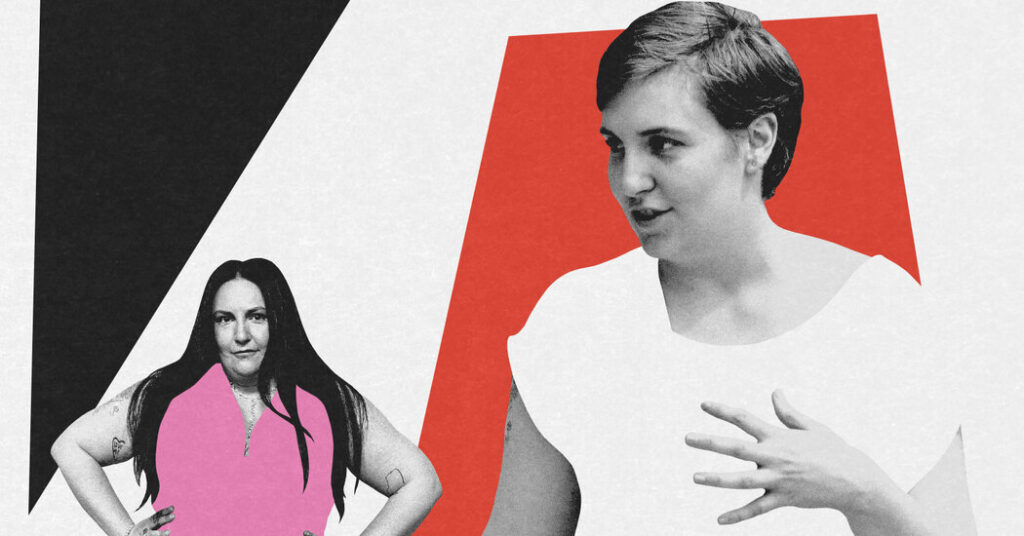
Source images for illustration above: Bauer-Griffin, via Getty Images; Siri Stafford/Getty Images; Jason Mendez/Getty Images; Alessio Botticelli/Getty Images.
The post Lena Dunham Made Millennial Culture. Then She Was Undone by It. appeared first on New York Times.