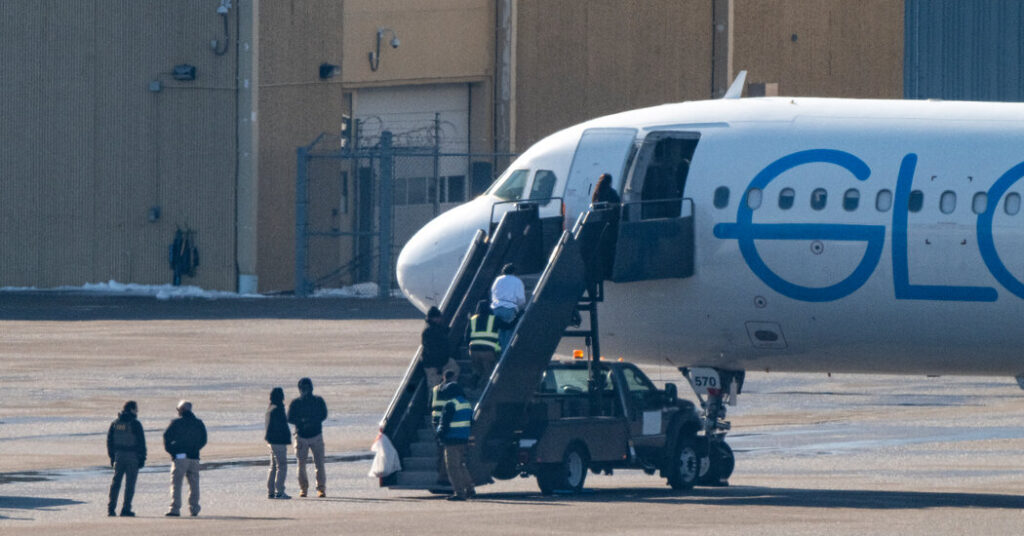
The Department of Homeland Security recently doubled its fleet of jets to carry out deportations under the Trump administration, shelling out $304 million for five planes including two high-end Gulfstreams, according to government documents and interviews.
The contract to buy the planes is intended to make it easier and, department officials say, cheaper to expel people from the country. But it is coming under scrutiny for its overall price tag as well as the inclusion of the Gulfstreams, which can accommodate fewer than 20 passengers and are more typically used as private jets for C-suite executives and high-net-worth individuals.
The purchase late last month included the two Gulfstream G650ER jets, two Boeing 737 planes, and a Boeing 737 Max, according to two people familiar with the purchase. In total, the Homeland Security Department has bought 10 jets as part of an effort to acquire and operate its own fleet of planes to deport people.
Administration officials have said that it would save taxpayer money for the department to operate its own planes. Immigration and Customs Enforcement has typically relied on chartered flights and commercial airlines to carry out deportations. But the purchase of the Gulfstreams struck some former ICE officials and aviation experts as a puzzling choice.
“I find that incredibly questionable,” said John Sandweg, an acting director of Immigration and Customs Enforcement during the Obama administration.
Richard Aboulafia, an aerospace consultant, said he thought the department had many options to buy less expensive jets that could be used for deportations.
“It’s bizarre,” Mr. Aboulafia said. “These are jets normally associated with billionaires.”
It is unclear how the department will move forward with the plan to operate its own fleet. A department spokesperson said in a statement on Friday that the agency was “assessing” its resources, including the planes, under the new homeland security secretary, Markwayne Mullin.
“Under new leadership, D.H.S. is assessing all our resources, including aircraft, to maximize efficiency and continue to deliver on President Trump’s mission of securing the homeland for all Americans,” the statement said. “Secretary Mullin is 100 percent focused on ensuring the needs of our department are met while being the best possible steward of taxpayer dollars.”
It is the latest contract to be scrutinized as questions have emerged about whether Homeland Security Department leaders are properly spending a windfall of funds for Mr. Trump’s immigration crackdown.
The money for the jets comes from Mr. Trump’s major domestic policy bill, which Republicans in Congress passed last year. The package gave the department more than $170 billion over four years to deliver on Mr. Trump’s pledge to deport millions of immigrants in the United States.
The 737 Max the department bought as part of the contract last month has been heavily criticized. NBC News reported in February that the department was seeking to purchase the $70 million executive jet, which it was chartering then. Images obtained by NBC showed that the plane had luxury amenities like a queen bed and large flat-screen TVs. The department said at the time that the jet was needed for deportations and travel by Kristi Noem, then the secretary.
The Wall Street Journal reported this month that the administration planned to keep the 737 Max for certain cabinet secretaries to use, even after Mr. Trump ousted Ms. Noem. The department did not respond to questions about whether the plane would still be used for deportations.
All 10 planes were purchased from Daedalus Aviation, a Virginia-based company. William Walters, the company’s president and a former State Department official, confirmed that the department had bought five additional planes from the company last month, saying the firm was “happy to support” the contract.
It is not unusual for ICE to use smaller jets to carry out some deportations, particularly for immigrants who are deemed national security threats or who are wanted in their home country. The agency has said publicly that it used older Gulfstreams and similar planes to carry out those deportations previously.
For “small, special high-risk charter missions,” ICE has chartered smaller jets such as a Gulfstream IV “or equivalent,” according to an archived ICE page last updated in January. That Gulfstream IV was introduced in the late 1980s, while the G650ER is a newer model that was brought onto the market in 2014.
The average cost of chartering a special high-risk flight is $6,929 to $26,795 per flight hour, depending on aircraft requirements, according to the ICE page.
Mr. Sandweg, the former acting ICE director, said those types of deportations were relatively few, and he questioned whether it was more efficient to buy the premium Gulfstream jets rather than continuing to charter those flights.
“Those Gulfstreams would only be used for high-risk individual removals, and the volume of those is so low that I think it’s incredibly hard to justify a business case,” Mr. Sandweg said.
It is not the first time the department has drawn criticism for its purchase of Gulfstreams. The department was also scrutinized last year after it bought two G700 jets for Ms. Noem and other top department officials for $172 million.
The contract for the five planes was finalized amid the department’s shutdown, which started two months ago after Congress failed to reach a deal to fund the agency. Even as some basic functions of the agency have been disrupted — such as critical training programs at the Federal Emergency Management Agency — the department has been able to press forward with Mr. Trump’s immigration agenda because of the funding from his domestic policy bill.
Madeleine Ngo covers immigration and economic policy for The Times.
The post Homeland Security Expands Deportation Fleet With High-End Jets appeared first on New York Times.