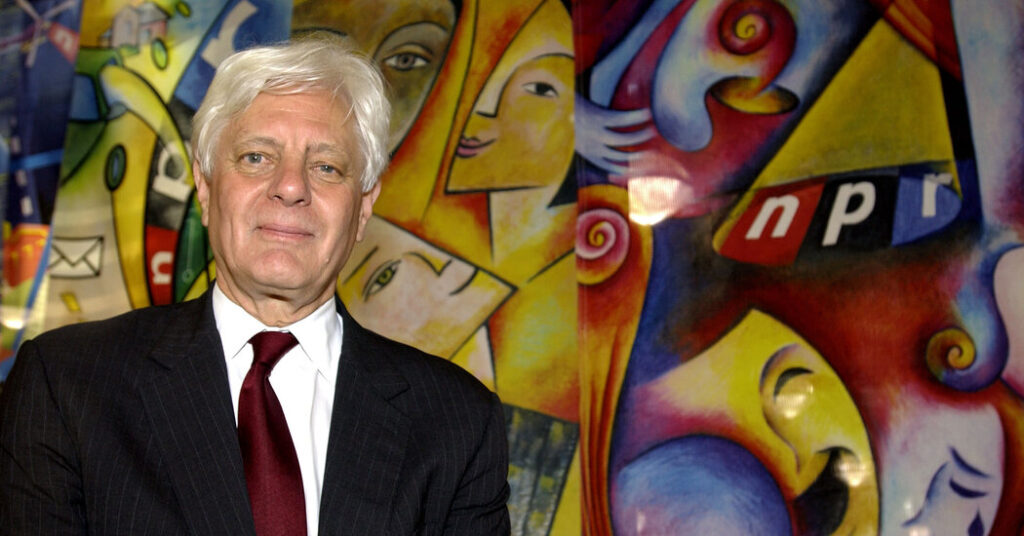
Kevin Klose, a veteran journalist who joined NPR as president and chief executive in 1998 with no fund-raising experience, and then more than doubled its audience, budget and endowment over the next decade — above all by landing a $230 million gift from Joan B. Kroc, widow of the McDonald’s founder — died on Wednesday in Washington, D.C. He was 85.
His wife, Deborah Ashford, said his death, in an assisted living home, was from Alzheimer’s disease.
Mr. Klose had been a widely respected reporter and editor at The Washington Post whose career there included four years as its Moscow bureau chief.
But his arrival at NPR, after five years running Radio Free Europe/Radio Liberty, was met with some concern. There were worries that he lacked the background in high-stakes donor management that the network, a nonprofit, needed, especially with the aggressive expansion plans he had in mind: a West Coast reporting and editing hub, more foreign bureaus and a more diverse range of programming and hosts.
“We were just at a place where we really needed to step up in a new way,” he told The Post in 2003. “We just needed to get deeper and wider and better at what we were doing. And I believe we’ve made credible and significant progress in all of those areas.”
Mr. Klose did much of what he had set out to do, and quickly. He brought in new hosts like Tavis Smiley, a Black journalist, and helped inject flair into shows like “Morning Edition.” By 2005, seven years into his term, he had boosted NPR’s average weekly audience by 50 percent, to 26 million; doubled its budget, to $167 million; and added 17 foreign bureaus, as well as a growing office and studio in Culver City, Calif., west of Los Angeles.
He was able to do all this because he also proved himself a consummate fund-raiser, sometimes spending months cultivating a given individual or corporate donor.
His relationship with Mrs. Kroc was a case in point. The widow of Ray Kroc, Mrs. Kroc was introduced to Mr. Klose through a mutual friend. Over several years, she sent NPR several sizable checks, at least one for $500,000. But Mr. Klose was shocked when, after her death in 2003, he learned that she was leaving some $230 million to the network.
The money let the organization hire more reporters, but the bulk of the principal was invested — a nest egg that in 2025 gave NPR and its member stations room to weather a decision by Congress to eliminate its federal funding.
Despite his focus on the business side of NPR, Mr. Klose always insisted on keeping its reporting at the center of its mission.
“We’re deeply dedicated to high-quality presentation of ideas,” he said in a 2001 speech in Bangor, Maine. “We’re not an entertainment or a sales medium, and that makes us different from everybody else.”
Kevin Klose was born on Sept. 1, 1940, in Toronto and raised in Red Hook, N.Y., a small town in the Hudson Valley.
His father, Willard, was an advertising executive, and his mother, Virginia (Taylor) Klose, was a journalist; together, they also produced a nationally syndicated call-in radio show, “Red Hook 31,” from their farmhouse.
Mr. Klose attended Harvard, where he helped write the memoir of a Holocaust survivor, Sala Pawlowicz, “I Will Survive.” It was published in 1962, the same year he graduated with a degree in English.
After two years in the Navy, Mr. Klose returned to the Hudson Valley to work as a reporter and editor at The Poughkeepsie Journal. He moved to The Post in 1967 and became its Moscow bureau chief in 1977.
In the Soviet Union, he distinguished himself as the rare American journalist who could get beyond the thick walls of officialdom and suspicion to write about everyday life under Communist rule.
He occasionally found himself in what he took to be a dangerous situation. In 1980, he and another reporter found themselves on a lonely stretch of Latvian beach with two university students who, he suspected, were working for the K.G.B.
“What remains clearest of all is the very ambiguity of the episode,” he wrote in The Post in 1986. “For ambiguity is the essence of life for an American correspondent in Moscow — even in broad daylight on a summer seashore just a short distance from a beach crowded with vacationers.”
After returning from Moscow, he wrote a book drawing on his work there, “Russia and the Russians: Inside the Closed Society” (1984).
“No American has written anything as powerful as this description of life in the Soviet Union,” the economist Marshall Goldman wrote in a review in The Boston Globe.
Mr. Klose went on to work as The Post’s Midwest bureau chief and as an editor on its national desk and for Outlook, its Sunday commentary section.
Communism had fallen in the Soviet Union and its satellite countries when, in 1992, he took over as head of Radio Free Europe/Radio Liberty, a federally funded nonprofit that had originally been intended to get independent journalism across the Iron Curtain. Among his tasks there was to give the organization a new vision. He moved its headquarters to Prague from Munich and expanded its geographic coverage to include undemocratic countries outside the former Eastern Bloc.
His first marriage, to Eliza Kellogg, ended in divorce. He married Ms. Ashford, his longtime companion, in 2013.
Along with her, he is survived by his children Nina, Brennan and Chandler Klose; his stepdaughters Jesseca, Sarah, Lilli and Rebecca Salky; his brothers, Christopher and Taylor; his sisters, Deborah and Tory Klose; 13 grandchildren; and four great-grandchildren.
After leaving NPR in 2008, Mr. Klose served as dean of the journalism school at the University of Maryland until 2012, after which he returned to lead Radio Free Europe/Radio Liberty for two more years.
Despite his newsroom background, he resisted the urge to get involved in NPR’s reporting. But he still marveled at what he called “driveway moments,” when he would arrive at home but stay in his car, glued to the radio.
“I have them all the time,” he told The Salt Lake Tribune in 2002, describing a report about a mother of four whose husband died on Sept. 11. “I was desperate to get out of the car because I had this meeting that was about to start. And I couldn’t do it.”
Clay Risen is a Times reporter on the Obituaries desk.
The post Kevin Klose, Who Made NPR a Reporting Powerhouse, Dies at 85 appeared first on New York Times.