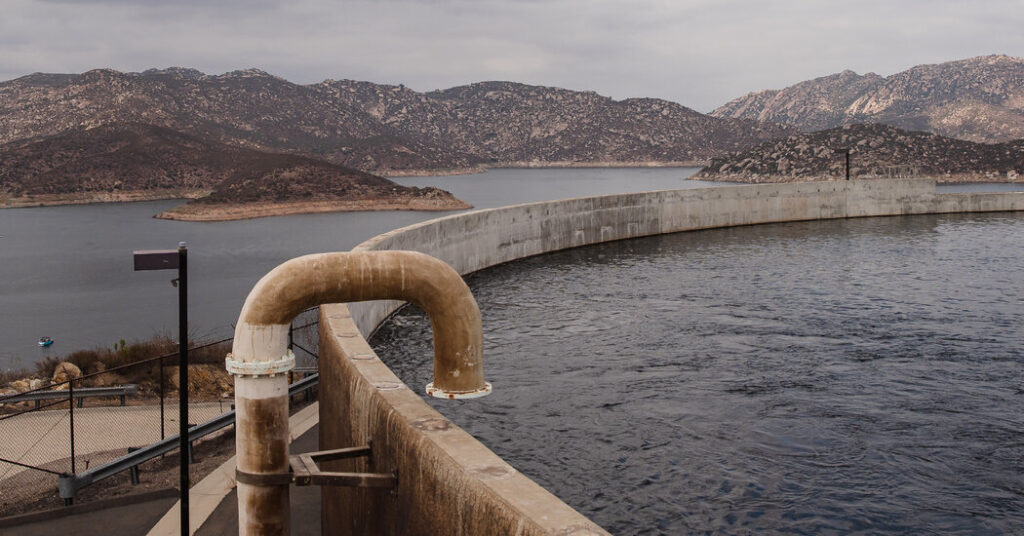
As most Western communities expect to grapple with water shortages this summer and fall, one is looking to share its unlikely surplus.
San Diego County in California spent nearly $1 billion on a desalination plant after a 1990s drought left it with scarce supply. Now, with the seawater-to-tap water plant running at just one-third of capacity, its water utility is shopping around deals to sell its water across the West.
Because of drought and minimal snowmelt, little water is expected to flow into Colorado River basin reservoirs this year, creating a shortage that could lead states such as Arizona, Nevada and Utah to try to buy excess water from San Diego.
“We’ve all collectively taken a step back and have realized we can’t continue to put a fence around ourselves,” said Dan Denham, general manager of the San Diego County Water Authority. “We can’t go at this alone any longer.”
It’s not yet clear how interstate transfers of water could occur — likely by Arizona or other states paying San Diego for its Colorado River water rights. Such transfers have never occurred and could require new federal laws or regulations.
Central Arizona water managers have been discussing the prospects of a deal for San Diego’s water, but have made no decisions, said DeEtte Person, a spokeswoman for the Central Arizona Project, the system that transports Colorado River water to most of that state’s populous areas.
John Entsminger, general manager of the Southern Nevada Water Authority, told The Wall Street Journal this week he plans to sign “an exploratory agreement” with San Diego County. Mr. Entsminger could not be reached for comment.
Utah, meanwhile, has been exploring investments in desalination, including through a potential partnership with California that would involve trading California’s Colorado River water rights.
In recent weeks, the San Diego County authority has announced deals to sell water to two utilities in Riverside County, Calif., a sprawling and rapidly developing region that borders the Colorado River.
“Regional cooperation is essential for a stable water future,” Stephen J. Corona, board president for the Eastern Municipal Water District in Riverside County, said in a statement last week.
Mr. Denham said he is hoping for additional partnerships. The San Diego County utility approved an agreement in February with the Metropolitan Water District of Southern California, a broader consortium of water systems that includes the San Diego system, that featured plans to include utilities in Nevada and Arizona in the collaboration.
In addition to desalination, some states are considering recycling wastewater. In 2021, Arizona and Nevada each invested $6 million in a water recycling initiative that is in the final stages. The project, Pure Water Southern California, could eventually convert enough sewage into purified drinking water to supply 500,000 homes.
As the San Diego County Water Authority pursues water deals, it is also looking to recoup billions in costs it has passed along to its ratepayers, Mr. Denham said. In recent years, the utility has imposed annual water rate increases of as much as 14 percent onto customers, but selling water to other states could allow it to keep future increases on par with inflation, he said.
But Mr. Denham said he also sees a responsibility to help address a long-simmering water crisis that is once again intensifying given the meager winter snowpack across the West that quickly melted during a record-hot March.
“It really underscored the urgency of coming up with a solution to not only figure things out over the next water year, but longer term,” Mr. Denham said.
Water officials said finalizing any transfers across state lines would be complicated, and could require action by Congress as well as a consensus that has been hard to reach among Western states struggling to secure volatile water supplies.
“It will take agreement among all of the stakeholders — including those whose water rights may be adversely affected,” Joseph Vanderhorst, a retired water law expert, told members of the Metropolitan Water District of Southern California’s board this week.
There had been hopes that a framework to guide interstate water transfers would be included in a plan guiding use of Colorado River water, after decades-old rules expired last year. New rules will have to reflect changes to the Southwestern climate that have reduced the Colorado River’s flow by nearly 20 percent over the past quarter century.
But the seven states that rely on Colorado River water — California, Arizona, Nevada, New Mexico, Utah, Colorado and Wyoming — failed to reach agreement on such a plan by a Valentine’s Day deadline imposed by the federal Bureau of Reclamation. The bureau is now in the process of charting the watershed’s future.
On Friday, the federal government announced emergency steps to prevent Lake Powell in Utah and Arizona, which is the nation’s second largest reservoir, from dropping to critical levels that could prevent the generation of hydropower.
Reclamation officials said they would move water from an upstream reservoir into Lake Powell, while also reducing releases from that reservoir into Lake Mead, which is farther downstream in Nevada and Arizona. As a result, Reclamation officials said, Lake Mead levels could drop enough to reduce hydropower generating capacity by as much as 40 percent at the Hoover Dam, which impounds Lake Mead.
To develop new rules for the river, Reclamation officials are considering plans that are raising concerns over water shortages and could spur litigation over the complex web of statutes and court rulings that govern use of the Colorado River. That is especially true for Arizona, which could see its supply of Colorado River water that flows into the Central Arizona Project virtually eliminated because it holds relatively junior water rights.
Confronting those water cuts may take precedence over any talks of interstate water trading.
The mayors of Phoenix and Mesa, Arizona’s first and third-largest cities, said water cuts under consideration by Reclamation officials would place a “disproportionate and devastating burden on Arizona” in a column in The Arizona Republic this week.
Phoenix Mayor Kate Gallego, a Democrat, and Mesa Mayor Mark Freeman, a Republican, wrote that Arizona, California and Nevada, known collectively as the Colorado River system’s lower basin, have pursued “collaborative proposals to stabilize the river system” and are urging federal officials to spread the pain of water cuts across the river basin.
“This is one of the most consequential moments for American water policy in a generation,” they wrote.
Scott Dance is a Times reporter who covers how climate change and extreme weather are transforming society.
The post How Pacific Ocean Water Could Help the Colorado River Crisis appeared first on New York Times.