History does not always repeat itself. Sometimes it doesn’t even rhyme. But it is always instructive. The moment we are living through is looking ever more like the 1970s — in the depth of the crises we face, and in its potential to create a genuine rupture with what came before.
To dispense with the obvious: It’s hard to imagine a president as unlike Donald Trump as Jimmy Carter, with his radically different approach to governing and to morality. But it’s also hard to miss the structural similarities between our time and the era that brought down Carter and shifted political and economic thinking globally to the right — as reflected in the rise of Ronald Reagan in the United States and Margaret Thatcher in Britain.
It’s not just that Iran has reoccupied center stage or that fear of stagflation looms again, even if this economy is different in important ways from the old one. In the late 1970s, Americans sensed that their country was growing weaker in the world, in the wake of the Vietnam debacle and as the Soviet invasion of Afghanistan and the Iranian hostage crisis set in. Today, they see it as enfeebled because of Mr. Trump’s assault on longstanding alliances, his devastation of America’s moral standing with his deranged threat to wipe out Iran’s “whole civilization” and his pursuit of a war without a coherent strategy or clear objectives.
The simultaneous rise during the late 1970s in unemployment, inflation and interest rates brought an end to the long post-World War II consensus around broadly egalitarian, Keynesian economics. Now the backlash is against the nostrums that replaced the earlier economic order — hyperglobalization, lower taxes for the wealthy and deregulation. Mr. Trump claimed to have the answer with his incoherent mix of tariffs, tax cuts for the wealthy and more deregulation. But his recipe has only sharpened economic anxiety. The University of Michigan’s consumer sentiment survey released last Friday hit its lowest point in more than 70 years, and the International Monetary Fund warned on Tuesday that war in the Middle East could slow growth and fuel inflation, risking a global recession. Mr. Trump’s approval rating on the economy averages in the 30s.
Voter discontent is a normal part of a democracy. But what we saw in the 1970s and what we are seeing now is distinctive: a comprehensive loss of faith in the future, a collapse of respect for our governing institutions and alarm that American influence in the world is doomed to diminish.
When Ronald Reagan ran for president in 1980, he understood the opening this sense of gloom offered him. He rewired politics and altered the philosophical direction of the public conversation. This time, it’s the Democrats who are called upon to make the leap past our distemper. They need to ask themselves: What would Reagan do?
I’m not romanticizing Reagan, especially since I think his social and economic policies set us down some damaging paths. But anyone seeking to change our trajectory can learn a lot from his shrewd understanding of the political imperatives and possibilities of his moment.
His public presence was sunny, and he knew that politicians who convey a sense of hope tend to win. (Reagan may have learned this from the hero of his younger days, Franklin D. Roosevelt.) Nonetheless, Reagan also understood the power of making clear what he was against. His three antis — anti-tax, antigovernment, anti-Communism — were the driving imperatives of his politics.
Those saying Democrats can’t win by just opposing Mr. Trump miss this point. Of course voters need a sense of where they’ll lead. But specific proposals grow out of what needs fixing. A place to start: commitments to end the in-your-face corruption of the current regime, its blatant favoritism toward a select group of very wealthy people and its authoritarian habits. The success of the opposition to Viktor Orban in Hungary’s election on Sunday suggests the power of these issues when they’re linked to economic discontent.
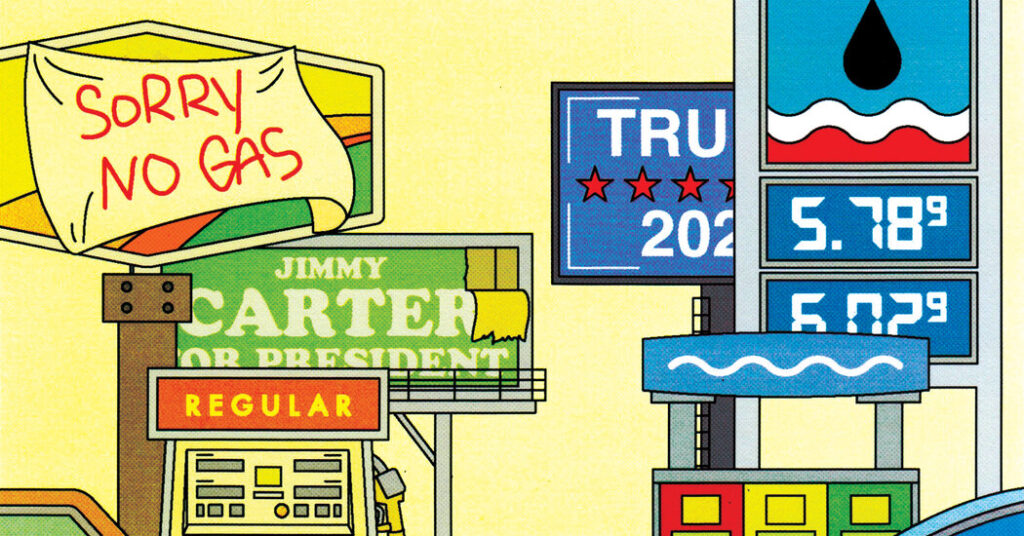
Reagan was also shrewd about turning a specific problem that was on voters’ minds into a rationale for policies he wanted to pursue anyway. He made the gas lines Americans hated into a case for deregulating the fossil fuel industry. He used stagflation to argue for tax cuts tilted toward the wealthy. Neither policy was necessarily popular, although the way inflation was driving people into higher tax brackets and rising property taxes helped make his supply-side approach sound positively populist. But above all, Reagan again channeled his inner Roosevelt, who had noted that in a time of crisis, the public is inclined to say: Above all, try something.
In their campaigns last year, Govs. Abigail Spanberger and Mikie Sherrill and Mayor Zohran Mamdani used public concerns about higher prices to make a case for government action in areas such as health care, child care, housing and electricity prices. Conservatives complained that they weaponized inflation to rationalize new government programs. But guess what? That’s akin to what the Gipper did with the discontents of his day to justify cuts in government programs, deregulation and tax reduction. Good politicians play the hand they’re dealt.
Voters don’t usually make foreign policy a priority, but they do sense when the country is in trouble in the world. That’s how they felt in 1980, and it’s how they feel now. Reagan used the crisis of his era to promote a more muscular foreign policy. Mr. Trump is making a bang-up case for why the United States is stronger when it respects and works with its democratic allies and when it stands up for values (human rights, democracy and simple decency) alongside its self-interest.
Here’s something else Reagan and those around him understood: Real change requires big-tent coalition politics. His leading primary opponent, George H.W. Bush, had called Reagan’s supply-side notions “voodoo economic policy.” No matter. Reagan chose Bush as his running mate, to make the more moderately conservative wing of his party feel at home with him.
Reagan’s remarkable 1980 acceptance speech was a model of outreach even as he stuck to his guns on taxes and deregulation. I still remember saying to friends upon hearing it, “This guy is going to win.” To paraphrase the late political commentator Mark Shields, you win elections by searching for converts, not by hunting for heretics.
Oh, yes, and this line from Reagan’s speech, with adjustments to his timeline, resonates in the face of Mr. Trump’s squandering of American leadership: “No American should vote until he or she has asked: Is the United States stronger and more respected now than it was three and a half years ago? Is the world today a safer place in which we live?”
It’s not obvious to me which politician out there has the gifts our time requires. But whoever hopes to lead the United States past this crisis needs to grasp the depth of the country’s anxieties, the truly radical nature of the challenge to its role in the world and the electorate’s longing for both transformation and reassurance.
E.J. Dionne Jr. is the author of “Why Americans Hate Politics,” “Our Divided Political Heart,” “Why the Right Went Wrong” and, most recently, “100% Democracy,” with Miles Rapoport.
The Times is committed to publishing a diversity of letters to the editor. We’d like to hear what you think about this or any of our articles. Here are some tips. And here’s our email: [email protected].
Follow the New York Times Opinion section on Facebook, Instagram, TikTok, Bluesky, WhatsApp and Threads.
The post It’s the 1970s Again. Democrats Should Study Up on Reagan. appeared first on New York Times.