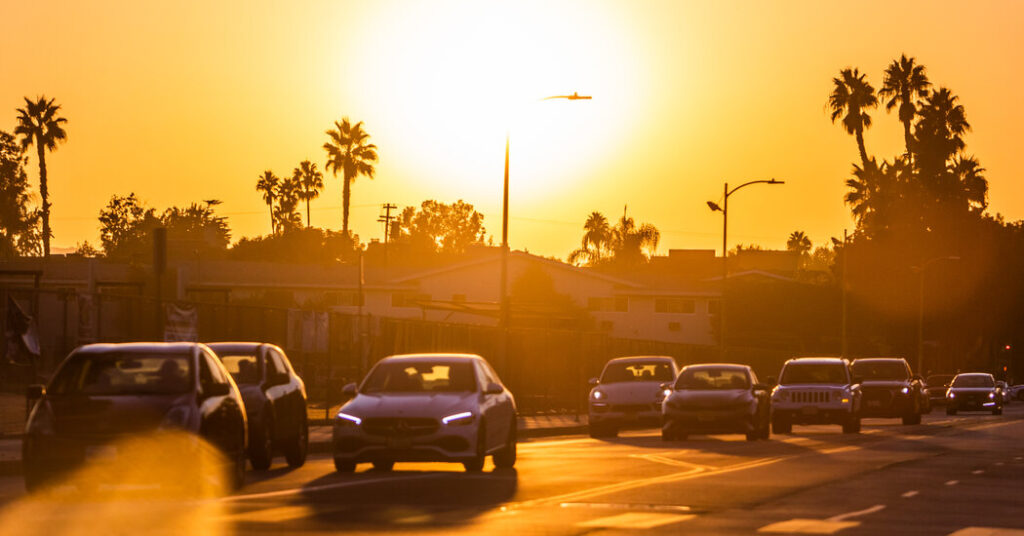
The mercury is starting to rise outside. While that may be welcome news for gardeners and beachgoers, higher temperatures can take a toll on your car.
“Heat is a stressor on the vehicle, and in many ways, a much greater stressor than even cold temperatures,” said Greg Brannon, director of automotive engineering and research at AAA. “It affects nearly every system.”
Here’s how you can prepare your car for what’s shaping up to be a hot summer.
New oil is cheaper than a new engine
Heat makes oil thin out and lose its lubricating qualities, said James Forbes, a professor of practice in automotive engineering at Clemson University.
That can cause engine parts to grind against one another and wear out more quickly. And once oil loses its viscosity, it never returns to its original thickness, even if the weather cools.
Mr. Forbes, who worked at Ford for three decades, said that many modern cars have smart sensors that will recommend an oil change sooner if they detect certain extreme conditions, like high heat. “Listen to your car,” he said. “And if it tells you to get the oil changed, do so.”
If a mechanic recommends that you change your coolant, Forbes said, that’s a good idea, too.
Where the rubber meets the blazing asphalt
When it’s 95 degrees Fahrenheit outside, the temperature of the asphalt could be as high as 140 degrees, or 60 Celsius.
That’s hard on your tires, especially if their pressure is low. Mr. Brannon from AAA said underinflated tires generate heat simply by rolling. Add in high road-surface temperatures, and you’ve got prime conditions for a blowout.
He recommends checking your tire pressure regularly and filling them if needed. The best time to do so is when your tires are cold: in the morning, before you’ve driven anywhere.
To know what pressure you’re shooting for, consult your owner’s manual or the sticker on the inside of the driver’s door. Those will tell you what’s recommended for your vehicle — as opposed to the number on the tire, which is the maximum pressure a particular tire can handle.
Even if your car automatically alerts you to underinflated tires, Mr. Brannon advised manual checks, because many warnings don’t activate until the pressure is 20 to 25 percent lower than it should be.
“If you were to check it once a month, on an average temperature day, you’re going to be well ahead of most Americans,” he said.
Take good care of that battery
Surprisingly, AAA gets more jump-start requests in the summer than it does in the winter, according to Mr. Brannon. That’s because batteries are powered by electrochemical reactions that speed up in the heat, causing them to degrade faster.
“Heat is the absolute killer of the battery,” he said.
While there’s not a ton you can do (Mr. Brannon likened a car battery to a piece of fruit that starts to spoil as soon as you pluck it from the vine), you can at least pop the hood and check the terminals. If you find any signs of corrosion, which can cause resistance that makes it harder to start your car, you can clean it yourself or enlist the help of a mechanic.
And if you have a car that you don’t drive regularly, Mr. Brannon recommended a battery maintainer that charges incrementally while the vehicle is parked. You want to avoid completely depleting the battery because, Mr. Brannon said, that reduces its life span “by a fairly significant margin.”
Speaking of batteries: What about E.V.s?
Drive an electric vehicle? Then you may have noticed that its range shrinks in really hot weather, sometimes by as much as 18 percent.
Mr. Brannon did have one tip to combat that: Turn on the air conditioning and cool down the vehicle before you get going, while your car is still connected to the grid. That’ll preserve some battery power for your trip.
And keep in mind the advice about tires. It applies especially to E.V.s, because they’re so much heavier than other cars.
You don’t need to spend a fortune
Being nice to your car doesn’t have to be expensive. Give it a wax at the start of the summer to help protect exterior paint from the sun. And, consider investing in a sunshade.
“One of the things that people don’t think about is the heat and the sun is so hard on interiors,” said Russell McCloud, the co-owner of an auto repair shop in Yuma, Ariz. “So window tinting, putting up a shade screen in the front windshield when you park. Those help.”
Mr. McCloud also urged drivers to keep water in their cars (stainless steel or glass bottles are best). In his towing business, he has seen stranded customers land in the hospital suffering from dehydration. Because extreme heat is even harder on humans than it is on cars.
The post How Can I Protect My Car When the Weather Is Scorching? appeared first on New York Times.