The framework of a proposal to increase property taxes on high-end second homes in New York City began to take firmer shape on Friday, as political leaders and fiscal watchdogs wrestled with key questions including who should be taxed and by how much.
Many of the details remained in flux. But one proposal being discussed would apply one tax rate to pieds-à-terre with assessed values between $5 million and $15 million; a higher rate for ones valued between $15 million and $25 million; and then an even higher rate for properties valued at $25 million or more, according to three people familiar with the matter. The assessed values are often far less than the actual market value of homes.
There is also talk about adding a fourth bracket for homes worth between $10 million and $15 million, one of the people said. City and state officials have yet to land on what the tax rates for each of these brackets would be, the people familiar with matter said, but the formula would be shaped so that it would bring in a half-billion dollars a year.
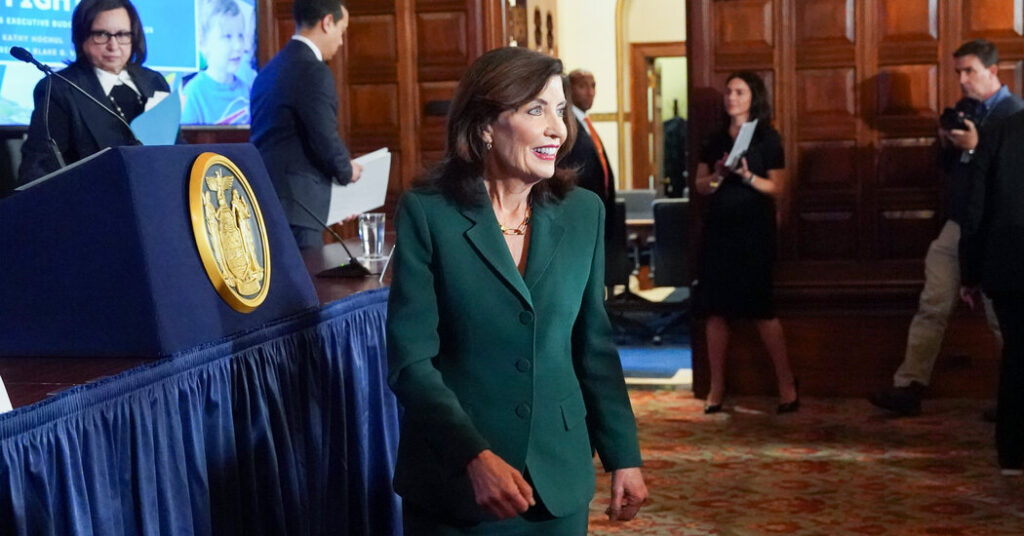
Gov. Kathy Hochul, who announced the proposal this week, has said that she is confident the tax could raise $500 million annually to help the city cover its multibillion dollar fiscal deficit.
“My objective here as we’re coming to the close of our budget, hopefully before too long, is that we are identifying ways to be of additional assistance to the city,” Ms. Hochul said on Wednesday, reiterating her opposition to raising corporate or income taxes as Mayor Zohran Mamdani had pushed for.
The new tax would require approval of both the State Assembly and Senate, whose leaders sounded broadly bullish about the possibility. But it comes as state leaders face the reality of a budget nearly three weeks overdue. The more than $260 billion spending plan has been delayed, as in years past, by contentious policy matters the governor has insisted on including.
The tax proposal continued to elicit fears from the real estate industry, whose members warned that investments in New York properties would plummet. The announcement also generated waves of excitement among a broad ideological range of figures in New York politics. With this proposal, Ms. Hochul found a way to flex the moderate bona fides she is eager to highlight ahead of her re-election bid and gingerly satisfy the progressive supporters of Mr. Mamdani, who has struck up a successful partnership with the governor.
Some lawmakers have interpreted the governor’s tax proposal as an indication that she wants to find common ground on sticking points that have held up the budget — choosing a pied-à-terre surcharge because it speaks to the Legislature’s priority to tax the rich. Ms. Hochul also felt more comfortable with a tax targeting the ultrawealthy who do not make New York City their primary homes.
The property tax code in the city is extremely complicated, with different types of exemptions and abatements and assessment techniques leading to a wide variation in tax bills. Generally, the annual property tax bill for a pied-à-terre with an assessed value of $5 million is between roughly $45,000 to $65,000 a year, said Pierre Debbas, a real estate attorney at the law firm Romer Debbas who works with people who own second homes.
Even so, the tax may run up against the longstanding intrigue around who actually owns the second homes. Ownership is often shrouded by blandly named limited liability companies or trusts. In some cases, international buyers, who were ostensibly anonymous, have purchased these homes to park their wealth in high-end New York City real estate.
An investigation from The New York Times in 2015 found that some of these owners included foreigners who had been the subject of government inquiries into environmental violations or financial fraud. A 2023 analysis by the watchdog group Reinvent Albany found that 37 percent of the properties in Manhattan — more than 15,000 units — were owned by limited liability companies, where the actual owner was not publicly disclosed.
It remains to be seen whether the discussions about the pied-à-terre tax lead to greater transparency for the public, said John Kaehny, the executive director of Reinvent Albany.
“Are they global oligarch class?” he said. “Or are they people who live in Westchester and go to Broadway shows and that kind of thing? The rich versus the superrich, or ultra-superrich.”
Ultimately, it may not matter from a financial perspective. The entities, even if anonymous, already pay property taxes, and tacking a surcharge on would be relatively simple, said Ana Champeny, the vice president for research at the Citizens Budget Commission, a nonprofit fiscal watchdog group.
The onus is likely to be on the limited liability company to prove that New York City is actually the owner’s primary residence. If it can’t, the property tax would apply.
But there are likely to be other trade-offs.
Jared Walczak, a senior fellow at the Tax Foundation, a nonprofit that generally favors lower taxes, said a tax on second homes would basically be a “patch” on a faulty system that under taxes some high-end properties. He said the tax could push people away from second homes, which are a source of tax revenue that imposes very little cost, since residents aren’t using city services like schools.
“It is actually subsidizing the city’s finances,” he said. “Obviously, a pied-à-terre is trying to increase that subsidy. But the risk is you change some of the incentive structure and you lose some of what you have now.”
Hours before a scheduled trip to Albany on Friday where he planned to see Ms. Hochul and other state leaders, Mr. Mamdani continued to say that the rich must pay more. He added that he would be “celebrating the pied-à-terre tax because I think that this proposal that we’ve worked on with the governor is one that speaks exactly to that need and does so while funding the kind of essential city services that New Yorkers cannot go without.”
While Ms. Hochul talked in broad generalities about “Russian oligarchs buying up properties,” Mr. Mamdani named individual billionaires, like financier Kenneth C. Griffin, whom the mayor said was emblematic of a “fundamentally unfair system that hurts working New Yorkers.”
Mr. Mamdani posted a video on X, which had more than 46 million views on Friday, about Mr. Griffin’s purchase of a $238 million penthouse in 2019. This week, The Wall Street Journal reported that Mr. Griffin had spent $38 million for another Upper East Side apartment, which is next to one he bought for $45 million last year.
Benjamin Oreskes is a reporter covering New York State politics and government for The Times.
The post Contours of Pied-à-Terre Tax in New York City Begin to Take Shape appeared first on New York Times.