One way to look at social media is as a machine for learning what goes with what. This model describes the business side of the industry, in which platforms collect data on user interests in order to sell targeted advertising. If an advertiser wants to know, let’s say, what men over 30 who have Googled “F-150” listen to on Spotify, platforms can probably answer that question. Users, meanwhile, get a similar service for free on the public-facing side. They can open their phones and meditate on, for instance, the “Ultimate Disney Adult Starter Pack,” a mood-board meme that depicts a Honda Jazz, slip-on Skechers and “prominent gums.” One of these data sets is aggregated and quantified, while the other is anecdotal and felt, but both serve the same purpose: revealing connections to people who might not discover them otherwise.
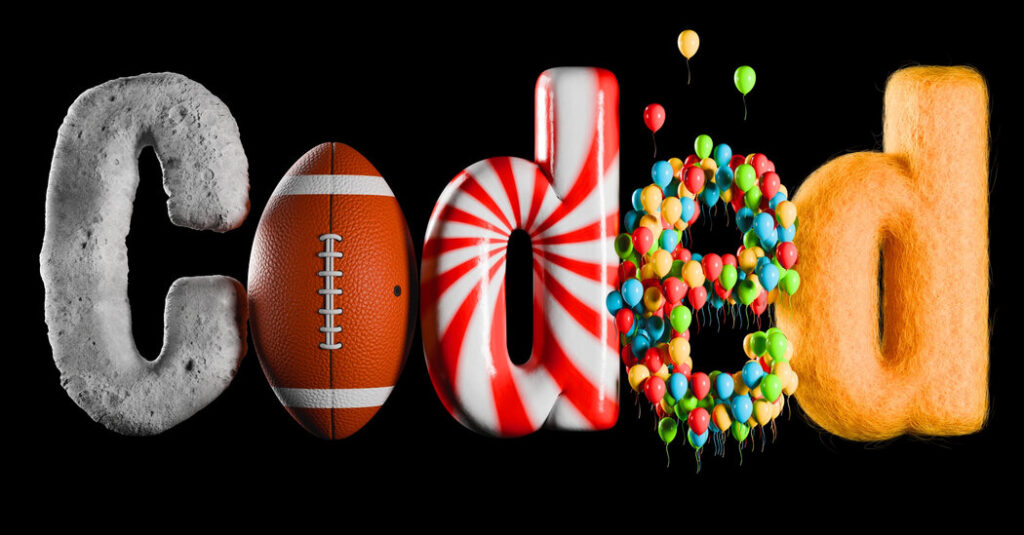
This ongoing mining of associations may explain why social media has popularized so many idiomatic expressions that convey vague feelings of resonance, including different types of “energy,” the construction “it’s giving [noun]” and the suffix “-coded.” That last one may be the most versatile of the group. It declares that something is present, kind of — not so directly that it can be proved or even made explicit, but phenomenologically, in the speaker’s experience.
Elle Fanning in a pink dress is “Barbie-coded.” The movie “Sinners” punishes its characters for various transgressions in a way that is “Christian-morality-play-coded.” BuzzBallz, the ready-to-drink cocktails in spherical containers, are “U.K.-coded,” even though they were invented in the United States. The construction turns a variety of verb phrases — looks like, feels like, reminds me of — into one adjective, but it also posits a connection too loose to be binding, in that pleasingly irresponsible way that characterizes so much online communication.
The cultural anthropology site KnowYourMeme.com argues that “coded” emerged from Tumblr discussions of cartoons. That may be an example of the internet knowing itself better than it knows anything else — the usage certainly predates Tumblr, in academic and critical contexts — but it’s true that cartoons are inherently coded. They often feature nonhuman figures with human qualities; they can also constitute a child’s first exposure to references, allusions and other culture-about-culture phenomena. To watch a cartoon is to continually interpret what things actually mean — in other words, to decode.
The observation that many Disney villains are queer-coded points to coding’s history, as a technique, in the long and surprisingly influential period before the internet. The Hays Code — the popular term for the set of moral standards that Hollywood semi-voluntarily enforced between 1934 and 1968 — effectively forbade onscreen depictions of homosexuality. Filmmakers who wanted to depict this dimension of human experience had to do so allusively, relying on tropes and associations that some but not all of their audience would recognize. Queerness was often portrayed as evil, and its secret signifiers in posture, speech and costume became shorthand for “villain,” establishing a code that persisted long after 1968, in characters like Jafar in “Aladdin.” It also prefigured our postmodern state of interpretive paranoia, in which everything can be taken to mean something else.
Recognizing what has been coded adds a frisson of sophistication to the experience of consuming popular culture, and this feeling is addictive; it accounts for pretty much the whole field of American studies. It may also explain the sometimes obsessive behavior of adult animation fans who, for example, spent a substantial portion of 2015 and 2016 arguing about whether Garnet — a sentient mineral formation from outer space in the Cartoon Network show “Steven Universe” — was “Black-coded.”
This debate was not as insipid as I have made it sound. A lot of children’s entertainment really is coded, and Estelle, the actress and singer who voiced Garnet, is Black. Still, there is such a thing as being too sensitive to associations. The habits of mind that help us recognize coded meanings will, with too much practice, lead us into a world of secret messages, in which the apparent becomes a tissue covering manifold associations that multiply and deepen even as they become, you know, potentially not real.
The spread of “-coded” suggests we live in that world already — one that has produced the claim that lifting weights, stand-up comedy and the hallucinogen DMT are “right-coded,” and the complementary assertion that doing cardio is “left-coded.” I wouldn’t swear to either of those in court, but neither can I argue against them. Such ideas ultimately do not operate at the level of logic. This caveat captures the difference between what is coded and what simply is: The connection inheres not in the thing itself, but in your experience of that thing, which of course depends on your experience of everything else.
I worry that this aspect of “-coded” makes it a vector for imprecision, by which a torpid vagueness spreads through our already dangerously unconsidered culture. But I would also prefer to look on the bright side. While it is true that “-coded” lets us make a connection without specifying what that connection actually is, it also lets us express what is felt but cannot be demonstrated logically — a legitimate and perhaps increasingly important category of relation in an online environment that ruthlessly converts experience into words and then sometimes, through large language models, reassembles it without employing a capacity for feeling at all.
So I welcome “-coded” as a means to restore the authority of gut feelings. I despair, though, when I see a potentially long and tendentious argument, of the kind I love, cut short by a construction that is both vague and familiar — and therefore inert. It’s like, you know. As the discursive center of the internet has shifted from blogs and message boards to social media, posts have gotten briefer, which is to say less nuanced, which is to say dumber. We need ways to express feelings beyond what words can convey, but we also need to nurture those feelings that, if left unattended after they are named, may grow quieter until they become mute.
Dan Brooks writes essays, fiction and commentary from Missoula, Mont. He last wrote for the magazine about the comedian Stavros Halkias.
The post What We Lose When Everything Is ‘-Coded’ appeared first on New York Times.