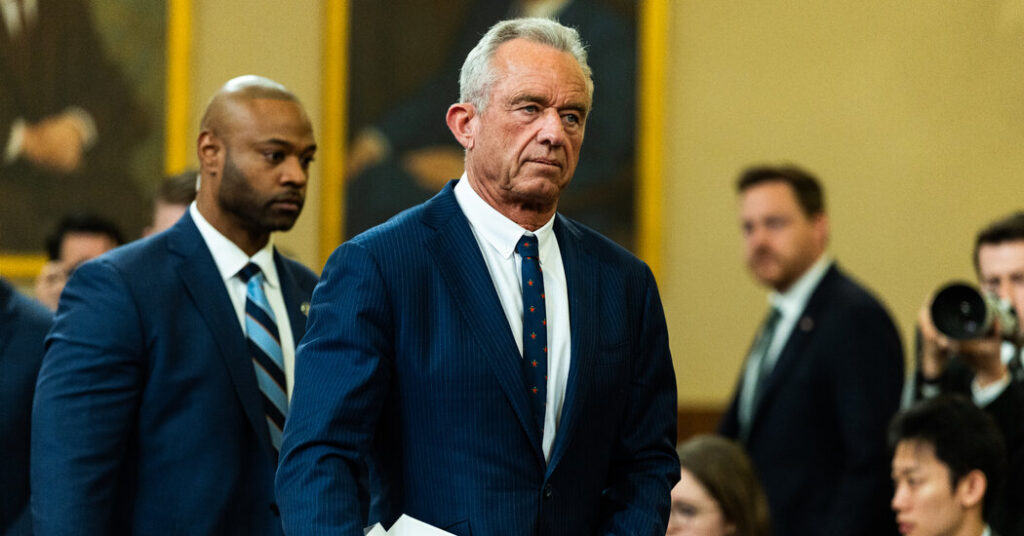
Health Secretary Robert F. Kennedy Jr. said on Thursday that he was reforming an influential task force that determines which preventive medical screenings, procedures and medications insurance companies must cover at no cost for millions of Americans.
Speaking at a congressional hearing, Mr. Kennedy accused the panel, the United States Preventive Services Task Force, of having been “lackadaisical and negligent for 20 years.” He said he would appoint new members with “a clear mission,” which he did not elaborate on.
The task force’s purview is broad; its recommendations cover colonoscopies and mammograms, depression screenings and osteoporosis tests, among many other medical services.
It was not immediately clear whether Mr. Kennedy intended to fire the current members of the task force, or simply add to their ranks. It was also not clear how many people he intended to appoint. Five of the panel’s 16 members had their terms expire in December, and Mr. Kennedy has yet to replace them.
Andrew Nixon, a spokesman for the Department of Health and Human Services, declined to comment beyond Mr. Kennedy’s remarks. A spokeswoman for the task force directed a request for comment to H.H.S.
Mr. Kennedy has quietly undermined the task force over the past year, including by indefinitely postponing its last three meetings and failing to replace the members whose terms were scheduled to end. With its meetings halted, the committee’s recommendations on preventive health services have slowed to a trickle. It was also unable to publish last year a legally mandated annual report to Congress on gaps in scientific evidence, which is used to guide federal research funding.
Mr. Kennedy told lawmakers on Thursday that the task force would meet more frequently, though he did not provide specifics.
His handling of the panel drew a rebuke last month from 19 senators, who sent a letter urging him to stop hindering the panel’s work.
The task force, which was formed in 1984, has historically been an independent panel made up of volunteer doctors and other health professionals. It reviews scientific literature and grades procedures and medications on a scale of “A” (the highest) to “D.” Under the Affordable Care Act, most insurance plans must fully cover services rated “A” or “B.” That gives the panel significant influence over what care Americans can obtain.
Doctors and public health experts have worried for much of the past year that Mr. Kennedy may purge the task force and fill it with members who are ideologically aligned with him, as he did with a vaccine advisory panel at the Centers for Disease Control and Prevention.
Members typically serve staggered four-year terms, so that each health secretary has an opportunity to replace only a portion of the task force. Last June, though, the Supreme Court ruled that Mr. Kennedy could remove members before their terms ended and could block any recommendations he disagreed with before they became legally binding.
That ruling stemmed from a lawsuit brought by conservatives after the task force in 2023 gave an “A” grade to pre-exposure prophylaxis, known as PrEP, medications that drastically reduce the risk of contracting H.I.V. from having sex or injecting drugs. Some plaintiffs argued that it was against their religious beliefs to require insurance companies to pay for PrEP.
If the new task force stops recommending a certain screening or drug, insurance companies could still opt to cover it, but would no longer be required to do so.
Maggie Astor covers women’s health and the health effects of government policies for The Times.
The post A Powerful Health Task Force Is in Kennedy’s Cross Hairs appeared first on New York Times.