A federal panel approved early designs for President Donald Trump’s planned 250-foot triumphal arch, even as members of the public urged Trump-appointed arts commissioners to block the project — and one commissioner suggested shrinking it.
Thursday’s vote by the Commission of Fine Arts, whose job is to vet the design of monuments and other major projects in the capital, does not give final approval for the project. Commissioners instructed Nicolas Charbonneau, an architect at the firm Harrison Design who is leading the project, to make some revisions to his plans and present them again at a later meeting.
“This was an impressive display,” said Rodney Mims Cook Jr., the commission’s chairman, praising Charbonneau and Trump officials for the project design and thanking members of the public for testifying. “This is personal to everyone in the room, and the president wants to do something that in his heart he feels is good.”
Trump has eyed Memorial Circle, a traffic roundabout near Arlington National Cemetery, for the structure, which he says will be the largest triumphal arch in the world and is intended to commemorate America’s 250th anniversary. The land is controlled by the National Park Service and sits just inside Washington’s boundaries. The project represents Trump’s most significant effort to remake D.C.’s skyline as he works to transform the city in his second term.
The president’s project has been opposed by military veterans who say that a towering structure in Memorial Circle would harm views of the nearby cemetery, and by Democrats who argue that any new monument must obtain authorization from Congress.
On Thursday, several members of the public testified in opposition to Trump’s proposal, saying they worried about the implications of a large triumphal arch interrupting what had been designed as a solemn corridor between the Lincoln Memorial and Arlington National Cemetery.
The fine arts commission received about 1,000 comments on the proposal in a public-comment period, and they were “100 percent” against the project, said Thomas Luebke, who serves as the commission’s secretary.
The commissioners, all of whom were appointed by Trump, generally supported the president’s idea.
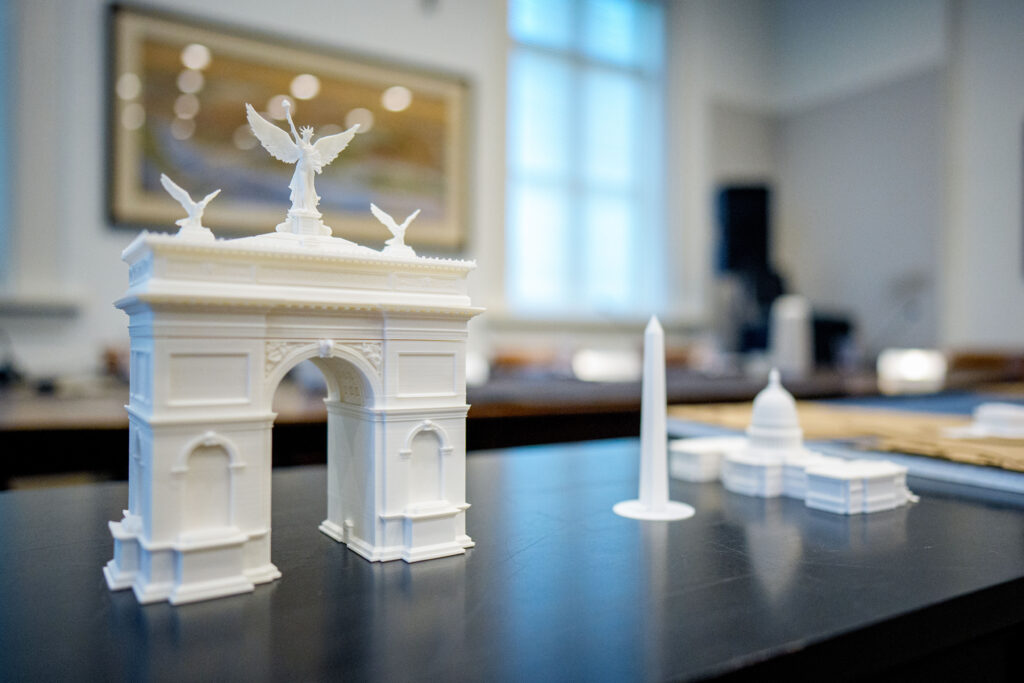
One commissioner, James McCrery II, offered a limited critique of the plan, suggesting that Charbonneau remove three golden statues atop the arch that add more than 80 feet to its height.
“I wonder if you need those up there,” McCreary said, suggesting that it would be “a better, more Washingtonian design” without the statutes. That change would lower the arch’s height from 250 feet to about 166 feet.
McCrery — who served as the first architect for Trump’s planned White House ballroom before wrangling with the president over its size — also questioned the golden animal statues set to adorn and flank the arch, suggesting that Charbonneau and Trump officials “find replacements” for four planned lions, given that lions are not native to North America.
He pressed Charbonneau on a plan to build a 250-foot underground tunnel for pedestrians to access the arch, suggesting it would complicate visitors’ experience.
Other commissioners defended the plan. Responding to a public comment that warned the large arch would disrupt Washington’s skyline, Chamberlain Harris, Trump’s 26-year-old executive assistant whom the president installed on the commission, said the proposal would “honor the original vision” of city designers.
Cook, who spent years trying to build an arch in Washington, repeatedly praised Charbonneau and White House officials in attendance for the presentation, as a black baseball cap reading “Make Design Great Again” sat on a table in front of him.
Interior Secretary Doug Burgum attended the hearing to personally present the proposal, saying the “United States Triumphal Arch” was an overdue addition to Washington. He cited efforts by planners and lawmakers more than a century ago to build a structure in Memorial Circle, which sits on a man-made piece of land known as Columbia Island, contending that the Trump administration was finishing that work.
“It’s a barren, it’s a flat, it’s vacant, grass-covered only traffic circle,” Burgum told the panel. “This large empty space directly contradicts the original vision, and that vision was for Columbia Island to be a site of a beautiful architectural [structure].”
White House officials have said they hope to start the project in the coming months.
“Beginning construction this year on the architectural [arch] is a fitting way to commemorate the 250th anniversary of American independence,” White House press secretary Karoline Leavitt told reporters Wednesday.
Some members of the public urged the panel to slow down the project, saying they had concerns about moving too quickly on a significant change to the city.
A woman who gave her name as Lisa Fuller and said she was a native Washingtonian shared a story of first walking across Arlington Memorial Bridge with her father after President John F. Kennedy was assassinated in 1963. She said their walk began at the Lincoln Memorial and ended in Arlington National Cemetery to witness the eternal flame lighted in honor of Kennedy — a trip she has continued to reflect on.
“Any major alteration should be approached with care to ensure the integrity of these nationally significant spaces,” she told the commission.
The post Trump’s 250-foot arch receives early design approval as public pans it appeared first on Washington Post.