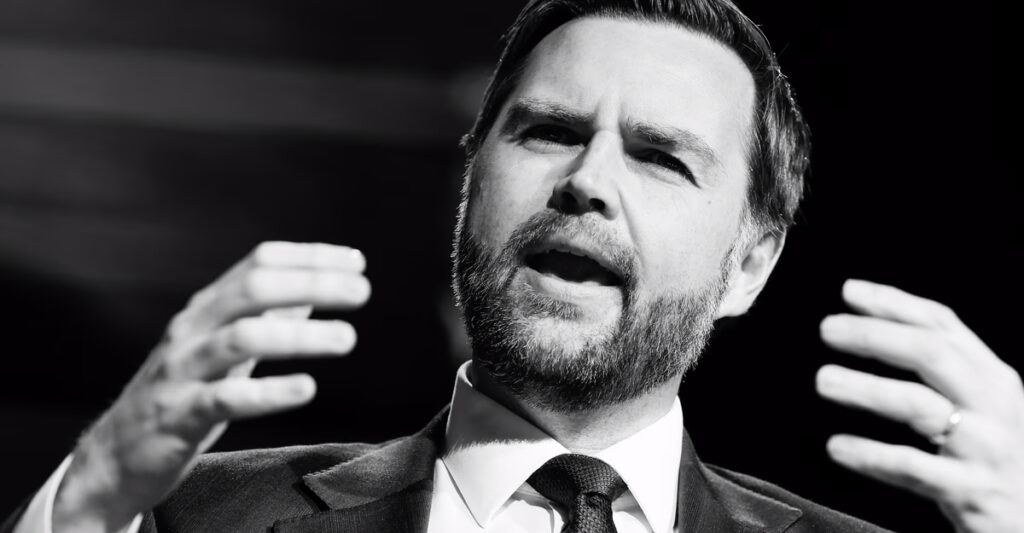
The Trump administration doesn’t seem to have many rules, but one of them is that once the president picks a fight, his posse must show up to support him, no matter how ill-advised the conflict. And few senior officials are more eager to back up the boss in every embarrassing beef than Vice President Vance, who recently seems to have decided that he, and not Pope Leo XIV, is the true arbiter of Catholic doctrine.
President Trump is personally angry with Leo because the pontiff has been deeply critical of America’s war of choice in Iran. Accordingly, Trump lashed out at His Holiness twice over the past few days. Vance might have seen this as a valuable opportunity to say nothing and let the storm pass; Leo, naturally, doesn’t seem to care all that much what Trump thinks. (As my colleague Liz Bruenig wrote, Leo answers to a higher authority.) Had the vice president remained silent, Trump might have moved on, and Vance, a relatively recent convert to Catholicism, would have been able to stay out of a dustup between his president and his spiritual leader.
But no. Vance just had to speak up. He could have taken his cues from John F. Kennedy or Mario Cuomo, Catholic politicians who were careful to note that their faith was personal and important to them, but that in their public life, they must govern as Americans according to the Constitution. Vance decided on a different approach: The pope, he implied, wasn’t a very good, or very smart, Catholic.
Vance’s response to Leo’s statements came during an interview at a Turning Point USA event in Georgia. It was a sour cocktail of equal parts hubris and ignorance with a spritz of Vance’s trademark smarm, and it is worth considering in full:
In the same way that it’s important for the vice president of the United States to be careful when I talk about matters of public policy, I think it’s very, very important for the pope to be careful when he talks about matters of theology.
And I think that one of these issues here is that there has been—if you’re going to opine on matters of theology, you’ve got to be careful; you’ve got to make sure it’s anchored in the truth, and that’s one of the things that I try to do, and it’s certainly something I would expect from the clergy, whether they’re Catholic or Protestant.
Vance just told the Bishop of Rome that theology should be “anchored in the truth”? What does that even mean? Whose truth? Somewhere in the nether gloom, Pontius Pilate is rubbing his aching temples and thinking he’s heard this one before.
Catholics, of course, believe that the pope is infallible when he issues ex cathedra pronouncements on faith and doctrine and, yes, morality, so challenging his pronouncements on war and peace seems a tad presumptuous for a member of the faithful. (My own faith, Eastern Orthodoxy, does not have a figure with power like the pope, but you can bet I’d think twice before telling our top cleric, the patriarch of Constantinople, that he was all hosed up on some important theological stuff.) Vance’s slap at Leo—including the pompous implication that he needs to go back and do some theology homework—illustrates the political and religious risks that Vance is willing to take not only with the Vatican, but with a country whose population is one-fifth Catholic, in order to demonstrate his utter fealty to Trump.
[Elizabeth Bruenig: A blasphemous president]
Some years ago, I wrote a book, The Death of Expertise, in which I examined the strange phenomenon whereby every person thinks they’re an expert, to the point where they are willing to lecture actual experts about those experts’ own field of competence. Doctors, lawyers, professors, and people in trades such as carpentry and electrical work can tell stories of some layperson who had ideas about medications, the law, or what kind of circuit breakers to use. It’s human, it’s silly, and it’s sometimes dangerous.
Vance, however, has blown right past all such minor examples and has now seized the top seat in the Death of Expertise Hall of Fame: He has lectured the pope—the pope, the leader of a billion and a half Catholics—about being too sloppy with theology.
It gets better—or worse, depending on how you look at it. Vance took issue with Leo’s declaration about war, in which the pope said: “Anyone who is a disciple of Christ, the Prince of Peace, is never on the side of those who once wielded the sword and today drop bombs.” What about World War II? Vance huffed. Wasn’t God on America’s side then? Of course, arguing that God takes sides in human wars seems a rather fraught business, which is why most Christian denominations tend to avoid such pronouncements and instead ask their adherents to pray for peace. During the American Civil War, although slavery was a manifest evil, Abraham Lincoln chose not to extol the North’s righteousness in his second inaugural address, but instead humbly reminded Americans that both sides “read the same Bible, and pray to the same God,” sorrowfully noting that the Almighty gave the conflict to both North and South as the price of exterminating the sin of slavery.
But Vance wasn’t really interested in arguing with his spiritual father; he was instructing him. “When the pope says that God is never on the side of those who wield the sword,” Vance pontificated, “there is more than a thousand-year tradition of just-war theory.”
It’s true that the early Christian world produced what is now known as the just-war tradition, a body of thought that serves as the foundation of much of American and international law about when countries may go to war, and how they should conduct themselves in combat. One of the first and most important of these thinkers was Saint Augustine. Indeed, Leo knows this because he was the leader of the Augustinian order for more than a decade, and so Vance might have paused for just one more nanosecond to realize he was lecturing the first Augustinian pope about the just-war tradition.
[David A. Graham: The parable of the president]
Less than a day after the vice president’s remarks, the chairman of the doctrine committee of the U.S. Conference of Catholic Bishops spelled it out for Vance that a difference of opinion with the pope is not just another internet wrangle with some random troll: “When Pope Leo XIV speaks as supreme pastor of the universal Church,” Bishop James Massa wrote, “he is not merely offering opinions on theology, he is preaching the Gospel and exercising his ministry as the Vicar of Christ. The consistent teaching of the Church is insistent that all people of good will must pray and work toward lasting peace while avoiding the evils and injustices that accompany all wars.”
Perhaps Vance will take the hint. Meanwhile, his attempt to enlighten the pontiff revealed not only his arrogance, but his lack of knowledge about the just-war tradition itself. No matter what the vice president thinks, it’s not a set of rules that tells Christians when God is on their side. The just-war tradition attempts to reconcile the reality of a violent world with the undeniable spiritual peril of taking up arms, and it’s a lot more complicated than Christ blessing the good guys. For nearly 20 years, I helped students every summer at Harvard wrestle with just-war concepts, debating what constitutes a “just cause,” considering the meaning of a “right intention,” and evaluating “proportionality,” among other tenets of the just-war tradition.
These concepts are not a checklist to be completed; they are not chits to be collected that then allow national leaders to assume that their wars are approved by Jesus. The entire body of just-war thinking regards war as evil and every human life lost, ally or enemy, as a tragedy. Its precepts are not excuses; they are meant to be questions that leaders should ask themselves before risking their mortal souls by going to war.
Vance’s attempt to take on Leo by going after the pope’s, shall we say, area of expertise only showcases what Pope Gregory the Great called “the queen of all vices,” the deadly sin of pride. The Catholic Church, in Latin, calls this the transgression of superbia. But describing the willingness of someone like Vance to do such a thing requires a word from Yiddish rather than Latin: chutzpah.
The post Pope John David Vance the First appeared first on The Atlantic.