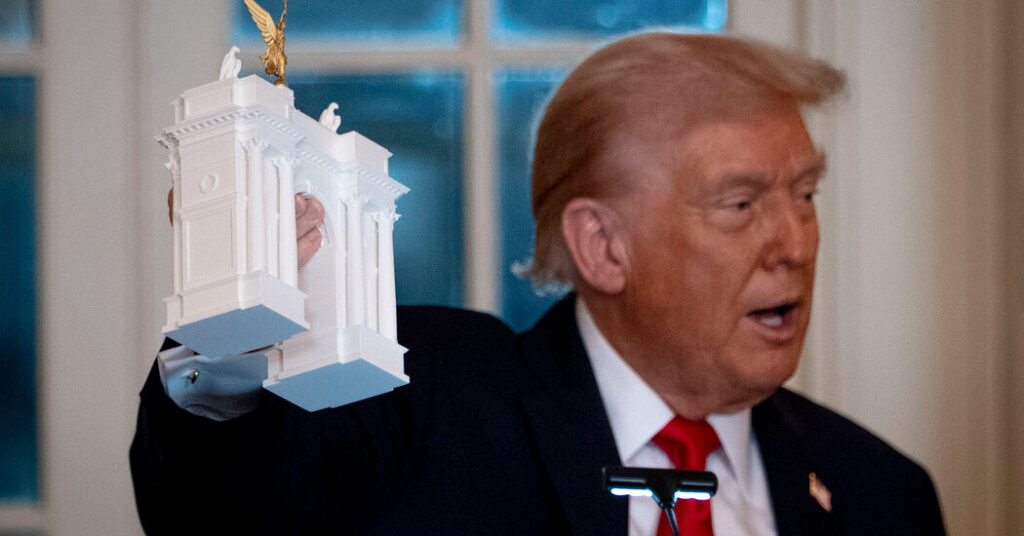
A fine arts commission gave preliminary approval to President Trump’s plans for a triumphal arch in Washington, but the panel’s vice chairman suggested significant changes, including losing the statues of golden eagles and a winged angel atop the structure that account for a third of its height.
The Commission of Fine Arts, which is filled with Mr. Trump’s appointees, has an advisory role on the design of the project, but no enforcement power. It asked the administration to return with updated drawings before a final vote on the project.
The outcome reflected the tension at the heart of Mr. Trump’s efforts to leave his imprint on the architecture of Washington. Even as the president has sought to defang the entities that might normally stand in the way of his plans, the sheer scale and lack of consultation on his designs have fueled intense public resistance.
James C. McCrery II, the vice chairman of the panel who was also the original architect for Mr. Trump’s $400 million ballroom, took issue with the statues at the top of the 250-foot arch. Removing the statues would decrease its size considerably, to about 166 feet.
“I wonder if you need those up there,” Mr. McCrery asked, suggesting it might be “even a better, more Washingtonian design” without the statues.
Mr. McCrery, who while working on the ballroom project objected to its ballooning size, also asked for the replacement of the statues of gold lions included lower down on the arch.
“Work on the lions and find replacements for them,” he said. “As I said earlier, they’re not of this continent. They’re noble, they’re courageous, and they’re strong. They’re all those things. But maybe there are alternatives.”
He also raised concerns about a 250-foot tunnel that architects have planned to build underneath the arch as a path for visitors to cross under the busy roundabout. Mr. McCrery described it as “less than ideal” and a “security risk.”
Before the vote, Thomas Luebke, the panel’s secretary, informed members that they had received a deluge of nearly 1,000 messages from the public: “One hundred percent of the comments were against the project,” he said.
The panel also received updated plans from the administration to build a 33,000-square-foot White House visitors screening center, which would now feature classical-style columns in front, and the president’s desire to paint the Eisenhower Executive Office Building white to better match the White House. That plan has received significant backlash over concerns about painting historic granite.
Before the vote on the arch plans, Rodney Mims Cook Jr., the panel’s Trump-appointed chairman, called the president’s idea “beautiful.” At the meeting, on the desk before Mr. Cook sat a hat that read: “Make Design Great Again.”
“The president wants to do something that in his heart he feels is good,” Mr. Cook said.
The president has proposed the arch, which would rise on a Washington roundabout near the border with Virginia, across the river from the Lincoln Memorial, as a way to celebrate America’s 250th anniversary and cement his legacy.
The renderings show an arch somewhat resembling the Arc de Triomphe in Paris, though the proposed arch would be taller. The words “One Nation Under God” appear above the arch on one side, and “Liberty and Justice for All” on the other, the only text visible in the design. The drawings of the arch were credited to Harrison Design, an architecture firm with an office in Washington.
There are still many questions about the arch’s path to being built.
Plans for the arch have yet to go before the National Capital Planning Commission, which reviews structural proposals around the National Mall and is also led by Trump allies. There is also the question of whether the administration will seek congressional approval.
A group of Vietnam War veterans has sued to stop construction, citing a lack of congressional authority and arguing that the arch would obstruct the view between the Lincoln Memorial and Arlington National Cemetery.
The plaintiffs maintain that Mr. Trump cannot build it without the authorization of Congress. They cite the Commemorative Works Act of 1986, which details a multistep process for authorizing and designing commemorative works in the District of Columbia and says any such work must be “specifically authorized” by Congress.
But in legal documents, the Trump administration has argued that congressional actions in the 1920s connected to the design of the Arlington Memorial Bridge already give it the legal right to build the arch. Congress at the time authorized “construction of two tall columns surmounted by statues on Columbia Island,” the administration wrote. “Although those columns have not yet been built, the statutory authority to build them remains.”
In presenting plans for the arch on Thursday, Doug Burgum, the interior secretary, argued that Congress originally intended for the bridge to feature large statues, such as an arch. He said Mr. Trump’s plan “embodies American freedom, American unity, American strength and the American dream.”
The Trump administration has not released a cost estimate for the project.
The president has suggested donors could pay for the arch, but documents show that the National Endowment for the Humanities, an independent federal agency, is reserving $15 million for the project. The overall cost is likely to be much higher. A White House official said the arch would likely be paid for through a mix of public and private money.
The administration anticipates breaking ground this summer, with construction completed before the end of Mr. Trump’s term.
Zachary Small contributed reporting.
Luke Broadwater covers the White House for The Times.
The post Panel Advances Trump’s Triumphal Arch, Even as Key Member Suggests Changes appeared first on New York Times.