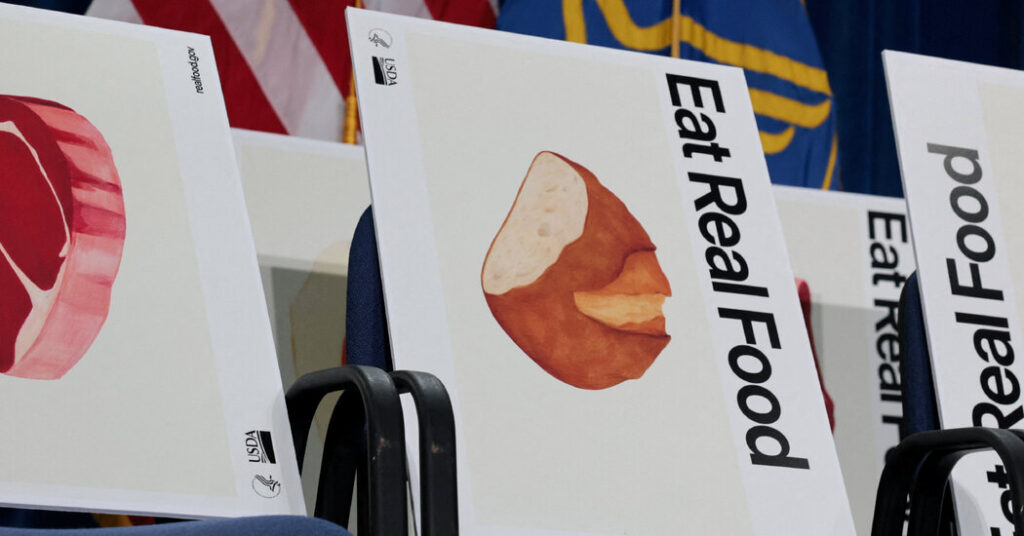
In late February, I went to Austin, Texas, to see America’s health secretary, Robert F. Kennedy Jr., headline an “Eat Real Food” rally. A Steak ’n’ Shake food truck was on site, offering free burgers and tallow-fried fries. A band of lanky young men with shaggy beards warmed up the crowd of a few hundred people with “swampadelic-country-rock” songs. As Mr. Kennedy touted the virtues of eating liver and cooking at home, supporters cheered and held up posters featuring steak and cartons of whole milk.
Enthusiastic MAHA supporters helped fuel Mr. Kennedy’s unlikely rise to his remarkable position of power, and have been credited with helping elect Donald Trump for a second term. “If you merge MAHA and MAGA, it’s like 1932, you govern forever,” the strategist and pundit Steve Bannon told Marjorie Taylor Greene, then a congresswoman, in 2025.
It’s critical to Mr. Kennedy’s future that everyone continue to believe this. Mr. Kennedy’s recent actions suggest that he is considering another run for president. His unlikely path to victory in a Republican primary will depend on credibly claiming that his movement is ascendant and that a growing constituency of MAHA voters are as devoted to him as MAGA voters are to Mr. Trump. “I read an article where they think Bobby is going to be really great for the Republican Party in the midterms. So I have to be very careful that Bobby likes us,” Mr. Trump joked during a January cabinet meeting.
There are plenty of examples of powerful interest groups in American politics — think anti-abortion activists, for example — that bring zeal, money and pressure to bear on political coalitions without, ultimately, being able to move a lot of votes. MAHA may well be one of these — an activist movement with political muscle, more than a bloc of swing voters.
Much of what MAHA wants conflicts with other Republican priorities, with the views of average Americans or both. This has put Mr. Kennedy in a bind. On the one hand, he needs to rally the army behind him; and on the other, he has to betray them in order to build mainstream support.
With one eye on Mr. Trump’s cratering approval ratings and another on the midterms, White House staff asked Mr. Kennedy to de-emphasize his anti-vaccine efforts and to back an executive order supporting pesticide makers. Mr. Kennedy obliged. In response, MAHA activists loudly expressed their displeasure and threatened to withhold their votes from Republicans, and have even teamed up with Democrats to oppose the White House’s agenda.
MAHA’s grass roots are loyal to Mr. Kennedy, but they are driven more by principle than by personality. Now, Mr. Kennedy and MAHA face a difficult question: Will the movement survive the revelation that Mr. Kennedy has been a regular, transactional politician all along?
MAHA’s leadership has worked hard to promote the belief that MAHA voters are a meaningful new constituency with the power to decide elections. In February, MAHA Action, a Kennedy-aligned advocacy group, sent leading G.O.P. committees a memo arguing that MAHA voters are critical to the party’s success in the midterms. MAHA is a “once in a generation political gift to the G.O.P.,” the memo begins.
“Republicans who failed to embrace the gift of the MAGA movement have had their political careers meet an untimely demise,” it goes on, in mob-boss style. “Republicans serving now shouldn’t make the same mistake and fail to embrace the gift of MAHA.”
In a recent Politico poll of American voters, 48 percent of respondents said they support or strongly support the MAHA movement, but only 34 percent of respondents in the same poll said they could actually explain what MAHA is, and only 31 percent identified as part of the MAHA movement themselves. The specter of the MAHA voter apparently still looms large for the Republicans. Political pundits have been writing pieces warning that “MAHA Could Decide the Midterms” and “Republicans Are Squandering Their MAHA Moment.”
The same Politico poll, however, asked people to rank issues in terms of importance. This is where MAHA Action’s confidence that the movement is a gift to Republicans begins to look like a check the group can’t cash: When asked which concerns they care about most, voters put the cost of living and the economy first, as they do in poll after poll. They ranked “Americans are too unhealthy” in a rough tie for second to last alongside “wokeism,” below climate change and gun rights. Other polls have also found that the gestalt of MAHA’s concerns is fairly popular, but very few Americans are going to vote one way or another because of them.
The true MAHA grass roots are a relatively small number of informed, determined activists who have achieved remarkable influence in a short time through sheer persistence. They are, functionally, a special interest to be managed rather than a major electoral force. This is why, despite MAHA’s apparent strength, Mr. Kennedy has little leverage among Republican leadership. They want him on the stump rallying his supporters, and they believe that his work on food and nutrition is a potential positive for them. They also know that most people are not going to base their vote on MAHA’s priorities, and that MAHA should not be given more weight than it’s due in the G.O.P. coalition.
This has become particularly clear around vaccines. Mr. Kennedy is often characterized as an anti-vaccine crusader, and for good reason. He’s been casting doubt on vaccine safety and crusading against vaccine makers for over 20 years. And in his year as the health secretary, he fired all the members of the Centers for Disease Control and Prevention’s vaccine advisory panel, removed several vaccines from the recommended schedule for children and cut off nearly $500 million of funding for mRNA vaccine development.
But as two Republican pollsters put it last year, “vaccine skepticism is bad politics.” It’s true that trust in vaccine safety has declined this decade, especially among Trump voters. But the majority of American parents continue to believe that vaccines are an important public health intervention and support mandates to require them for school attendance. Against the backdrop of America’s worst measles outbreaks this century, efforts to roll back vaccinations are a bridge too far for most voters.
The White House knows this. Last month, a federal judge put an injunction on Mr. Kennedy’s vaccine advisory committee, invalidating its recommended changes to the vaccine schedule, and Casey Means, the administration’s nominee for surgeon general, appears unlikely to be confirmed, because of her equivocal support for vaccines during her hearing. In both cases, the White House has shown no sign of putting up a fight. “We’re just kind of done with the vaccine issue,” a White House official said earlier this year.
Mr. Kennedy seems to know it, too. I have seen Mr. Kennedy speak twice in recent months about his accomplishments in office, and neither time did he mention vaccines. He also tried to outrun the issue the last time he was running for president and had to win over a general audience. “We did our very best to get him to avoid the issue like the plague,” Charles Eisenstein, a Kennedy 2024 speechwriter, told The Times.
Leaders at his former nonprofit Children’s Health Defense, and at the MAHA Institute and the Brownstone Institute (both MAHA-aligned think tanks), are not done with vaccines. They’re still hosting round tables on “the massive epidemic of vaccine injury,” suing medical associations over vaccine safety claims and advancing anti-mandate legislation around the country. Bills aimed at rolling back school vaccine mandates are currently under consideration in states as varied as Oklahoma, Hawaii, New York and West Virginia.
All this activity in the MAHA ecosystem, together with rising measles and whooping cough cases across the country, keeps vaccines in the news and a millstone around Mr. Kennedy’s neck. His approval rating has dropped steadily since he first took office, and it will stay low if vaccines continue to be the issue people associate him with.
Things have been particularly tense since February, when President Trump signed an executive order authorizing use of the Defense Production Act to spur domestic production of the chemical glyphosate, a common herbicide ingredient. The administration claimed this was a matter of national security, since the vast majority of American crops, including roughly 90 percent of corn and soybeans, are grown from herbicide-resistant varieties.
The MAHA movement has long declared war on glyphosate because of its suspected role in causing hormone disruptions, gastrointestinal issues and cancers, and it once seemed that Mr. Kennedy did, too: One of the crowning achievements of Mr. Kennedy’s career was winning a $289 million lawsuit in 2018 against the company Monsanto on behalf of a former groundskeeper who developed non-Hodgkin’s lymphoma after years of glyphosate exposure. When Mr. Trump declared glyphosate a national security priority, Mr. Kennedy supported him — ostensibly reluctantly, but also perhaps because farmers are a critical Republican constituency.
MAHA activists went ballistic. “That is America Last, Anti-MAHA and unforgivable,” the anti-glyphosate activist Kelly Ryerson wrote on social media after Mr. Trump’s executive order was released. “Moms across the country reveal they are unlikely to vote red in the midterms BECAUSE OF THE GLYPHOSATE EXECUTIVE ORDER,” Alex Clark, a movement leader, posted on X.
Last Thursday, the White House invited Ms. Clark, Ms. Ryerson and other MAHA activists to meet with the president, Mr. Kennedy and White House senior staff members to talk about the issue. Ms. Ryerson told me that the meeting was promising. But she also said “very real actions” need to happen between now and November if Republicans “hope to keep MAHA showing up at the voting booth.”
Glyphosate may have been Mr. Kennedy’s first “Sister Souljah” moment — a showy betrayal of his base in order to reassure his skeptics. This might ultimately serve him if he runs for president and needs big agriculture to give him a chance. But in the short term, all it’s done is make him look weak to both his boss and his supporters.
These recent setbacks have fueled rumors that Mr. Kennedy might be leaving his post soon. His office denies this, but I’ve long thought that Mr. Kennedy may be on his way out, given how constrained he’s become. If he wants to run for president, leaving will improve his chances to get some distance from the Trump administration’s errors.
Recently, he’s been testing out new material that might hint at what a rebranded Robert F. Kennedy Jr. could run on: a health care reform agenda that Americans actually want. A few weeks before my visit to Austin, I saw Mr. Kennedy speak in Nashville about prescription drug price negotiations and rural hospital subsidies. Mr. Kennedy, the anti-corporate former Democrat, is pivoting from resenting pharma companies for pushing their products on Americans to taking them on for price gouging.
A platform that takes the most popular elements of the MAHA agenda, disavows the rest and leans in hard to the populist beliefs that have always been part of Mr. Kennedy’s shtick may well appeal to Republican primary voters in search of a new anti-establishment champion in a post-Trump world. To execute the pivot, Mr. Kennedy will have to keep making compromises. His base may decide to bite their tongues and get on board for another campaign, but only if they believe they’ll be repaid in policy changes. Robert F. Kennedy Jr. isn’t a zealot for a cause; he’s just another man who wants to run the world, hiding in plain sight. MAHA moms, however, are potentially too committed to sacrifice their goals even in service of their own leader’s ambition.
Rachael Bedard is a contributing Opinion writer, a geriatrician and a palliative care doctor.
The Times is committed to publishing a diversity of letters to the editor. We’d like to hear what you think about this or any of our articles. Here are some tips. And here’s our email: [email protected].
Follow the New York Times Opinion section on Facebook, Instagram, TikTok, Bluesky, WhatsApp and Threads.
The post MAHA Propelled Kennedy to the White House. It May Become His Downfall. appeared first on New York Times.