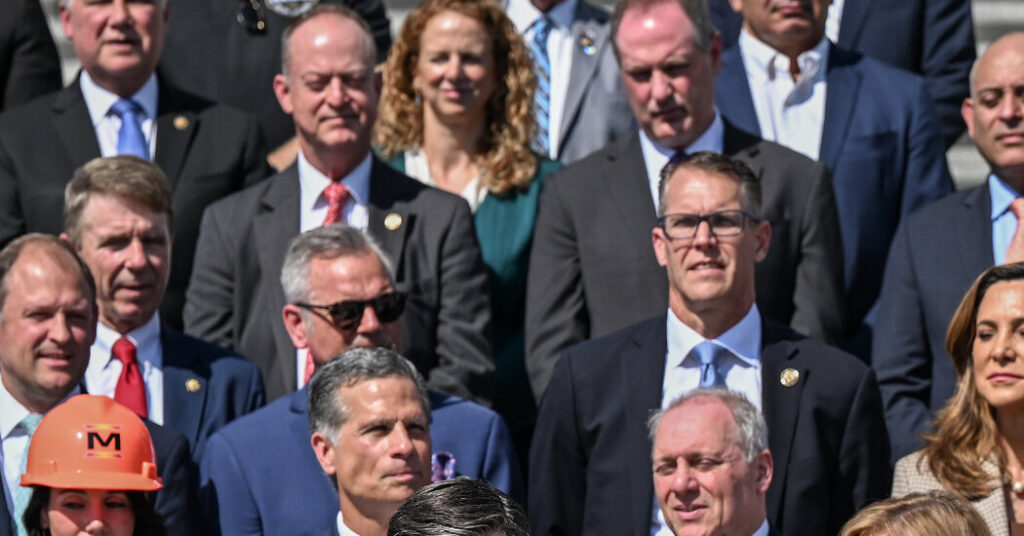
Republicans are hoping your Tax Day is a joyous one.
But as my colleague Andrew Duehren explains, while President Trump’s tax cuts succeeded in increasing refunds this year, the increase was smaller than expected — and, he added, “It is always difficult to wring much political reward out of a tax cut.”
Republicans, for their part, could certainly use some wins right now.
After all, Trump’s disapproval rating has climbed past 60 percent in some surveys. A recent CNN poll found Trump’s approval rating for handling the economy hitting a career low of 31 percent. The administration is in an extraordinary spat with the Catholic Church after Trump excoriated Pope Leo XIV, a critic of the war with Iran, on social media.
And as that unpopular war rages in the Middle East, gas prices at home are going up — a tangible, immediate and painful reminder for many Americans of the high cost of living, and often a problem for the party in power (something Democrats experienced during the Biden administration.). A Quinnipiac University poll released today found that 65 percent of voters blame Trump, at least in part, for the rising gas prices.
“Voters remain most focused on affordability, but Washington is not,” Robert Blizzard, a Republican pollster, told me, saying that “foreign policy is crowding out what Americans care most about.”
He added, “That gap is becoming a clear political vulnerability and an opportunity for the political party that can credibly own that issue.”
“Because the G.O.P. is in power,” he said, “it’s very much on us.”
Trump is expected to visit Las Vegas tomorrow to talk up his tax policies.
Whether he stays on message is, as always, an open question.
On Monday, as he received two bags of a McDonald’s food delivery to the Oval Office — a delivery the White House tried to use to highlight his “no tax on tips” policy — he used the moment to explain to reporters why he had posted an image on social media that appeared to depict him as Jesus. (He took down the post amid an outcry.)
And even if he stays on message, it is not clear how receptive voters will be. A Fox News poll found that a “record 64 percent of voters disapprove” of his handling of taxes, up 11 percentage points since last year.
Still, there was at least one bright spot for the administration on Wednesday: Stocks hit a record high.
Who will succeed Sherrill in the House in New Jersey?
New Jersey will hold a special election on Thursday to succeed Gov. Mikie Sherrill, a Democrat, in the House. My colleague Tracey Tully gives us a preview.
Joe Hathaway, the Republican candidate in Thursday’s special election, seems well aware of his long odds and President Trump’s impossible-to-escape presence in the contest.
“Look, I get it, I’m pretty self-aware, right?” he said last week at a candidate forum. “The general issue with our district when I talk to a lot of people is people’s points of view on the president.”
There are 65,000 more registered Democrats than Republicans in the 11th Congressional District, and Sherrill, a Democrat, was re-elected two years ago by nearly 15 percentage points.
Hathaway, a Trump supporter, has said that he would not be a rubber stamp for the president if he wins his long-shot bid against Analilia Mejia, a progressive Democrat who helped run Senator Bernie Sanders’s 2020 presidential campaign.
The winner will serve out the remaining eight months of Sherrill’s term and must immediately begin campaigning for a full, two-year term. Early voting in the June primary starts in just 40 days.
Hathaway, a former Yale football player, tossed something of a Hail Mary pass in his final message to voters, suggesting a money-back guarantee by November.
“You have an opportunity to test-drive a Republican for the next six months,” he said. “See how I handle, see how I hug the curves.”
Democrats, including the governor, have rallied to Mejia’s side after she beat Tom Malinowski, a former House member and the race’s early front-runner, in a bruising 11-candidate primary. Malinowski lost by about 1,000 votes after being battered by negative ads paid for by a group aligned with the American Israel Public Affairs Committee, a pro-Israel powerhouse.
Democratic turnout in that odd special-election primary — also held on a Thursday — was enormous.
And, just as in other recent elections in Georgia and Wisconsin, Democrats in New Jersey again appear eager to vote.
As of Monday, roughly 54,000 people had already cast ballots. Nearly 15 percent of the district’s registered Democrats have voted, compared with about 8 percent of registered Republicans.
One Number
51 percent
That’s the share of Americans who think the war in Iran has not been worthwhile, according to a survey from Ipsos and Reuters that was conducted after the cease-fire and after Trump threatened that “a whole civilization will die tonight.”
Even among the president’s core supporters, my colleague Ruth Igielnik writes, there was a divide: 55 percent of Republicans said they thought the war was worth it, a far cry from the vast majority of his base who support him on most other issues.
Democrats eye more campus influence
Democrats desperate to win back young voters who drifted rightward in the 2024 election have rolled out a host of projects since then aimed at appealing to Gen Z.
The latest group to try to harness students’ voting power is More Perfect Union, a progressive group run by a veteran of Senator Bernie Sanders’s presidential campaigns.
The group’s initiative, called More Perfect University, is being pitched as a liberal answer to Turning Point USA, the right-wing activist group that has pushed conservative values at colleges and mobilized young voters for Trump.
My colleagues Kellen Browning and Shane Goldmacher lay out the high stakes of winning over more young voters.
ONE LAST THING
Is Ohio ready for Governor Ramaswamy?
You may have last heard of Vivek Ramaswamy during his ill-fated 2024 run for president, when he made a name for himself by trying to run to Trump’s right and floating conspiracy theories.
Now he’s back and running for governor of Ohio — a state that has disappointed Democrats again and again, but that looks surprisingly competitive this year. My colleague Campbell Robertson has more.
Tracey Tully and Taylor Robinson contributed reporting.
Katie Glueck is a Times national political reporter.
The post Can Trump and Republicans Get Back on Message on the Economy? appeared first on New York Times.