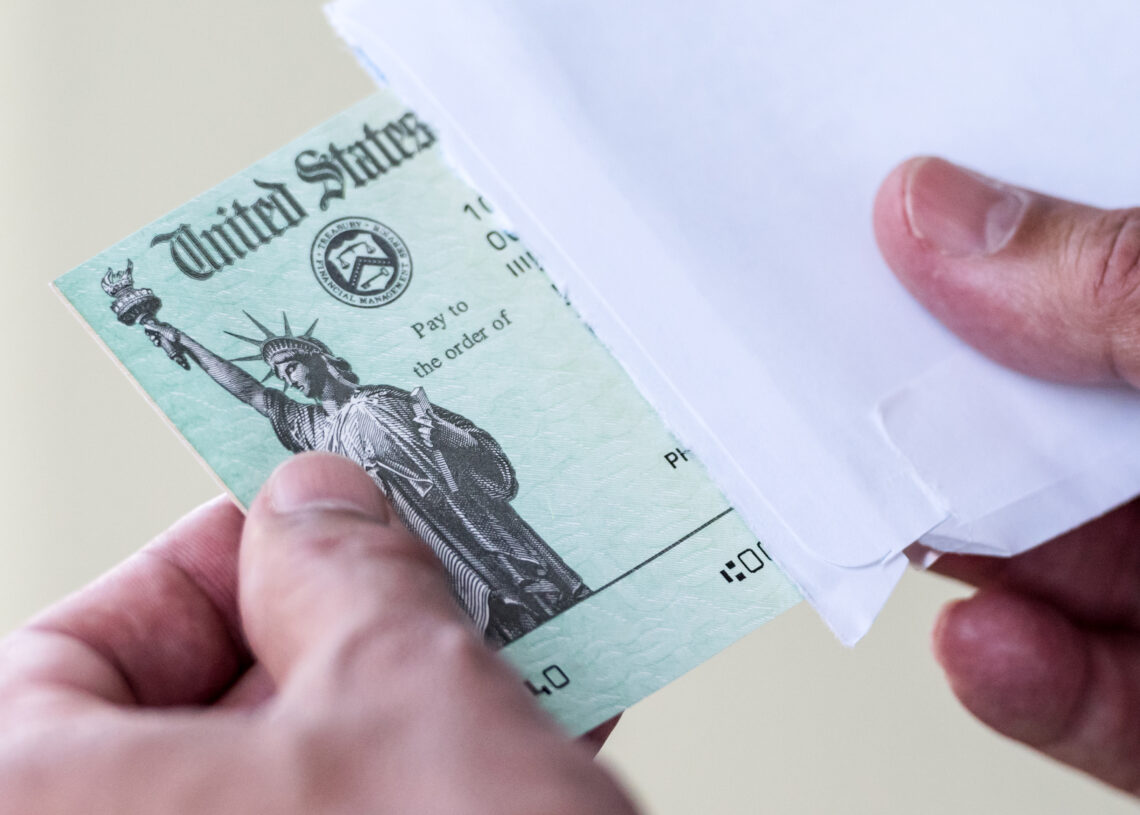
This Tax Day, more people might be celebrating their refunds than usual.
The Internal Revenue Service is sending more money back: The average refund for the almost 100 million households who had already filed their returns as of April 3 was $3,462, more than 10 percent above last year’s average of $3,116 for similarly early filers.
The bigger refund checks reflect the major tax cut passed by Congress in July, which reduced many households’ tax bills. Because the law went into effect midyear, it also meant that many companies ended up withholding too much from workers’ paychecks, based on previous formulations.
As of April 3, the most recent data published by the IRS, the number of returns filed was below the number at the same point last year: a little under 100 million, compared to more than 101 million. But the IRS sent out much more money than at the same point last year: more than $241 billion in refunds, a 14 percent increase compared to $211 billion last year.
The portion of people who get a refund, rather than owing money at tax time, seems to be going up: just over 70 percent of people whose returns were processed by April 3 this year, compared to 67 percent of similar filers last year and 62 percent of all filers last year. (People who owe money, understandably, tend to wait longer to file their taxes, so the early returns show more refunds.)
The Republican law increased the standard deduction and included many new tax cuts for specific groups. The child tax deduction increased, from a maximum of $2,000 to $2,200 per child. New tax breaks for the years 2025 through 2028 let people deduct their tip income, overtime pay and certain car loan interest paid.
Alia Shawa, 35, benefited from the new tip and car-loan deductions, as a server at a New York City restaurant who bought a new car in July. She earned about $40,000 in tips and was able to skip paying taxes on $25,000 of it.
In 2024, Shawa’s husband, a chef, earned more money than he thought he would, so they owed a painful $12,000 tax bill. “It totally broke us,” she said.
In 2025, they withheld much more during the year, plus they benefited from the new deductions, adding up to a whopping $26,000 refund. “I finally get something back. … For how much we work, we weren’t getting help.”
Shawa, an immigrant from Spain, enthusiastically supported the new deduction, saying it would help both service workers and the low-margin restaurant industry. “They’re not able to pay us a livable wage. … If we were only taxed on our wage, not tips, that makes so much more sense for the cost of living here in New York.”
The car-loan deduction that Shawa claimed is available only for certain American-made cars that were bought new in 2025; so far, just over a million households have claimed it, according to Politico, well below the Trump administration’s predictions.
The overtime deduction, on the other hand, has proven far more popular than anticipated, with more than 23 million households claiming it as of early April. Some experts worried that people who misunderstand the new rules are improperly claiming the deduction, which only applies to specific workers, and only to part of their pay (the “and-a-half” part of “time-and-a-half,” not their full pay for those hours).
The popularity of the overtime deduction has a lot to do with the overall average rise in refund amounts, said Kasey Pittman, managing director of tax policy at the tax firm Cherry Bekaert. “It’s sometimes very hard to parse that information” about what overtime pay should be tax deductible, she said. “Those provisions are driving a lot of the increase in tax refunds.”
The Republican law also gave qualifying senior citizens a new $6,000 deduction, which can cut their overall tax bill by as much as $1,320, according to analysis by the Bipartisan Policy Center.
Karen Richardson, 68, has had a predictable tax return since she retired from her job administering government benefits four years ago. She lives on a fixed income and usually owes some money at tax time, so she was surprised to get a $1,000 refund this year due to the senior deduction.
“The Big Beautiful Bill worked for me,” she said. “I didn’t think it applied to more than the richer people. … I really didn’t think it applied to me.”
The Bipartisan Policy Center found that the potential tax savings for households from any single provision in the Republican law varies widely. The most that any household can save from the increased standard deduction is $555, for the highest earners; the vast majority save much less than that. The tax deductions for tips and overtime can be worth up to $6,000 for a married couple.
The biggest potential savings comes from the bill’s higher threshold for deducting state and local tax (SALT) amounts from federal income — a married couple earning up to $500,000 per year can now deduct $40,000 in SALT, instead of $10,000, which would save them close to $10,000 on their taxes.
That newly generous SALT deduction benefits wealthier people much more than lower-income households — most low- and middle-income households don’t have more than $10,000 in state and local tax bills to deduct.
Before this year, the average total refund amount hadn’t changed much in recent years: $3,167 in 2025, $3,138 in 2024, $3,167 in 2023, $3,252 in 2022.
Going forward, taxpayers shouldn’t expect the bigger refunds to be the new normal.
Employers are supposed to withhold about the right amount of money from paychecks to pay a worker’s taxes. This coming tax year, withholding formulas will reflect the new law. Workers will get to keep more money throughout the year, and their refunds next tax season will be smaller.
In some sense, it’s truly better for workers to get their money up-front, Pittman noted: “Refunds just mean you’ve given the government an interest-free loan.”
But many people feel good getting a bigger check on Tax Day. “That was a strategic decision,” Pittman said. “[Republicans] did not adjust the withholding tables for this year, because it was likely to result in a boon at refund time, which is strategically not too far from midterm elections.”
Republicans in Congress have been touting the bigger average refund checks, casting the money as an answer to the rising cost of living driven by inflation.
April 15 is the deadline to file or request an extension. People who file on the deadline should expect to receive a refund, if they are owed one, in about three weeks, the IRS said.
The post Tax refunds shoot up as Americans take advantage of new deductions appeared first on Washington Post.