This article is part of our Museums special section about how institutions are commemorating the past as they move into the future.
Just over an hour outside New York City in the quiet bedroom town of Ridgefield, Conn., the Aldrich Contemporary Art Museum faces a conundrum. So close to New York, it competes for attention with some of the world’s top museums.
To be fair, the Aldrich is no small fish. It has made a name for itself with groundbreaking exhibitions like “Twenty Six Contemporary Women Artists,” a 1971 survey that the museum said was the first in the United States to focus on female artists, as well as “52 Artists: A Feminist Milestone,” the acclaimed 2022 show that revisited this moment, adding the next generation of nonbinary or female-identifying artists to the mix.
“Still, in a way, it’d be easier if we were hours from a city,” said Amy Smith-Stewart, chief curator of the Aldrich. “People take for granted what they have in their backyard.”
This June, the museum is planning the “Aldrich Decennial: I am what is around me,” an exhibition that it hopes will remind visitors of its position as a world-class institution and also of the vibrant creative community in Connecticut.
Curated by Smith-Stewart and Caitlin Monachino, the show will feature artists living and working in the state. As its title suggests, the exhibition will return every 10 years, an ambitious marker of the museum’s commitment to supporting its neighbors.
A recurring exhibition has the potential to become a defining characteristic of the Aldrich. Indeed, these events are staples of the industry. This year a number converge, including the Venice Biennale, the Whitney Biennial and MoMA PS1’s “Greater New York” survey of artists in and around the city, held every five years.
For Smith-Stewart, who began her curatorial career at MoMA PS1 and worked on multiple editions of “Greater New York,” starting a similar exhibition at the Aldrich has long been a goal.
“Doing an exhibition that’s in a series is a big risk,” she said. “But artists are taking risks every day, and what I learned at PS1 is that museums have to find ways to match this.”
To this end, in June 2024, Smith-Stewart and Monachino began crisscrossing Connecticut, visiting over 100 artists’ studios, including antique barns and industrial warehouses, spending more than 600 hours combing every corner of the state. They set a parameter for the artists, focusing only on those who have never had a solo museum show in Connecticut. Many had been on their radars for years; others were discovered by word of mouth.
In the end, the curators selected a group of 40 artists who offer a glimpse into the state’s creative community. Only five of the artists are from Connecticut originally, and 13 were born outside of the country.
They are an intergenerational bunch, ranging from early and mid-30s, like Sonja Langford, a photographer in the University of Connecticut’s M.F.A. program who explores how care and empathy fit within medical history, to 88 with Lucy Sallick, a painter who moved to Westport from New York more than 50 years ago for her husband’s work.
“Back then, the suburbs were a kiss of death,” Sallick said from the barn that houses her studio. “I used to pretend I wasn’t a suburban artist, as we were called, and made sure I was seen out in New York.”
Sallick remained “oriented toward the city,” she said. In ways, she had to. Before the internet, artists showed their work on physical slides, bringing them to different galleries. As the dissemination of art changed, so too did the experience of being an artist in the suburbs.
While Sallick has decades of artwork to offer the Aldrich, the works in the show had to be made within the last 10 years to fit the decennial theme. The curators chose Sallick’s small books she made of personal ephemera, like her grandfather’s handkerchief and photographs of her ancestors.
Smith-Stewart and Monachino did not approach the show with specific themes in mind, though some did emerge, in particular why the artists chose to be in Connecticut. Some cited the high cost of living in New York. Many have ties with schools in Connecticut. For others, the impetus was more room or the possibility of having an at-home studio.
Further avoiding a proscriptive lens, the exhibition title, “I am what is around me,” is open-ended. The opening line of “Theory,” a 1917 poem by Wallace Stevens, who also lived in Connecticut, the phrase underscores how man becomes inextricably linked to his surroundings.
With their studios, the artists in the show are particularly creative. The Iranian artist Arghavan Khosravi made the top floor of a three-story townhouse in Stamford into her studio and installed a wood shop in the basement.
In the quaint town of Southbury, the Canadian painter Danica Lundy built her studio in 2023 after moving from New York a few years before that for her husband’s job at the University of Connecticut, commuting to her old studio in Brooklyn until the space was finished. “Connecticut is mildly unsexy, but I’m OK with that,” Lundy said.
Farther northeast, about three hours outside of New York, Lula Mae Blocton moved to the rural town of Hampton in 1989 for a job at Eastern Connecticut State University.
“It was an adjustment,” Blocton, who grew up in Detroit and lived in New York in the 1970s, said. As rents increased in New York, Blocton realized she had to leave. “There are only a few things that attract people to this area: nature and UConn basketball. It’s all darkness and wild animals. But it’s given me quietness to focus on my work.”
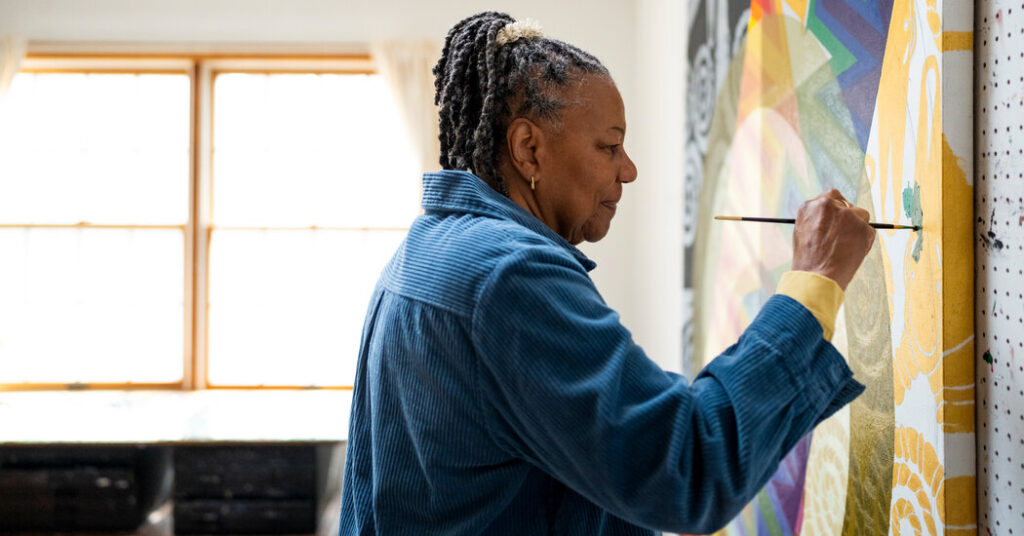
Blocton’s abstract paintings in the exhibition feature overlapping geometric shapes in colors representing the updated L.G.B.T.Q.+ flag — the six colors of the rainbow flag, as well as the transgender flag and black and brown to represent marginalized communities.
Like Blocton, the interdisciplinary artist Tammy Nguyen was initially apprehensive about the rural town of Easton where she moved to in 2021 after getting a position at Wesleyan University in Middletown, Conn.
“At first I was commuting from Harlem,” she said. “When you’re young, there’s pressure to be in the city and you become proud of the grind, but when Covid happened it made sense to move.”
Nguyen was familiar with Connecticut, having done her M.F.A. at Yale, and she knew of Easton, a small, agricultural town, through the artist James Prosek, an environmentalist known for his depictions of fish and birds. (Having already had museum shows in Connecticut, Prosek wasn’t eligible for the decennial.) “James took me to his studio and birding around Easton, but I thought it was the deep woods,” Nguyen recalled.
Though Easton is only about 90 minutes from New York, Nguyen is not wrong with the generalization; after all, it is known as the Christmas tree capital of Connecticut. (It’s also my hometown.) Over time, she became accustomed to the rural setting and even has a chicken coop.
“I didn’t know how much nature was going to give me,” Nguyen said. “I now know things like when tomatoes are about to be perfect. You become aware of the planet in orbit out here.”
Nguyen’s works in the exhibition include books inspired by archival papers related to U.S. land reformation during the Vietnam War and Ralph Waldo Emerson’s essay “Nature” (1836). Dedicating a book to each season, Nguyen explores the relationship between man and the environment and notions of manifest destiny.
Nguyen’s connection with Yale is common among Connecticut artists. Others in the show with Yale M.F.A.s include the Sudanese Canadian installation artist Azza El Siddique, who works in a sprawling industrial warehouse in North Branford, and the mixed-media artist Felandus Thames.
For Thames, who makes portraits and installations primarily with hair beads strung on wire, the urban setting of West Haven was fitting for his community-based practice.
“I’ve always used art to empower young people of color by giving them jobs in my studio,” he said. “Art can show youth that there’s a way out of whatever social ills they’re facing.”
Nearby in New Haven, artists have formed a community, not in small part thanks to the NXTHVN residency. The annual fellowship program has become a hub for artists, including the sculptor Kristy Hughes, who has three pieces in the Aldrich show.
Exploring joy and empowerment through color, Hughes is originally from Texas and was living in Vermont before moving to New Haven for her residency in 2024.
Drawn to the intellectual community of nearby Yale, the proximity to New York (just under two hours away) and the affordability of studio space, Hughes decided to stay in New Haven. The Aldrich exhibition gave Hughes the opportunity to create her first outdoor piece: two large ovals resembling portals installed in front of the museum.
Like Hughes, the Venezuelan American artist Enrique Figueredo created an outdoor work for the show, though not his first.
A printmaker and assistant professor at the University of Connecticut’s main campus in Storrs, Figueredo explores themes including power, economy and colonization of the Americas.
His carved plywood sculpture features images of boats, a motif the artist has become increasingly interested in since moving to Connecticut.
“There are so many historic ports here,” Figueredo said. “There’s so much to learn from them and their ties to global expansion and the repeat cycles of war and fights for resources. I’ve seen ports all over, but for some reason, Connecticut has slowed me down to pay attention.”
The post Putting Connecticut Artists in the Spotlight appeared first on New York Times.