NEW YORK — During a recent visit to the Kunsthistorisches Museum in Vienna, I had almost the same experience that happens to me in Washington’s National Gallery of Art. Upon encountering Raphael’s “Madonna of the Meadow,” all of the museum fatigue evaporated — and with it that peculiar brain fog of an overfull yet completely scattered mind. At the National Gallery, it’s the same painter’s Alba Madonna that inevitably arrests and refreshes.
The Alba Madonna is one of the essential works anchoring the Metropolitan Museum of Art’s magnificent and expansive survey “Raphael: Sublime Poetry,” which includes more than 200 paintings, drawings, tapestries, documents and religious pieces. It is a major event: The galleries are packed, and somehow seeing Raphael at this moment feels more profound than usual. There is in his work a sense of serenity and stillness, an adamantine quietude, that should shame us at the civilizational level, for what we have become, what we threaten to do, what we’ve done with no remorse or regret.
The Alba Madonna is a study in actual and metaphoric drapery. The Madonna’s dress is a miracle of unfussy fluidity that lovingly connects three figures: Mary, her infant son Jesus and the baby Saint John the Baptist. It swaddles Jesus in blue, the color of the sky and the heavens, and he seems already installed there, as if his life, death and divine purpose are looped together in a temporal circle. The what-is-yet-to-come — the sorrow, crucifixion and resurrection — has always been there, has already happened and is always happening.
But it is also a masterpiece of metaphoric drapery, complexity clothed in simplicity. Raphael painted dozens of Madonnas, and each one is a subtle variation on a symbolically dense and deeply meaningful aspect of Christian dogma. Yet that symbolic density is discreetly veiled under an aura of perfect calm and placidity.
A newcomer to these paintings — which have an astonishing power to make us perpetual newcomers, no matter how often we have seen them — might think their strength lies in the lack of thick religious symbolism, the way they humanize the Christian story without getting into the weeds of doctrine or messaging. In fact, every detail, from the cross held by Jesus to the book in Mary’s hand, bursts with symbolic significance. Jesus was the word made flesh, and thus Mary holds a book, which makes her seem more real, more vulnerable (the need to pass the time is fundamentally human) and yet fully a part of the divine mystery she has engendered.
I hate to use the word “serenity” when writing about Raphael because it recalls the clichés that began to gather around the artist as his reputation waned in the 19th century. Yes, waned. As curator Carmen C. Bambach writes in the catalogue, Raphael, who died in 1520 at the age of 37, was famous, admired and wealthy in his lifetime. But his reputation as the “Prince of Painters” — a kind of Mozart figure, a font of faultless genius — peaked and ebbed in the 1800s, as critical reevaluation of the other Renaissance titans (Leonardo and Michelangelo) began to put him in third place.
When his star was ascendant, he was admired for the clarity and serenity of his work and the sweetness of his figures. But it was precisely those qualities that critics began to find cloying in the 19th century.
The Met exhibition argues for a more comprehensive understanding of the artist, from his origins in the fading days of one of the great, humanist courts of Europe — Urbino in the mid-15th century, considered the Athens of its day — to his dominant role in the art business of Rome, painting for the Vatican and running a production house that was so busy it may have contributed to his early death. He was a prodigy who could socialize with the most learned and powerful men of his age, a well-read man with graceful manners and a winning personality.
His remit, for the Vatican, wasn’t just about putting paint on the walls. He also served as an architect, developing ideas for what was then the biggest building project in Rome, St. Peter’s Basilica, as well as an architectural historian, surveying and mapping the remains of the ancient city. In a letter written by his friend Baldassare Castiglione, but conveying Raphael’s thoughts about the legacy of ancient Rome, he made one of the first arguments for what we would today call historic preservation.
Castiglione appears in one of the greatest portraits ever made, Raphael’s 1514-1516 depiction of the author and scholar borrowed from the Louvre. He is posed and framed almost exactly as Leonardo framed the Mona Lisa, a painting “with which it begs to be compared,” says Bambach. He is a strikingly calm yet forceful presence. Here, in perfectly distilled form, is the paradox of Raphael’s serenity, which flows from strength. Here, too, clothing is part of the message. Castiglione, who wrote the essential Renaissance text on manners, etiquette and deportment, “The Book of the Courtier,” is dressed in dark colors, sumptuous but sober. Manners are the dress of morals, and in his writing, Castiglione extolled grace and simplicity; he deplored foppishness.
So, even if it’s a cliché, you can’t escape the pleasure and depth of Raphael’s serenity. And why would you want to? Self-control, the ability to step back and think for a moment, the mindfulness it takes to resist our first impulses — what might our world look like if it was led by people endowed with these virtues? What would our daily life feel like if the technologies of distraction and narcissism weren’t constantly whittling away at the possibility of serenity?
Among the most fascinating works in the exhibition is a drawing not to be missed, a sketch for the Alba Madonna that shows one of Raphael’s male studio assistants standing in for Mary. He sits in almost exactly the same pose as she does in the finished painting, his left leg jutting forward and his right leg bent at the knee, with his foot tucked behind him. In the drawing his legs are exposed, and thus we see that he is a powerfully built figure, yet graceful, and that the pose that seems so perfectly relaxed in the finished painting is actually a muscular armature under dynamic tension.
Raphael, unlike Leonardo and Michelangelo, seems to have been mainly heterosexual, so this isn’t a study in gender fluidity. But it does prove something lost to many of us today: that strength and grace are essentially intertwined, and cannot be sorted into masculine or feminine traits. Women tend to know this. Too many men are utterly ignorant of that truth.
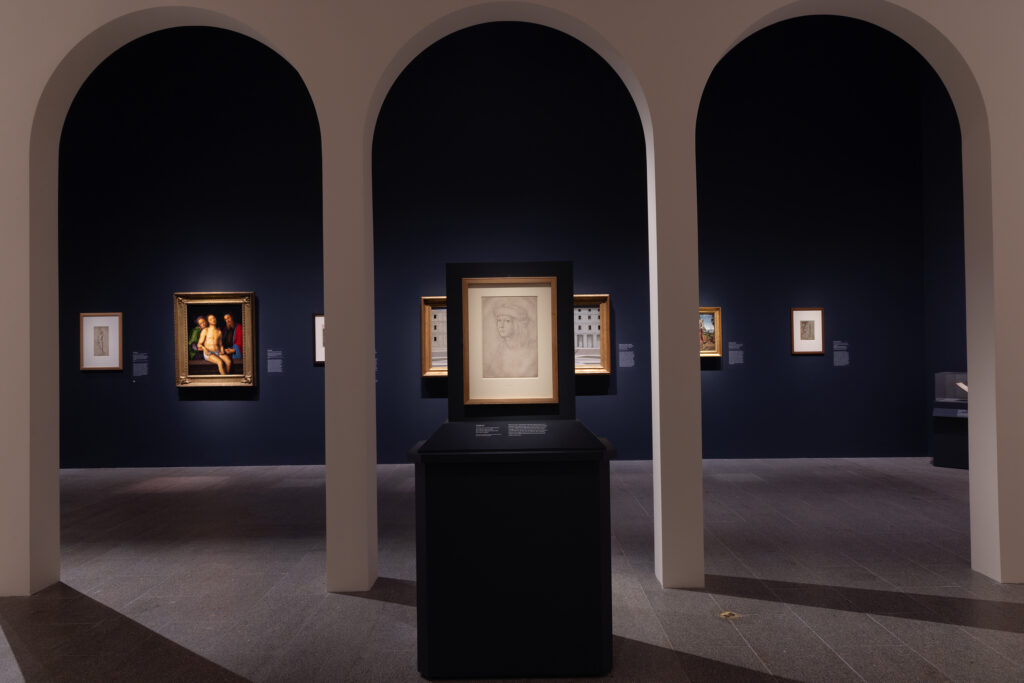
If you visit, prepare for the crowds. The exhibition is laid out in roughly chronological order, but I would recommend proceeding to the galleries with the Madonnas and the portraits first. How he got there, his evolution from a painter under the influence of Perugino, and the curious twists and turns he was taking before his premature death are fascinating stories. But the essential core of his work begins with his stay in Florence, his encounter with Leonardo and Michelangelo, and the frescoes he painted for the rooms known as the Vatican Stanze (represented in a special gallery with digital video projections).
And don’t overlook the little fresco fragment of a putto, a chubby male figure with a garland, that once decorated a fireplace in the apartment of Pope Innocent VIII. Putti are utterly conventional decorative elements that clutter Renaissance paintings by the tens of thousands. But this one is fully present, intelligent, skeptical. His facial expression is priceless. With gentleness, with serenity, he seems to be saying: Look at the mess you’ve made.
With gentleness and serenity, we should accept his indictment. And start working toward a world full of grace.
Raphael: Sublime Poetry, through June 28 at the Metropolitan Museum of Art. metmuseum.org.
The post Raphael, a master of serenity, is the artist we need right now appeared first on Washington Post.