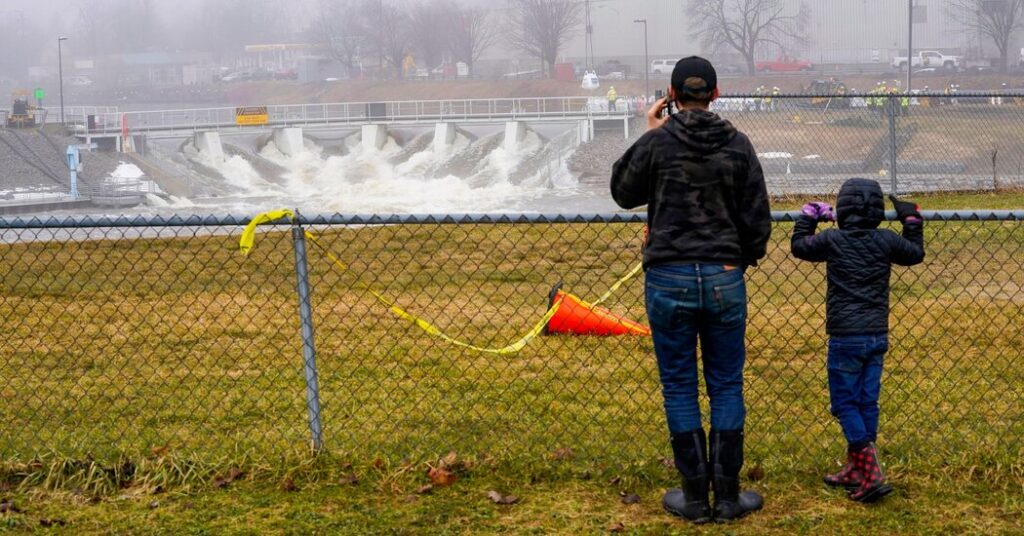
Engineers and emergency workers in northern Michigan have nervously watched rising waters at the Cheboygan Dam for days, warning residents that they might have to evacuate.
So far, the dam has held.
But roads are washing out, homes are taking on water and several other dams are pushed to their limits as heavy rain and melting snow inundate rivers across the Upper Midwest.
On Tuesday afternoon, many in Cheboygan, a Lake Huron port city with 4,800 residents, were told to leave their homes after a levee was breached outside town. And on Wednesday, the sheriff’s office in Cheboygan County warned that a “significant influx of water” was possible at an inland lake.
“There are many residents currently experiencing flooding inside their homes,” the sheriff’s office said on social media. “If you feel water levels are rising and deem it to be unsafe, you should self-evacuate.”
The levee breach on Tuesday followed days of unfavorable weather and emergency work to shore up infrastructure. Gov. Gretchen Whitmer declared an emergency on Friday as melting snow and heavy rain increased water levels in Cheboygan.
On Monday night, a small dam in Alcona County, which is along Lake Huron, had failed. By Tuesday, officials in nearby Antrim County were warning people near the Bellaire Dam to prepare for a possible evacuation and state engineers were visiting other dams that officials said were the “most critical.” On Wednesday, many roads were impassable.
“The damage we’re seeing across Northern Michigan is absolutely devastating,” State Representative Cam Cavitt posted on social media, along with a video of a washed-out road.
Ms. Whitmer’s office said on Tuesday that a U.S. Energy petroleum terminal in Cheboygan, downstream from the dam, had decided to delay barge deliveries of gasoline and diesel for safety and environmental reasons. Because that terminal is an important conduit for fuel coming into the region, the governor exempted truck drivers carrying fuel into northern Michigan from certain regulations.
Michigan has seen an unusually wet start to spring, receiving nearly twice its average March precipitation, according to the National Oceanic and Atmospheric Administration.
That weather has continued into April, where parts of northern Michigan have already recorded their wettest spring, according to Harold Dippman, a meteorologist at the Gaylord, Mich., office of the National Weather Service.
The high water at Cheboygan Dam — 6.6 inches below the top on Wednesday morning — has been created by melting snow and the heavy rainfall. Northern Michigan began the spring with an above-normal snowpack following a mid-March storm that dumped more than 50 inches in just two days.
More rain is expected in Michigan this week, though the storms in the northern part of the state are not expected to be as widespread or as intense as last week’s downpours. Near the Cheboygan Dam, rainfall is expected to range from about 0.25 to 0.50 inches.
Kitty Bennett contributed research.
Mitch Smith is a Chicago-based national correspondent for The Times, covering the Midwest and Great Plains.
The post Floodwaters Strain Dams in Northern Michigan With Thousands Downstream appeared first on New York Times.