This article is part of our Museums special section about how institutions are commemorating the past as they move into the future.
Days before hundreds of thousands of people crowded into downtown Austin for the annual tech-driven South by Southwest festival, the Blanton Museum of Art took a timely step: It opened an exhibition of digital art.
That exhibition, “Run the Code: Data-Driven Art Decoded,” showcases some 20 pieces of digital art, all borrowed from the collection of the Thoma Foundation, a nonprofit started by the Dallas art collectors Carl and Marilynn Thoma — who, incidentally, made their fortune investing in software.
All the works featured were created between 2004 and 2022 — the “post-social media era,” as Hannah Klemm, the museum’s curator of modern and contemporary art, put it.
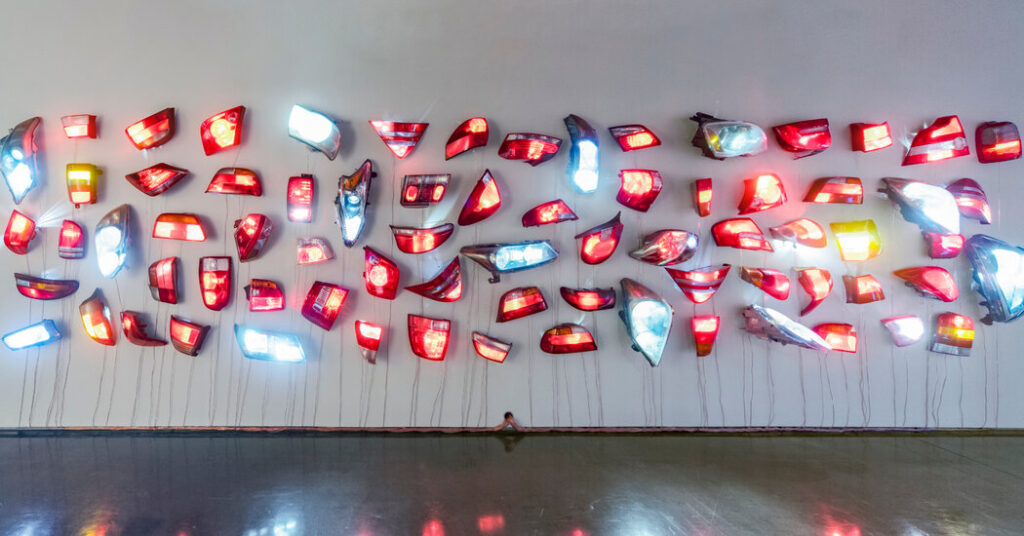
Wandering through the galleries, visitors can stand in front of a wall of sculptural, blinking car headlights; see a digitally created oil slick on the Nile River; or gaze into mesmerizing, color-changing shapes.
The artist and art collectives featured — including well-known names like teamLab, Leo Villareal and Marina Zurkow — all use either data, coding or both to shape how their works appear, change and interact with museum-goers, while just one artist, Refik Anadol, uses generative A.I.
His piece, “Machine Hallucinations — Study 1,” presents a swirl of liquid-like images resembling Gothic architecture, eternally torn down and rebuilt, informed by thousands of photos of real buildings.
In bringing these works together, “Run the Code” explores what art is now, what it is becoming, and who, exactly, is making art when it is created with the help of machines — or even, in some cases, with the help of the visitor.
The seeds of the show were sown three years ago, when Klemm arrived at the Blanton. The museum sits on the University of Texas at Austin campus, and Klemm watched as the entanglement between the city and the tech industry solidified.
Tesla had already moved its headquarters to Austin in 2021; in 2023 the university started a graduate ethical A.I. program; and the following year, South by Southwest rolled out themed programming dedicated to A.I. Taking this in, Klemm pushed harder for the Blanton to put on a show of digital art. That idea bloomed into “Run the Code.”
On entering the show, visitors are immediately greeted by Martin Reinhart’s trippy “tx-mirror” (2018), which will show them slippery images of themselves from both the present and — if they come back in 20 minutes or so — the immediate past. In fact, most of the pieces move, and several change over time in unpredictable, code-produced ways: You can visit the exhibit in the morning and afternoon and see different iterations of the same art.
“Billow I” (2020) by Daniel Canogar, for instance, is a curving wave of LED screens on which Google Trends search terms flow by in real time in color. Camille Utterback’s “Untitled 5” (2004) is an early iteration of interactive art, with evolving graphics reminiscent of the clip art era. On a recent Sunday, children and adults alike enjoyed moving in front of the piece and watching it change — thin lines and crystalline figures sprouting on the ever-changing “canvas” — with their shadows’ movements.
Nearby, in “The World of Irreversible Change” (2022), a luminous work by teamLab, people move about their days, wandering through a golden-lined village on 55-inch LED screens. As the small figures garden and fish, skip and laugh, the world inside the work changes as Austin does outside the museum’s walls: that Sunday, a dusting of snow lined the digital streets as a thunderstorm rolled through; on a cloudy Thursday, clouds lined the sky of this glowing, miniature world in accordance with real-life gloom.
“The World of Irreversible Change” was designed as an interactive piece; however, to interact with this world means to disturb its inhabitants. Touch the screen once too often and, eventually, these people will begin to fight and, over time, destroy themselves and their home, leaving only nature to regrow.
The piece sits in an explicitly interactive section of the exhibit. Yet, to dissuade touching, a thin, low stanchion creates a two-foot-high barrier in front of the piece. When visitors asked the museum security guards if they could touch it they were told no; one guard even said the sensors for the interactive artwork were off.
In a phone interview a few days later, Klemm said that this was a misunderstanding, and that the piece could not be installed without working sensors. She theorized that teamLab had “set these conditions up where everybody kind of has to make their own decision about how they view interaction with this artwork.”
“Do you really want to be the one that destroys this artwork?” Klemm said during another conversation about the piece. “Maybe art should be a little dangerous.”
On the exhibit’s opening day, a woman reached out and touched the screen. A man in the golden world stumbled over, disturbed by an invisible force.
Bill Smith, a biotech consultant in his 70s from the San Francisco Bay Area, said it was a “bummer” that he could not touch the teamLab piece. “It seems like we’re being blocked from what the artist’s intentions were,” Smith said.
TeamLab’s communication director, Takashi Kudo, likened this work to the intergenerational growth of a bonsai tree, which can grow for 400 years. “Even if you cut one leaf, in 10 or 20 years, the tree will be changed, and it’s never going back,” Kudo said in a video interview. “You have choice every moment.”
The question of choice and authorship has always existed throughout the advent of each new art form, from Marcel Duchamp famously turning a urinal on its side, signing it and declaring it art, to Dadaists throwing cards on the floor, Klemm said.
“What we’re really talking about is what art is,” Klemm said. “And it oftentimes has to do with who thought of something first, who made the statement in the context that caused us to consider something else art that we didn’t consider art.”
Jason Salavon, a Fort Worth native, created his piece in the show, “100 Special Moments (The Graduate),” in 2004. It was part of a series in which each piece focused on a widely shared milestone, like getting married or sitting on Santa’s lap.
For each occasion, he sourced photos on the internet, which he then amalgamated into one “mean” or “median” image through a code, Salavon explained in a phone interview. The result is a haunting, blurred-out image of an anonymous graduate wearing a cap and gown sandwiched between two faceless loved ones.
Salavon started writing code to make art while at the University of Texas at Austin in the early 1990s. Today, he teaches an art class at the University of Chicago in which his students are invited to experiment with code and A.I.; he said he saw a sea change in the quality of art created by students between this year and last.
“My aggregate experience was a little bit like vertigo, in the degree of what people were able to do in a two-week assignment,” Salavon said. “It is really noticeable how much more kids were able to do than they would have been able to do a year ago. One part of the conversation was: ‘How much do you feel like you authored this? How much do you feel like you were the person making the call, and how much do you think this sort of weird agent just went and did stuff?’”
Salavon remembers when Apple arrived in Austin in the ’90s, and he said that he had witnessed the tech-induced, “character robbing” transformations of cities like San Francisco and Seattle since then.
“My wish for any of these places as they grow an influx of wealth would be that they somehow maintain character and opportunity for all kinds of people to live there,” Salavon said. “You end up making the place completely unaffordable to the people who aren’t enjoying the benefits of tech. It wrecks places.”
Klemm understands this, as well as other criticisms and cautions around the tech.
“I don’t ever want to stop people from being worried about what technology does to society,” Klemm said. “We’re not showing artists being replaced by technology. We’re showing artists harnessing the powers of technology to make art.”
And day in and day out, the art keeps changing. On that rainy Sunday, a young man stood in front of Anadol’s machine hallucination-informed artwork, watching spires, turrets and arches rise and fall. He is coming of age in a time when hallucinations are synonymous with tech and not severe illness.
“What is that?” he asked, as the work churned. The man with him responded, “It’s what you’re going to dream about tonight.”
The post In the Tech Heart of Texas, an Art Show Built on Data, Code and A.I. appeared first on New York Times.