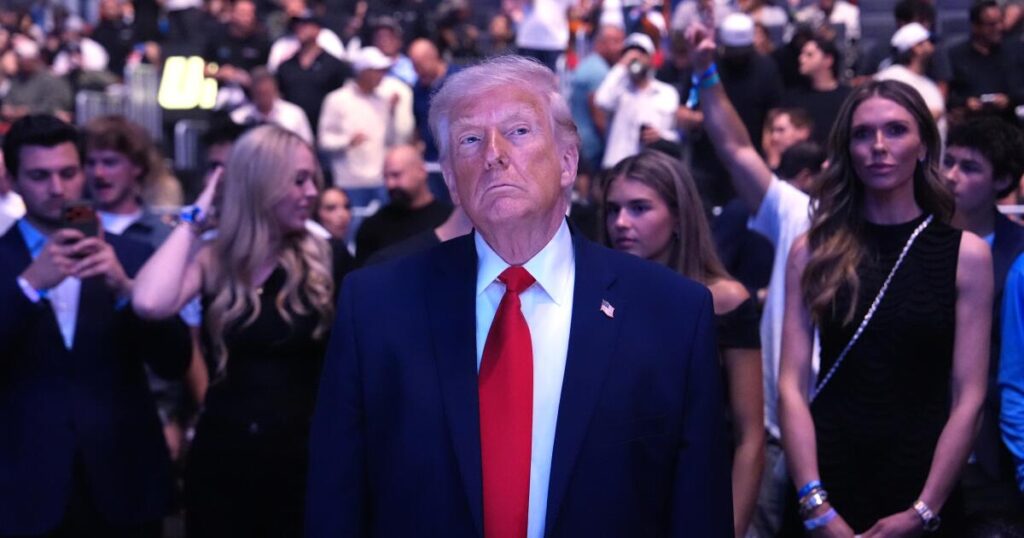
WASHINGTON — It was hard to miss President Trump’s very public spat with Pope Leo XIV this week.
The split was the first time in modern memory that an American president has so openly badmouthed a sitting pontiff, or, for that matter, distributed an image depicting himself as Jesus Christ. Critics cried “blasphemy!” even as supporters continued to stand behind the man whose presidency, some argue, was God sent.
Students of American history will recall an earlier incident that pitted papal and presidential authority against each other. The concern: that a president would align himself too closely to the church, or even take orders from the pope.
That anxiety seeped into the 1960 presidential campaign of John F. Kennedy, whose eventual victory would make him the first Catholic president.
Back then, Kennedy was constantly fending off accusations from Protestant ecclesiastic types who were wary that his nomination meant the pontiff, John XXIII, was already packing his bags for a move into the White House.
The issue was so pronounced that 150 clergymen and laypeople formed Citizens for Religious Freedom, which in a pamphlet warned, “It is inconceivable to us that a Roman Catholic President would not be under extreme pressure by the hierarchy of his church to accede to its policies and demands.”
One particularly loud voice among the ministers was the Rev. Norman Vincent Peale, a popular and influential pastor and author. Peale was especially disturbed by Kennedy’s prospects.
“Our American culture is at stake,” he said at a meeting of the ministers. “I don’t say it won’t survive, but it won’t be what it was.”
The group asked Kennedy to “drop by Houston” to make clear his views on faith and government. He agreed, making a televised speech at the Rice Hotel, where he famously spelled out his firm opinions on the separation of church and state.
“I am not the Catholic candidate for president,” Kennedy told the group. “I am the Democratic Party’s nominee for president who happens to be Catholic.”
Time magazine reflected on the address some years later, concluding that the speech had gone so well for Kennedy “that many felt the dramatic moment was an important part of his victory.”
Since then, modern presidents have occasionally found themselves at odds with the Vatican. Typically Republican presidents would hear from the pope about foreign wars, while Democratic presidents were derided over abortion policies.
But such disagreements tended to be handled with the decorous language of diplomacy.
Then came Trump, who is now being accused of openly mocking the Catholic faith and the 1st Amendment. He called Leo weak on crime and foreign policy, among other things. A self-described nondenominational Christian who says his favorite book is the Bible, Trump’s hasn’t shied from bashing the pontiff, nor has he hesitated to blur the line separating church and state.
Where Kennedy argued for an absolute separation, Trump has advanced a model of religious resurgence, promising “pews will be fuller, younger and more faithful than they have been in years.” Through initiatives including the “America Prays” program launched last year, the White House has sought to bring “bring back God” by inviting millions of Americans to prayer sessions. The webpage for the program focuses features only Christian Scripture.
“From the earliest days of the republic, faith in God has been the ultimate source of the nation’s strength,” Trump said at a National Prayer Breakfast in February.
In the United States, the Catholic Church historically has “loved the 1st Amendment” and its guarantee of religious liberty and, as a result, largely kept some distance from government, according to Tom Reese, a Jesuit priest and religious commentator. After its failures attempting to influence monarchs and politicians in Europe, the Catholic Church “didn’t want the government interfering with them and knew that it wasn’t their right to interfere with the government,” Reese said.
Kennedy loved the 1st Amendment too. He put it above his own religious beliefs, and said as much on his way to the White House.
“I would not look with favor upon a president working to subvert the 1st Amendment’s guarantees of religious liberty,” he said. “Nor would our system of checks and balances permit him to do so.”
The post In 1960, fears over papal influence. In 2026, a president attacks a pope appeared first on Los Angeles Times.