If you are anything like me, you have spent a lot of time over the past few weeks opening letters, finding receipts, requesting PDFs, scanning documents, and going through your credit-card statements line by line. It’s tax season. And in the United States, taxes are a DIY affair.
This is the case even though Washington could probably do your taxes for you. If you earn a salary or an hourly wage, the Internal Revenue Service already knows how much money you make. It likely knows how much you owe or how big your refund should be too. Nine in 10 households take the standard deduction, making their liability easy to glean from payroll and banking data.
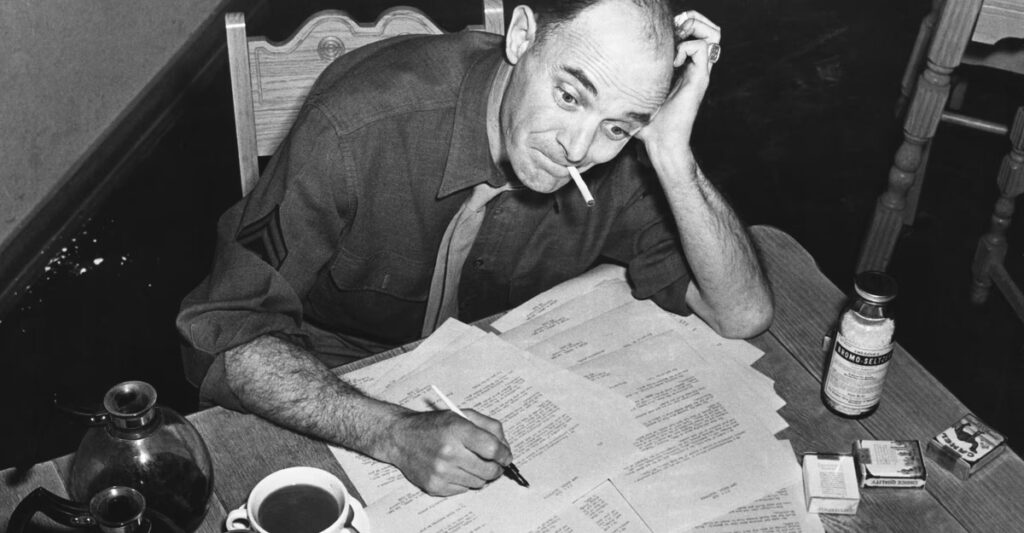
Yet Uncle Sam demands that Americans fire up TurboTax, head to a storefront preparer, hire an accountant, or sit down with a sharp pencil and a strong cup of coffee to get their taxes done each spring. The average filer spends 13 hours on their 1040—a time tax that many of our wealthy peer countries have reduced to a couple of minutes, if that. Prepopulated documents and return-free systems are common everywhere but here. Sweden lets residents file by text. Canada prefills paperwork. Japan sends households a document summarizing their tax contributions. If everything looks copacetic, many workers get to do a blissful nothing. Denmark, Estonia, Spain, and Norway have similarly simple processes.
The United States imposes a cost in cash, as well as in effort. A majority of Americans, whether wealthy or poor, pay for help with their return, spending an average of $290 annually. Add up the amount that people spend out of pocket, and you would have a sum 12 times larger than the IRS’s budget. The situation is needless, as well as annoying. It’s far past time for it to end.
To be fair to the IRS, the situation is not its fault. The country’s politicians have created a tax code with 10,000 sections and innumerable carve-outs. It includes deductions for medical expenses, tips, overtime earnings, prescription-drug costs, state income and sales taxes, mortgage interest, charitable giving, gambling losses, student-loan-interest payments, alimony payments, and retirement contributions, as well as write-offs for property destroyed by or stolen during a natural disaster. (A favorite Kafkaesque fillip of mine: The cost of tax preparation is often itself deductible.) The tax code offers credits to parents and low-income Americans, as well as to people paying for child care, job-training programs, and college. Families taking the standard deduction don’t have to substantiate the $500 that they tithed to their church or the “Don’t worry about it, sweetie” funds that they lost in Vegas. But they do need to demonstrate to the IRS that they had a kid or enrolled in a vocational-training program.
At the same time, politicians have woven safety-net initiatives into the tax code. The IRS has become a shadow social-insurance agency, requiring the painstaking vetting of family finances and the ginning up of all kinds of fussy contingencies and phase-ins. If the United States scrapped the child tax credit and opted for universal child care, tax season wouldn’t be so onerous. Tax filing would be simpler if Washington covered college tuition instead of subsidizing student loans. Things would be easier if the country had a single-payer health-insurance system instead of an employer-sponsored, tax-subsidized omnishambles.
But tax expenditures tend to fly through Congress, whereas social-spending bills tend to get stuck. Tax initiatives can be pinpoint-targeted to households with specific earnings and work situations, whereas universal programs are universal. And tax programs are cheaper for the government to administer than direct services are. As a result, Washington keeps layering complicated provisions into the code, and letting individual families do the work.
The IRS could take over, as tax experts have suggested for three decades. Complexity does not pose an insurmountable obstacle. A few years ago, the IRS built a TurboTax competitor—a free, public system that could help families fill in lines and check boxes on the 1040, and calculate their liability. Direct File aided half a million households with simple tax situations in 2024 and 2025. Most people got their taxes done in less than an hour. Americans loved it.
The tax-preparation industry did not, and neither did many Republicans. A group of attorneys general asserted that Direct File was an affront to the Americans who choose to hire “small businesses in our states to file their taxes at an affordable cost.” More than 30 members of Congress argued that the IRS was acting as “assessor, collector, preparer, and enforcer—all in one,” a “deeply concerning” situation and “a clear conflict of interest.” Although the IRS wanted to expand Direct File, Donald Trump killed it.
Direct File was neither deeply concerning nor a clear conflict of interest. The tax returns that it generated were more accurate than those created by other filing tools. Families were under no obligation to use it, either. They could hire a storefront preparer or do their taxes by hand if they wanted, and they could adjust the government’s tabulations.
As a general point, the IRS prepopulating returns would not create opportunities for graft or amp up the risk of error. The agency’s commissioner isn’t getting a bonus for denying a low-income mom a refund. And automatic filing would lower many households’ tax bill by ensuring that they get all of the subsidies and credits they qualify for. (Many families miss out because they do not file a return or do not fill out the paperwork correctly.)
Of late, Washington has taken a few steps toward efficiency: expanding the standard deduction, signing young men up automatically for the draft. Yet mostly, it has sprinted backwards: gutting the Consumer Financial Protection Bureau, adding work requirements to Medicaid and SNAP, axing Direct File. Many Republicans remain resolute in their opposition to actual administrative elegance. And Jackson Hewitt and the like retain their billion-dollar interest in ensuring that the IRS doesn’t become like Denmark’s Skattestyrelsen or Japan’s Kokuzei-chō. The company behind TurboTax has spent millions of dollars on a “sophisticated, sometimes covert war” to keep tax season excruciating, a ProPublica investigation found.
Washington has gotten used to providing substandard services, and Americans have gotten used to accepting them. This spring, the government is giving households 7 billion migraine-blinded hours’ worth of needless homework, and is forcing them to hand billions of dollars over to rent-seeking accountants as they hand over trillions of dollars to the IRS. If Denmark and Japan can make tax filing painless, so can we.
The post America’s Insane Tax-Filing Process appeared first on The Atlantic.